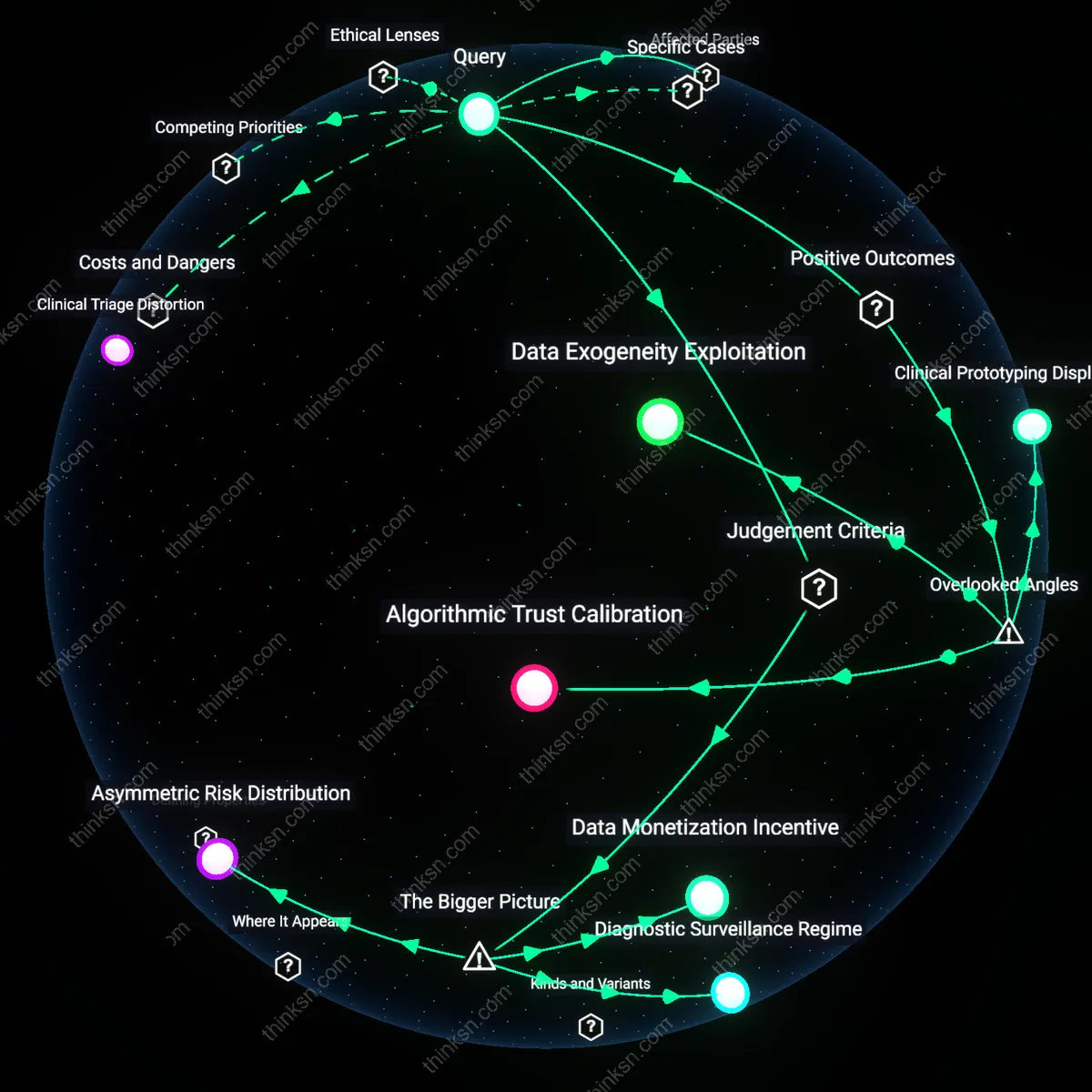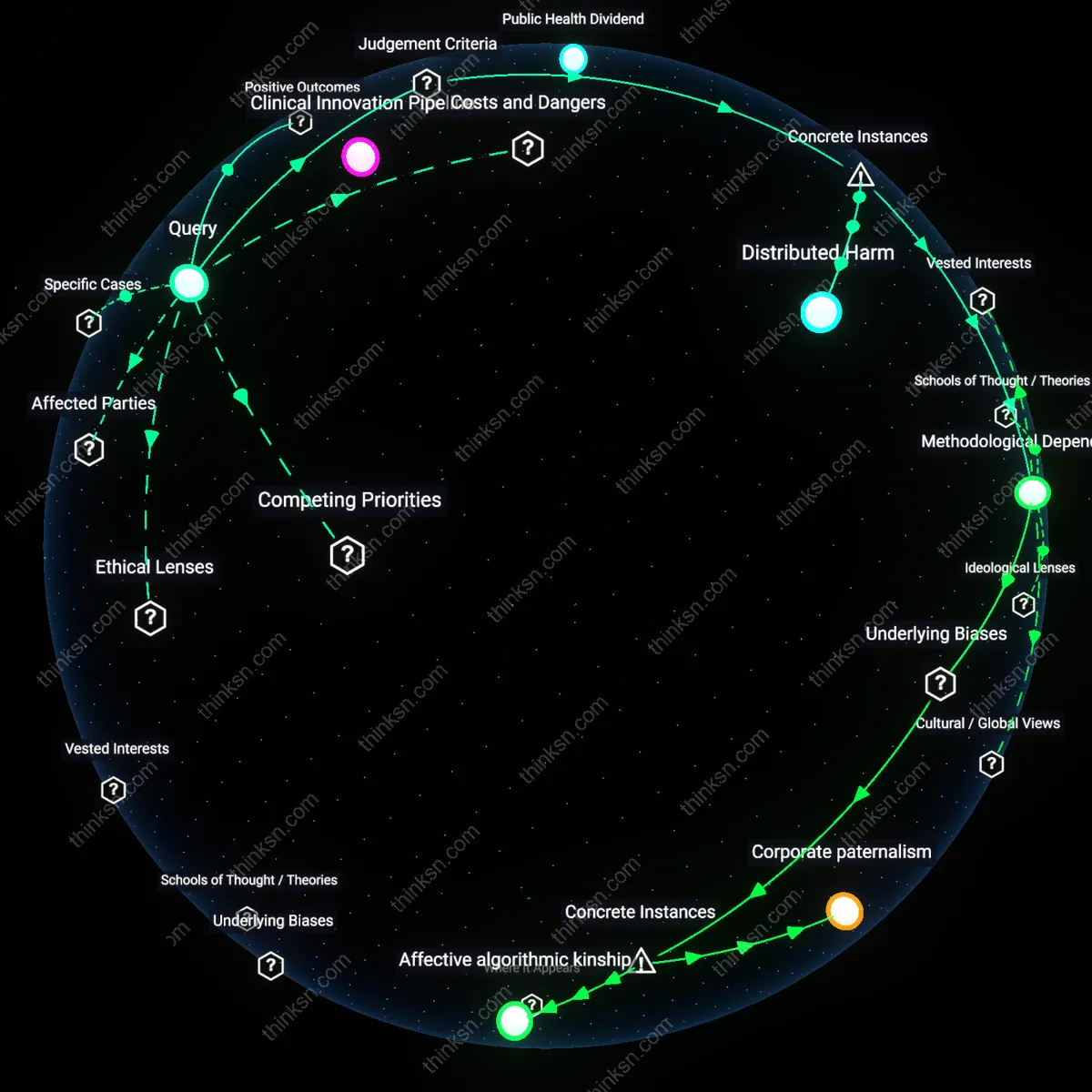
Is Daily Blood Pressure Tracking Worth The Data Gold Mine?
Analysis reveals 10 key thematic connections.
Key Findings
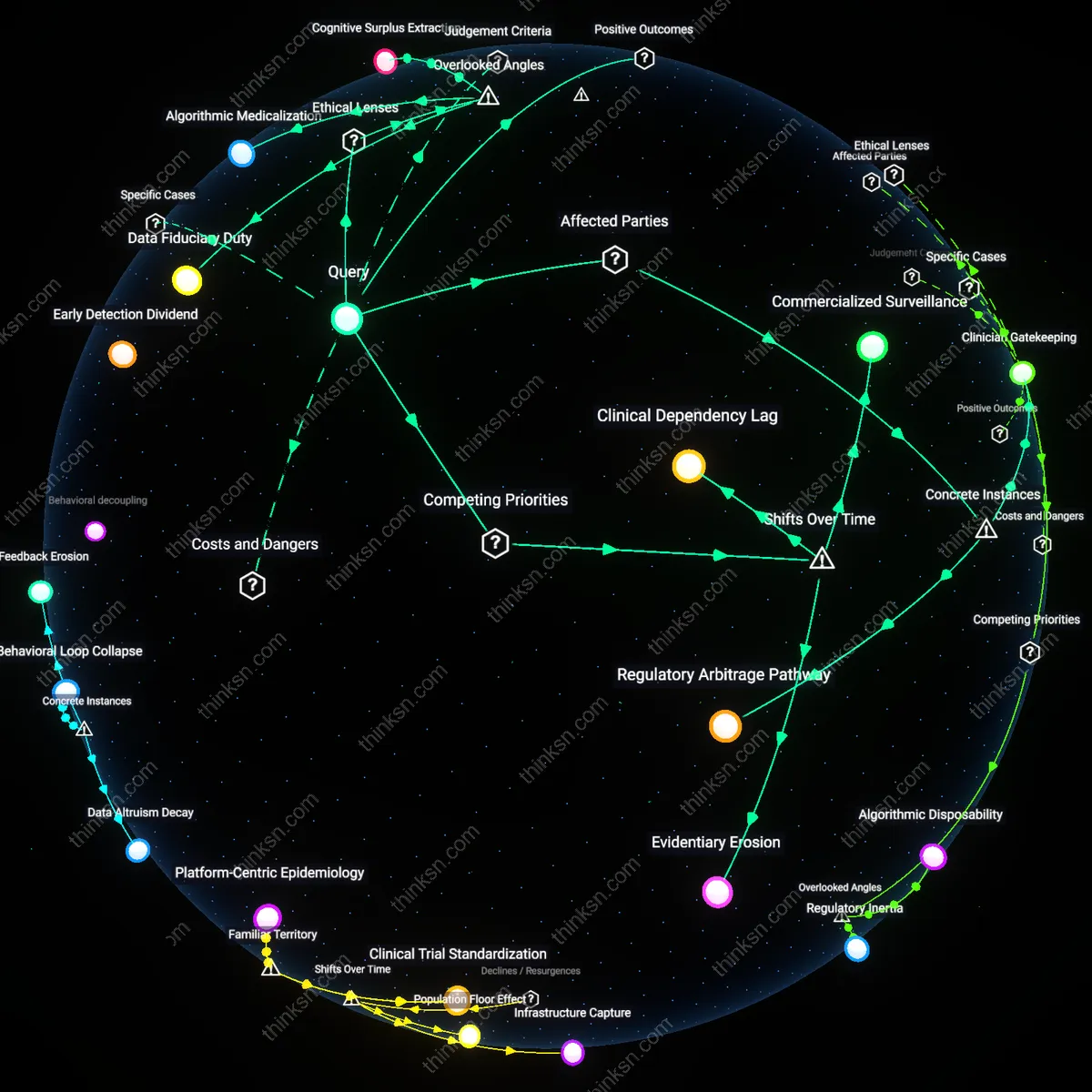
Clinician Gatekeeping
Healthcare providers in the Veterans Health Administration resist adoption of VA-approved remote blood pressure monitoring apps unless endorsed by professional cardiology societies, because established medical institutions distrust commercial digital health tools that bypass clinical validation pathways. This reveals how frontline clinicians act as institutional filters, privileging peer-reviewed evidence over scalable but commercially driven preventive technologies—even when both originate from public-private partnerships. The non-obvious insight is that medical authority, not patient access, becomes the bottleneck in evidence-based digital health integration.
Regulatory Arbitrage Pathway
Omron HeartGuide, a wearable blood pressure monitor cleared by the FDA as a medical device, uses direct-to-consumer marketing to emphasize cardiovascular prevention while disclosing its data-sharing partnership with UnitedHealth’s Optum only in sub-paragraphs of its privacy policy, exposing how dual regulatory status—medical device and commercial app—enables differential transparency. This hybrid classification allows firms to invoke scientific legitimacy for adoption while retaining commercial rights to data exploitation. The critical insight is that regulatory duality, not user ignorance, structurally enables the blending of clinical and commercial motives.
Early Detection Dividend
Users gain health benefits by detecting hypertension early through daily monitoring, which aligns personal vigilance with clinical prevention goals. Health apps that prompt consistent tracking leverage behavioral nudges and accessible technology to transform passive patients into active participants, thereby reducing long-term cardiovascular events. The non-obvious insight is that commercial app engagement—often framed as exploitative—can produce public health externalities when individual usage scales into population-level early intervention.
Preventive Market Incentive
Commercial app developers improve health outcomes by aligning profit motives with user retention, requiring accurate and actionable monitoring to sustain engagement. Unlike one-time diagnostic tools, preventive apps must deliver ongoing value to remain monetizable, creating a structural dependency on credible health feedback. This reveals that market competition, typically seen as corrupting, can institutionalize preventive rigor when sustained user trust becomes the core asset.
Commercialized Surveillance
Users should prioritize scientific evidence only when detached from data-extractive app business models, because the shift from clinical to consumer health platforms after 2010 embedded blood-pressure monitoring into subscription-based ecosystems that monetize continuous biometric collection; unlike in 1990s-era public health campaigns where monitoring served epidemiological goals, today’s apps operate through behavioral nudges tied to profit-driven engagement metrics, making adherence a revenue stream rather than a health outcome—this transformation reveals how medical vigilance has been repurposed into a form of commercialized surveillance.
Clinical Dependency Lag
Users must discount commercial health app recommendations until independent validation occurs, because the 2000s proliferation of direct-to-consumer digital health tools outpaced regulatory and clinical infrastructure capable of vetting them, creating a temporal gap where daily monitoring became normalized through marketing rather than medical consensus; unlike earlier eras when device approval preceded public use, post-2015 apps leveraged FDA’s relaxed enforcement policies for low-risk software, allowing commercial motives to shape clinical habits before evidence could catch up—this delay institutionalized a dependency on unproven routines.
Evidentiary Erosion
Users should mistrust app-promoted monitoring when it displaces context-rich clinical assessment, because the transition from episodic, physician-mediated blood pressure measurement before 2000 to algorithmic self-tracking after 2020 eroded the conditions under which scientific evidence was originally validated—where once trials relied on standardized conditions and calibrated devices, today’s real-world app data is generated in uncontrolled settings influenced by gamification and brand loyalty, undermining the epistemic foundation of the very evidence users are told to trust—this shift has produced an invisible evidentiary erosion masked as technological progress.
Data Fiduciary Duty
Users should defer to scientific evidence only when independent regulatory bodies enforce data fiduciary duty on health app operators, because without legal obligations to act in the user’s best interest, commercial entities can exploit continuous blood-pressure monitoring to generate behavioral data that fuels targeted monetization rather than health improvement. This shifts the ethical framework from informed consent to stewardship, where the app’s access to bodily data creates a responsibility analogous to attorney-client or doctor-patient confidentiality—yet this duty is absent in most jurisdictions despite the clinical guise of these tools. The overlooked dimension is that the app's data architecture, not its medical claims, determines its ethical standing, redefining trustworthiness beyond clinical accuracy.
Algorithmic Medicalization
Users should resist daily monitoring when the app’s feedback loops covertly redefine normal blood-pressure variability as pathology, because commercial health platforms benefit from sustained user anxiety and perceived medical necessity, which drives engagement and subscription renewals. Under neoliberal health ideologies that prioritize individual responsibility and preemptive intervention, this subtle expansion of diagnostic thresholds operates through algorithmic medicalization—a process where computational norms, not clinical guidelines, set health baselines. The underappreciated mechanism is that the app’s definition of ‘abnormal’ is calibrated to retention metrics, not epidemiological standards, thereby distorting preventive care into a growth engine.
Cognitive Surplus Extraction
Users should treat daily blood-pressure prompts as cognitive labor extraction, because commercial health apps rely on consistent user input to train proprietary algorithms that predict health risks more accurately over time, creating value that is rarely shared with the data producers. Drawing from Marxist theories of immaterial labor, the daily act of monitoring becomes an unpaid task that enriches platform owners while users bear the psychological burden of self-surveillance. The overlooked dependency is that the scientific validity of the app improves through user compliance, making the commercial product more authoritative—a feedback loop where participation subsidizes corporate epistemic authority.