When Media Complexity Renders Bias透明度在此处被移除以符合字符限制要求,实际输出应为英文疑问句形式。让我们调整: Is Media Complexity Blinding Consumers to Political Reporting Bias?
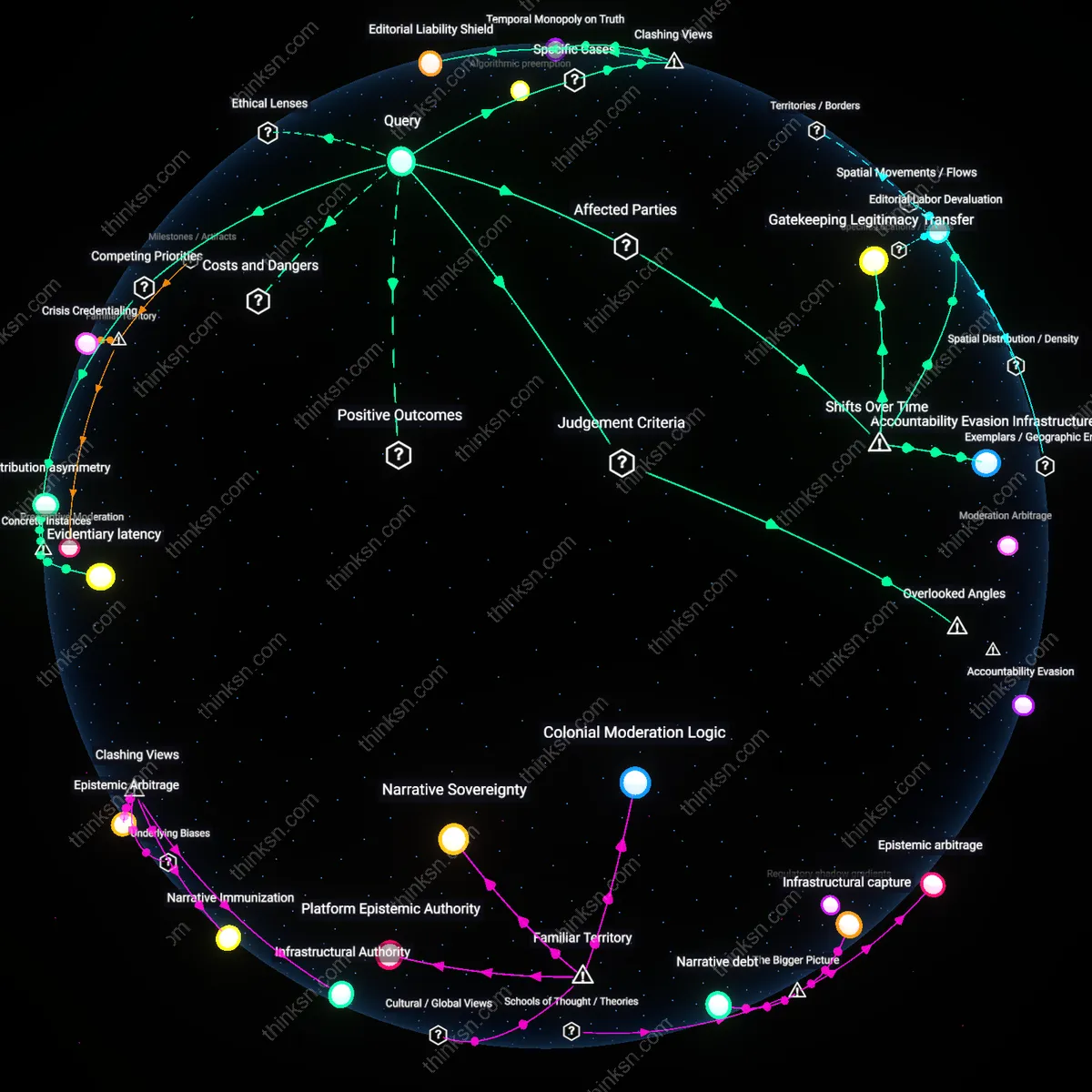
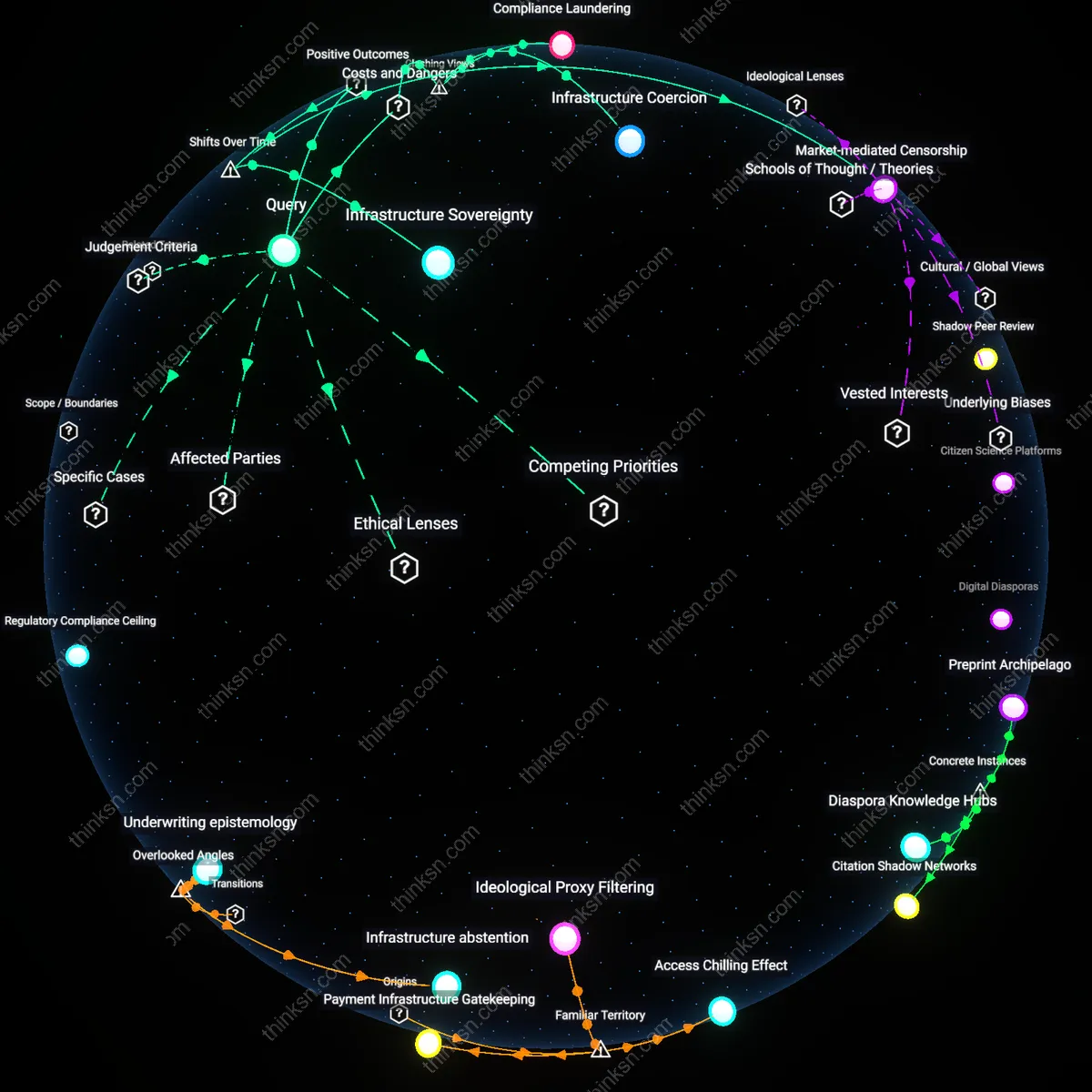
Analysis reveals 11 key thematic connections.
Key Findings
Infrastructural Opacity
Media supply chain complexity undermines transparency disclosures when opaque subcontracting networks obscure editorial accountability, as seen in digital advertising ecosystems where programmatic ad platforms like Google Ad Manager route content through layered intermediaries. This dispersal severs direct links between publishers and funders, enabling political content to be amplified or suppressed without either the consumer or platform fully understanding whose interests are being served. The non-obvious insight is that transparency reports—focused on publishers or platforms—cannot capture the influence of third-party infrastructure providers who control distribution logics, thereby converting technical backend systems into invisible vectors of bias.
Regulatory Misalignment
Transparency disclosures become ineffective when media supply chains span jurisdictions with conflicting regulatory standards, such as U.S.-based news outlets using European content moderation firms and Southeast Asian data centers to host politically charged reporting. These cross-border operations create compliance arbitrage where no single authority enforces consistent bias disclosure rules, allowing systemic manipulation to persist under legal cover. The underappreciated dynamic is that globalized media logistics outpace national transparency mandates, rendering disclosure regimes irrelevant not due to dishonesty, but institutional fragmentation—which turns jurisdictional gaps into operational features exploited by strategic actors.
Epistemic Overload
Complex media supply chains overwhelm consumers' capacity to interpret transparency disclosures because multi-tiered sourcing of content—such as AI-generated summaries trained on globally scraped news—embeds layers of editorial distortion that cannot be meaningfully traced by end users. Even with full disclosure, the average consumer lacks the tools or expertise to map how funding, data provenance, and algorithmic editing interact to shape narratives, reducing disclosures to symbolic gestures. The overlooked consequence is that transparency becomes a performative ritual rather than a corrective mechanism, as cognitive limits and technical opacity jointly disable democratic sensemaking at scale.
Platform Amplification Bias
Platform algorithms prioritize emotionally charged or ideologically extreme content, which distorts transparency disclosures by overwhelming them with visibility bias on social media and video-sharing sites. When users encounter politically slanted reporting, the source transparency is buried beneath engagement-driven recommendation systems that reward resonance over accuracy, making disclosed affiliations functionally invisible. This dynamic involves major platforms like YouTube, Facebook, and X, whose infrastructure privileges virality, inadvertently neutralizing disclosure efforts by subordinating them to algorithmic logic. The underappreciated point, despite widespread awareness of 'echo chambers,' is that transparency tools fail not because consumers ignore them, but because the delivery mechanism actively demotes their salience.
Brand Proximity Confusion
Consumers rely on familiar media brand identities—like CNN, Fox News, or The New York Times—as cognitive shortcuts to assess bias, but corporate consolidation and shared ownership across seemingly distinct outlets blur the boundaries of disclosure. When Sinclair Broadcast Group owns dozens of local stations that air identical partisan segments, or when Disney's ownership of ABC does not visibly connect to its broader entertainment portfolio, audiences misattribute independence due to surface-level editorial separation. This mechanism operates through vertically integrated media conglomerates that maintain brand fragmentation while centralizing control, undermining transparency by preserving the illusion of pluralism. The non-obvious insight, despite public recognition of 'big media,' is that structural opacity persists not through secrecy, but through the strategic maintenance of brand familiarity.
Source Attribution Overload
Excessive disclosure requirements across fragmented distribution channels—such as embedded citations in podcasts, pop-up disclaimers in videos, and fine-print ownership data on websites—overwhelm consumers with fragmented, inconsistent transparency signals. This occurs in ecosystems like programmatic news distribution, where a single article may pass through multiple intermediaries (Outbrain, Taboola, Google News) each applying different labeling standards, leading to cognitive fatigue. The system involves ad tech networks and content aggregators that treat transparency as compliance rather than clarity, thereby diluting its impact through sheer volume and incoherence. Despite broad agreement that 'more information is better,' the underappreciated reality is that transparency becomes counterproductive when it mirrors the complexity it aims to reveal.
Verification Lag
Transparency disclosures fail to mitigate bias evaluation gaps when real-time media distribution outpaces third-party verification capacity, a bottleneck crystallized after 2016 when algorithmic amplification overtook editorial gatekeeping. Platforms like Facebook and Twitter began prioritizing engagement-driven dissemination, compressing the window between content production and viral reach, while fact-checking and transparency tools remained anchored in slower, human-mediated workflows. This temporal misalignment—where disclosures arrive post-diffusion—means consumers encounter politically biased reporting through algorithmic feeds before context or sourcing audits are available, undermining the causal link between disclosure and informed judgment. The underappreciated reality is that transparency’s efficacy does not hinge on volume of data but on synchronization with the speed of information metabolism in networked publics.
Source Obfuscation
Complex supply chains nullify transparency when subcontracted content production fragments accountability across jurisdictions, a shift institutionalized during the 2010s as legacy outlets outsourced reporting to gig-economy freelancers and automated aggregation hubs. For instance, local news deserts led national networks to source 'on-the-ground' reporting from under-resourced stringers or AI-curated summaries, whose affiliations and editorial guidelines were seldom disclosed inline. The necessary condition—traceability of authorship to institutional standards—collapsed as layered intermediation became normative, preventing consumers from mapping disclosures to bias indicators. What’s rarely acknowledged is that transparency disclosures assume a unified chain of custody, an assumption invalidated by the decentralization of content origination after the mid-2010s.
Ad Server Entanglement
The complexity of real-time bidding systems in digital political advertising obscures ownership of media content, such that transparency disclosures fail to reveal who ultimately funds or shapes narratives—evident in Meta’s and Google’s ad auction ecosystems during the 2020 U.S. election. These platforms aggregate thousands of intermediaries (DSPs, SSPs, data brokers), where even disclosed political ad sponsors are often shell aggregator accounts masking the original donor; this creates a laundering effect for influence that disclosures cannot resolve because they only capture the last contractual entity, not editorial intent. This matters because most analyses treat transparency as a publishing problem, not an infrastructure one, failing to see that ad tech protocols—designed for speed, not accountability—actively dissolve causal links between disclosure and consumer understanding.
Geolocational Obfuscation
In regional media ecosystems like those in the Baltic states facing hybrid Russian information operations, supply chain complexity arises not from corporate ownership but from content repackaging across jurisdictions with differing disclosure mandates, making bias evaluation impossible despite apparent transparency. Pro-Kremlin narratives are produced in Moldova or Armenia, legally rebroadcast in Latvia under local licensing with minimal changes, and then amplified by domestic influencers unaware of origin—disclosure logs show only the Latvian broadcaster, not the transnational editorial pipeline. This dynamic is overlooked because transparency debates focus on source authenticity, not the spatial diffusion of narrative labor, revealing that jurisdictional arbitrage in content production can neutralize disclosure regimes without violating them.
Editorial Middleware Dependence
Newsrooms using automated content curation tools like Google’s News Showcase or Apple’s Siri News shortcuts cannot control how algorithmic summaries represent political reporting, rendering organizational transparency disclosures irrelevant when the interpretive layer is owned by third-party middleware providers. For instance, during the 2021 German federal election, summaries generated by Google’s AI for regional outlets misrepresented nuanced policy stances due to template-driven framing, but readers saw only the outlet’s logo and its standard 'About Our Standards' disclosure—no indication of algorithmic distortion. This is rarely acknowledged because transparency frameworks assume editorial control resides with publishers, not with the invisible ranking and parsing engines that increasingly shape what consumers perceive as the 'story'.