Can the EU’s Digital Services Act Tame Global Cloud Giants?
Analysis reveals 4 key thematic connections.
Key Findings
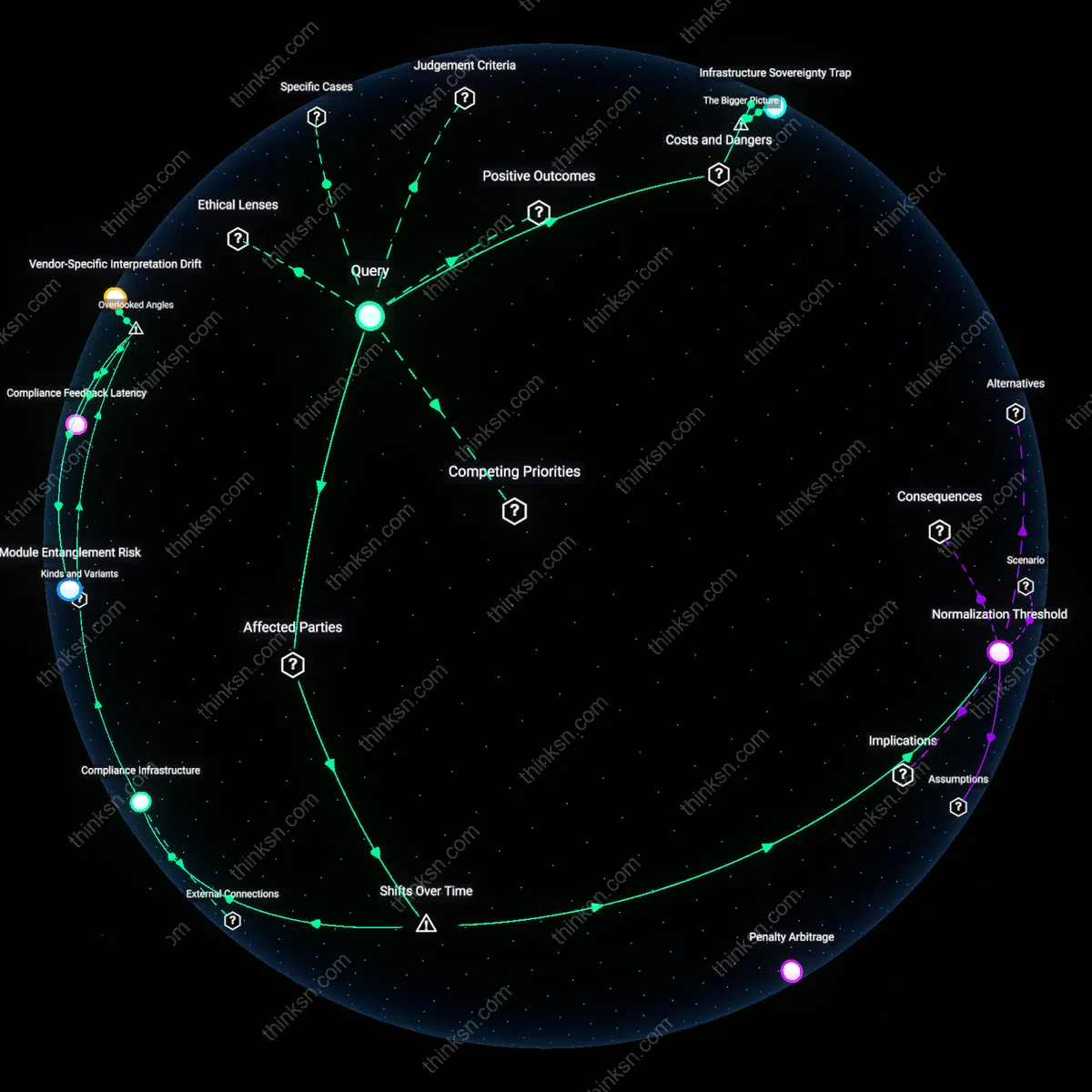
Normalization Threshold
The DSA signals that global cloud providers have crossed a threshold where their operational indispensability—evident in the dependence of public services, SMEs, and critical infrastructure on AWS, Google Cloud, and Azure—has made selective utility-like regulation politically viable, even without formal reclassification. Prior to the 2020–2022 pandemic and semiconductor shortages, cloud outages were seen as technical risks; now, they are treated as systemic threats, with the DSA’s risk-management mandates reflecting a post-2022 consensus that continuity of digital infrastructure warrants intervention akin to utility oversight. The underappreciated shift is not in ownership or pricing regulation, but in the EU’s tacit acknowledgment that reliability, not competition, has become the primary public interest—marking the normalization of cloud as essential, even if legally unmoored from utility frameworks.
Compliance Infrastructure
Treating cloud providers as de facto utilities under the DSA has catalyzed the formation of internal compliance bureaucracies within firms like Oracle and SAP, where dedicated legal-technical teams now map data flows and audit APIs to meet EU transparency and interoperability mandates—a change solidified after 2023 enforcement deadlines. This institutional shift reflects a move from ad hoc legal adaptation to permanent regulatory integration, where cloud firms replicate features of utility compliance systems (e.g., tariff filings, service logs) without adopting utility ownership models. The overlooked development is that the DSA has not reshaped market structure but has instead embedded regulatory surveillance within corporate operations, generating a new layer of governance that functions like a public utility administration despite private control.
Infrastructure Sovereignty Trap
The Digital Services Act indirectly exposes the infrastructure sovereignty trap that emerges when states attempt to apply public utility logic to globally distributed cloud systems. By classifying certain digital services as systemically important and imposing localized accountability, the EU inadvertently pressures member states to mandate data localization, redundant architectures, or national gatekeepers—measures that increase systemic fragility and operational costs. This occurs because cloud providers, responding to DSA compliance demands, must reconfigure technically integrated networks into legally fragmented zones, introducing latency, single points of failure, and higher barriers to cross-border service continuity. The underappreciated effect is that sovereign attempts to assert control through utility-like regulation generate cascading technical and economic penalties that degrade the very resilience and accessibility such regulation intends to ensure.
Legitimacy-to-Control Feedback Loop
The DSA reveals a legitimacy-to-control feedback loop in which the EU’s effort to legitimize oversight of cloud platforms as public utilities actually accelerates corporate consolidation and de facto privatization of governance. By designating gatekeeper roles and embedding audit requirements, the Act accords dominant providers formal recognition as indispensable infrastructure, thereby increasing their bargaining power with governments and partners while raising entry barriers for competitors. This mechanism functions through the alignment of regulatory compliance costs—such as algorithmic transparency or data sharing—with the financial and technical capacity only the largest firms possess, reinforcing their entrenched position under the guise of public accountability. The systemic irony is that treating cloud providers as utilities does not democratize control but institutionalizes dependency on private actors who now operate with state-sanctioned authority over digital public space.