Does Founding Stall Skills in Fast-Evolving Industries?
Analysis reveals 8 key thematic connections.
Key Findings
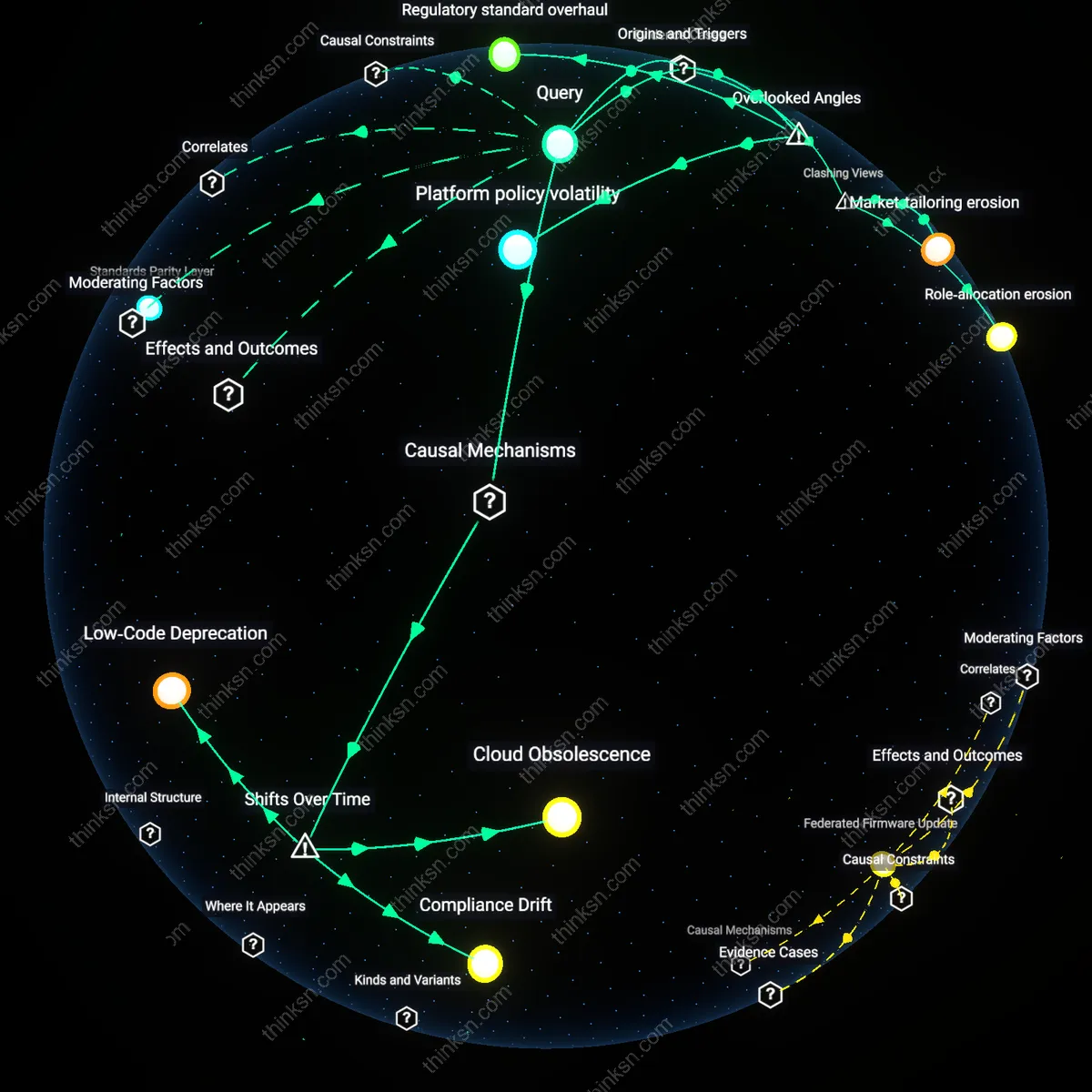
Market‑tailoring erosion
The hidden skill depreciation that persuades founders to leave employment stems first from the need to constantly remodel their service playbook to accommodate the ever‑shifting preferences of disparate clients. In practice, founders are compelled to trim or eliminate deep, niche techniques—eschewing intricate, high‑value methods because clients only pay for incremental, risk‑free improvements that fit their existing workflows. This occurs anywhere a professional‑services provider faces a spectrum of clients—say, a boutique brand‑strategy consultancy in London grappling with fintech versus luxury‑goods firms. The result is a leakage of specialized know‑how even as the business expands, contradicting the assumption that a broader client focus preserves skill depth.
Role‑allocation erosion
The primary hidden‑skill depreciation driver for founders is the inevitable dilution of skill‑cultivation time that arises from juggling every operational role in their own firm. Founders rapidly trade off finance, client acquisition, compliance, and daily operations for hands‑on practice, leaving little bandwidth to sustain expertise. In contrast, employees in large corporations benefit from dedicated training budgets, structured knowledge‑management protocols, and mentors to navigate shifting standards. This immediate spiral of resource allocation, rooted in the systemic need for cash‑flow stability in nascent firms, erodes core competencies the fastest, challenging the belief that entrepreneurship itself guarantees skill preservation.
Methodology misalignment
Hidden skill depreciation in founder‑run services is triggered by the misalignment between entrenched, bespoke methodology stacks and the swift codification of new industry standards imposed by client governance frameworks. Founders invest heavily in custom frameworks that become siloed knowledge; when a regulatory shift or new technical stack arrives, clients demand adherence to compact, standard‑de‑facto blueprints, pressuring founders to discard or over‑haul their proprietary systems. The immediate spark is the regulatory requirement letter, while the deeper systemic cause is the homogenisation of professional deliverables through the platformisation of industry knowledge. This rewiring of skill focus is frequently underestimated because founders view custom methodology as a moat, not a vulnerability.
Cloud Obsolescence
The rapid transition from on‑premise server architecture to cloud‑native services during the 2015‑2018 technology boom caused consulting founders who specialized in physical infrastructure to abandon the manual troubleshooting routines that constituted their core competency, thereby risking hidden skill depreciation. In this period, vendors such as Amazon Web Services and Microsoft Azure introduced pay‑as‑you‑go models that shifted client expectations toward continuous deployment and automated monitoring, making deep knowledge of rack‑mount hardware less relevant. Founders, motivated by the higher profit margins of managed cloud services, pivoted their operations toward migration consulting, leaving behind the very hands‑on diagnostic skills that had previously differentiated their firms. This displacement is analytically significant because it reveals how market‑driven technology standardization can covertly erode niche expertise, a process that has often been overlooked in discussions of cloud adoption.
Compliance Drift
The enforcement of the EU General Data Protection Regulation in 2018 reoriented consulting founders from tech‑centric innovation toward stringent compliance audit services, which led them to increasingly rely on standardized compliance procedures and consequently neglect their prior custom development skills, risking hidden skill depreciation. Post‑GDPR, firms demanded certifications such as ISO/IEC 27001 and contractual data‑handling standards, creating a supply chain of compliance specialists that valued audit frameworks over bespoke technical solutions. As founders focused on surveying data flows and building compliance roadmaps, the daily application of their software‑engineering creativity diminished, causing those specialized abilities to creep into obsolescence. The significance lies in the fact that regulatory frameworks can act as a selective filter, preserving certain standard practices while unintentionally degrading highly contextual, albeit hidden, expertise.
Low‑Code Deprecation
The 2020s surge of low‑code/no‑code platforms condensed application development into drag‑and‑drop interfaces, compelling consulting founders who had honed low‑level programming abilities to shift focus to platform administration; this transition exposed a hidden skill depreciation risk for their deep coding fluency. Companies such as Salesforce, Microsoft Power Apps, and OutSystems now offer rapid development cycles that favor visual constructors, and clients began to demand faster time‑to‑market without the need for traditional code. Consulting founders, seeking to capture new revenue streams, specialized in setting up these visual pipelines and performing governance checks, leaving their hands‑on coding routines underused. This dynamic illustrates how technology consolidation into user‑friendly tools can stealthily dilute the experimental, low‑level expertise that had originally defined a founder's value proposition.
Platform policy volatility
Founders who rely on long‑standing platform‑based client acquisition (e.g., Google AdWords partners) experience hidden skill depreciation because policy changes force them to abandon manual techniques they mastered while employed. When Google began throttling API requests and introducing automated bidding in 2017, many independent digital‑advertising agencies had to replace in‑depth keyword‑optimization knowledge with new automation scripting, eroding the very manual expertise that secured their initial client pipeline. This dynamic, rarely highlighted, shows that rapid shifts in platform governance—rather than the usual technology evolution—drive skill depreciation for founders.
Regulatory standard overhaul
Certified public accountants who launch independent audit and advisory firms face hidden skill depreciation as evolving financial reporting standards (e.g., transition from ASC 842 to IFRS 16) render their legacy GAAP‑centric models obsolete. The 2019 adoption of IFRS 16 required a comprehensive restructuring of lease accounting; CPAs who left banks in 2018 to start their own practices relied on proprietary lease‑analysis scripts built for ASC 842, which became quickly outdated, causing a loss of competitive differentiation. This under‑appreciated dependency on shifting regulatory frameworks explains why founders risk skill depreciation when industry standards evolve.