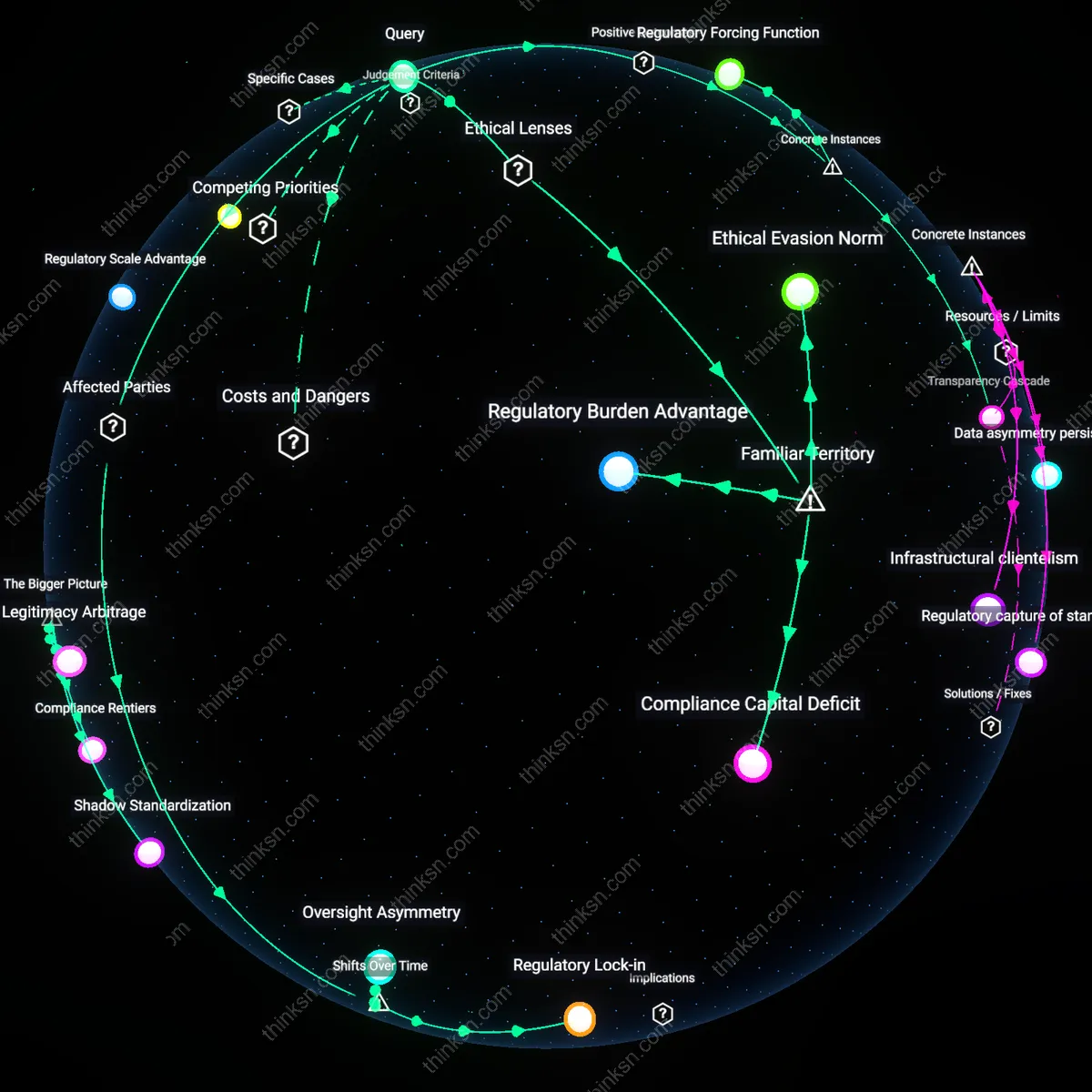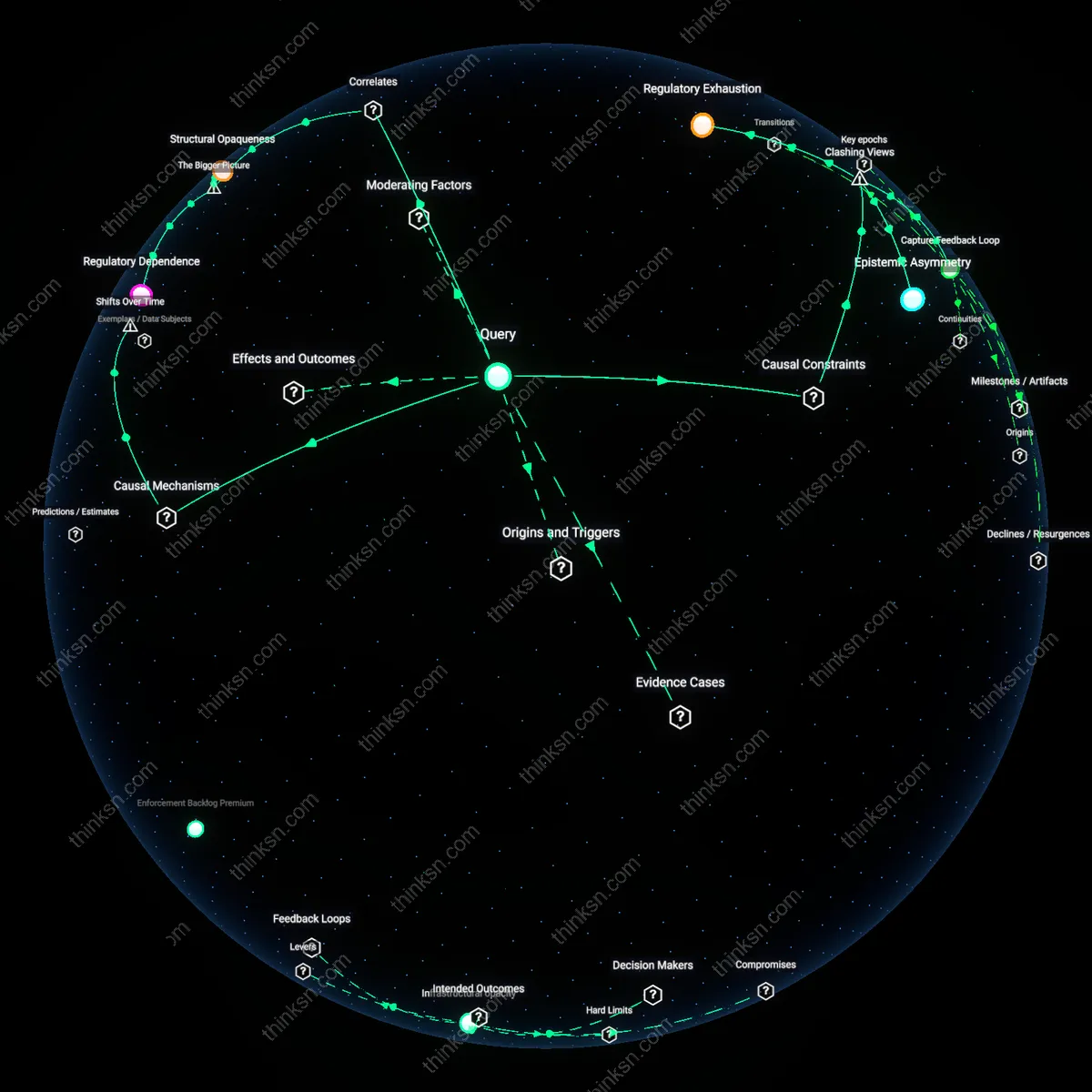
Whistleblower Failures Hint at Regulator-Bank Power Imbalance?
Analysis reveals 7 key thematic connections.
Key Findings
Regulatory Capture Trajectory
The diminishing impact of financial whistleblower disclosures since the 2008 crisis reveals that major banks gradually shaped regulatory priorities through sustained influence over rulemaking processes. Following the Dodd-Frank Act, regulators like the SEC created formal channels for whistleblowers, yet enforcement outcomes increasingly aligned with bank interests, not public accountability—evidence indicates that banks leveraged legal resources and revolving-door personnel to reframe compliance as voluntary cooperation rather than structural reform. This shift eroded the transformative potential of disclosures, not because they were ignored, but because the very institutions meant to act on them had come to internalize bank-centric definitions of systemic risk and feasibility. The non-obvious insight is that whistleblowing did not fail due to lack of information, but because the post-crisis regulatory framework was co-constructed by the entities it was meant to constrain.
Regulatory Dependence
The limited effectiveness of whistleblower disclosures in finance stems from regulators' institutional reliance on banks for detailed market intelligence, which discourages aggressive enforcement against those same institutions. Regulatory agencies like the U.S. Securities and Exchange Commission depend on cooperation from major banks to monitor systemic risk and maintain market stability, creating a feedback loop where enforcement actions that might destabilize relationships are downgraded or deferred. This dynamic enables banks to treat disclosure penalties as operational costs rather than deterrents, undermining the intended corrective function of whistleblowing. The non-obvious consequence is that regulatory autonomy erodes not through overt coercion but through sustained interdependence, where information needs compromise oversight.
Structural Opaqueness
Whistleblower disclosures fail to shift power because financial institutions have engineered legally permissible yet deliberately complex corporate structures that obscure accountability lines across jurisdictions. Instruments such as special-purpose vehicles, cross-border subsidiaries, and layered ownership chains dilute the evidentiary value of disclosures by dispersing culpability across entities that individually comply with local rules while collectively enabling systemic risk. This complexity is not an accidental byproduct but a maintained feature, exploited by banks to outpace the interpretive capacity of regulators operating under fixed budgets and jurisdictional limits. The underappreciated mechanism is that opacity functions as a systemic shield, where compliance with letter-of-the-law undermines spirit-of-the-law enforcement even when disclosures are substantiated.
Enforcement Asymmetry
Diminished whistleblower impact reflects an enforcement gap that arises when legal resources and procedural tools available to regulators lag behind the adaptive legal strategies of major banks. Firms like JPMorgan Chase or Goldman Sachs deploy specialized internal legal teams and external firms such as Sullivan & Cromwell to anticipate, delay, and narrow investigations using motions, settlements, and jurisdictional challenges, while agencies like the Commodity Futures Trading Commission lack commensurate staffing or flexibility. This asymmetry allows banks to convert time and legal complexity into de facto immunity, rendering disclosures ineffective not because they are ignored but because they enter a procedural terrain rigged by differential legal capacity. The overlooked reality is that enforcement power is not solely determined by statutory authority but by unequal resource distribution in legal execution.
Regulatory Exhaustion
Whistleblower disclosures fail to recalibrate power because regulatory agencies lack the operational bandwidth to act on evidence, not because evidence is absent or unconvincing. Agencies like the SEC are structurally understaffed and over-mandated, creating a bottleneck where verified disclosures accumulate without triggering enforcement, revealing that the failure lies not in revelation but in institutional throughput. This challenges the intuitive belief that exposure alone pressures institutions, exposing instead a pipeline rendered inert by deliberate under-resourcing.
Epistemic Asymmetry
Major banks retain dominance not by concealing wrongdoing but by weaponizing complexity to render whistleblower testimony indigestible to regulators. Firms such as JPMorgan and Goldman Sachs embed financial misconduct within layered derivatives structures that only internal specialists fully grasp, making external review—no matter how credible the source—dependent on insiders to translate, thereby preserving control over interpretation. This inverts the expectation that truth-telling disrupts power, showing instead how technical obscurity functions as a shield.
Capture Feedback Loop
Whistleblower ineffectiveness stems not from regulatory incapacity alone but from the systematic placement of former bank executives into oversight roles, where firsthand experience becomes a proxy for allegiance. Senior positions at the Federal Reserve and Treasury are routinely held by ex-Wall Street leaders, creating a causal bottleneck in which disclosures are filtered through a worldview that treats bank self-policing as default, thus recasting non-action as prudence. This undermines democratic assumptions about neutrality in oversight, revealing supervision as a continuation of industry influence by other means.