Are Private Platforms True Public Squares for Free Speech?
Analysis reveals 9 key thematic connections.
Key Findings
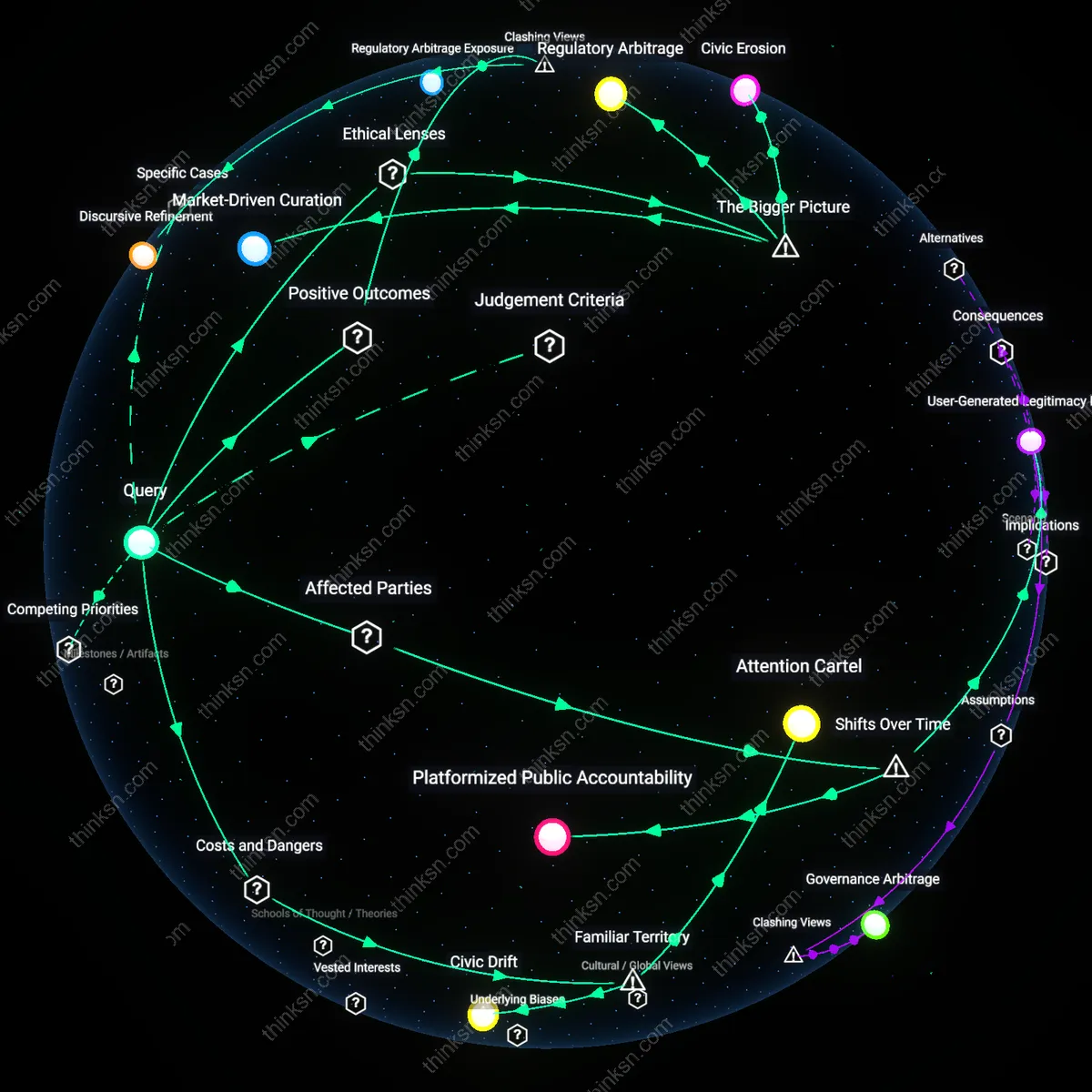
Platformized Public Accountability
Regulatory inaction since the late 1990s—especially Section 230's liability shield—enabled private platforms to assume public functions without commensurate public oversight, shifting the balance of speech governance from state duty to corporate discretion. As governments outsourced content moderation challenges to platforms post-2010, these firms became de facto arbiters of acceptable discourse, yet remained accountable only to shareholders and reputational risk, not citizens. This trajectory from hands-off internet policy (1996–2016) to reactive platform governance (post-2016 disinformation crises) exposes how the withdrawal of state capacity created a power vacuum filled by for-profit entities. The underappreciated shift is that the erosion of public square ideals stems less from corporate intent than from the long retreat of institutional sovereignty in digital space.
User-Generated Legitimacy Deficit
Since the mid-2010s, user dependence on centralized platforms for social, political, and economic participation has created a legitimacy crisis in speech governance, where rules are enforced without consent or transparency. Unlike historical public squares—regulated by visible, contestable legal norms—platforms derive operational authority from Terms of Service shaped by venture capital pressures and global scalability demands, not civic inclusion. The pivot from decentralized internet cultures (e.g., early web forums, 1990s–2000s) to mass-platform reliance (e.g., Facebook, X, TikTok) means users now inhabit spaces where due process is algorithmic and appeals are outsourced to under-resourced moderation teams. The non-obvious outcome is that the profit motive undermines the public square analogy not by distorting speech, but by eroding the very conditions for legitimate rule-making in shared communicative spaces.
Discursive Refinement
The profit motive of private platforms enhances the quality of public discourse by incentivizing engagement with diverse, moderated viewpoints, thereby improving societal dialogue. Platform algorithms prioritize content that sustains user attention, which rewards nuance and reliability over time, especially as outrage fatigue erodes ad revenue. This mechanism, driven by advertisers and user retention metrics on platforms like YouTube and Instagram, creates a feedback loop where constructive content outperforms incendiary material, contradicting the assumption that profit demands polarization. The non-obvious insight is that commercial accountability can function as a disciplining force on misinformation, more effectively than state-imposed speech rules.
Jurisdictional Arbitrage
Private platforms exploit their profit-driven structure to host speech that democratic states would restrict, creating a de facto expansion of expressive freedom in authoritarian-adjacent environments. By operating under U.S. legal frameworks while serving global audiences, companies like Meta permit dissident communication in countries with repressive speech laws, where even fragile access to open dialogue is better than state-controlled media. This dynamic turns shareholder value into an unintentional vector for transnational free expression, exposing the paradox that corporate self-interest can circumvent geopolitical censorship more reliably than public institutions. The challenge is that the First Amendment, bound by national jurisdiction, cannot achieve what profit-motivated scalability enables.
Attention Cartel
Private platforms operate as an Attention Cartel that monopolizes public discussion spaces while evading civic accountability, because their market dominance allows them to set de facto speech norms without democratic input. This system leverages network effects and data control to lock users into proprietary architectures where profit logic overrides pluralistic access, distorting who gets heard and under what conditions. Despite public associations with 'open internet' ideals, the underappreciated reality is that these platforms replicate enclosure movements—privatizing commons not for stewardship but for scalable extraction, making First Amendment analogies functionally hollow.
Civic Drift
The profit-driven design of platforms induces Civic Drift by systematically deprioritizing truth, accountability, and inclusion in favor of retention metrics, because sustainable public discourse does not generate outsized returns compared to viral content. This slow misalignment operates through A/B testing, recommendation loops, and moderation outsourcing, eroding the conditions necessary for democratic legitimacy over time. While people readily link platforms to free expression, the unnoticed cost is the gradual disconnection between public conversation and civic function—a drift so incremental it masks the collapse of common ground.
Market-Driven Curation
Private platforms’ profit-driven algorithms prioritize engagement over civic discourse, thereby disqualifying them from being analogized to public squares under First Amendment principles. Commercial actors like Meta and YouTube deploy attention-maximizing recommendation systems that amplify outrage and misinformation because virality increases ad revenue; this operational logic fundamentally conflicts with the normative ideal of a public square as a space for rational deliberation. The non-obvious consequence is that the business model itself constitutes a form of editorial control that undermines claims to functional equivalence with traditional public forums.
Regulatory Arbitrage
The classification of platforms as private enterprises enables deliberate avoidance of public obligations, making the profit motive a structural enabler of free speech deregulation. By positioning themselves as neutral intermediaries rather than publishers, tech firms exploit legal ambiguities in doctrines like Section 230 to resist content moderation mandates while still exercising selective enforcement that serves brand safety and investor interests. The underappreciated dynamic is that this dual posture—private ownership shielding public impact—creates a governance vacuum where corporate risk management replaces democratic accountability.
Civic Erosion
When profit-oriented platforms become dominant venues for political speech, the commodification of user attention systematically distorts democratic discourse, weakening the epistemic foundations necessary for self-governance. Ad-based revenue models reward platforms for fragmenting audiences into polarized segments, as ideological extremity drives higher engagement metrics; this reshapes public discourse not through overt censorship but through invisible behavioral incentives embedded in algorithmic design. The critical insight is that economic incentives, not just editorial policies, are now primary determinants of who gets heard in the national conversation.