Is Regulatory Capture Too Simple? Exploring Power Dynamics Between Corporations and Agencies?
Analysis reveals 7 key thematic connections.
Key Findings
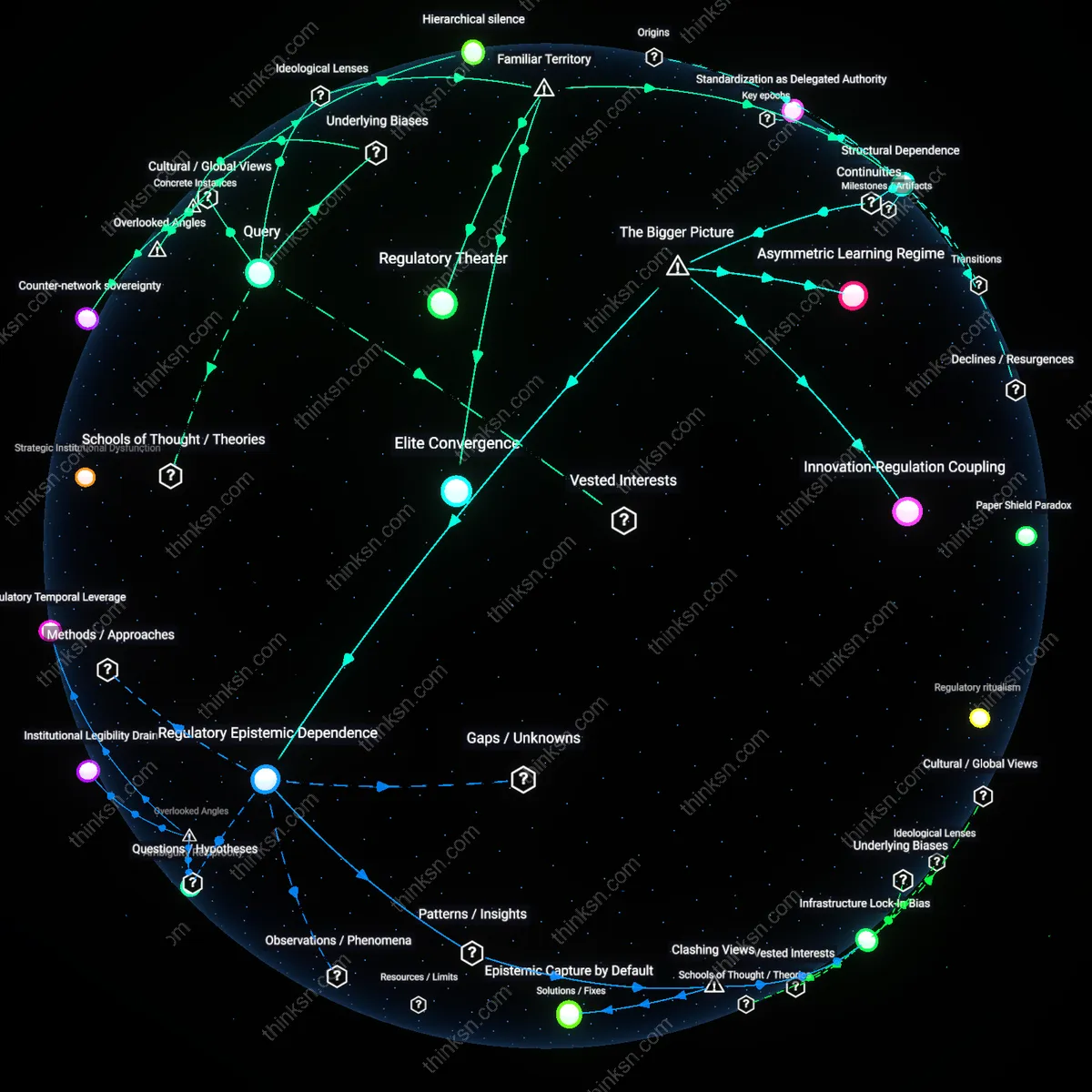
Regulatory Theater
Regulatory capture frameworks fail because corporate influence often operates not through secret collusion but through visible, ritualized compliance that legitimizes agency ineffectiveness. Industries like fossil fuels or pharmaceuticals routinely engage in public comment processes, safety disclosures, and advisory committees—forms of participation that appear transparent and democratic but systematically defer to industry expertise, timelines, and risk assessments. This dynamic is underappreciated because the public equates procedural legitimacy with accountability, when in fact these rituals can neutralize regulatory ambition without overt corruption. The result is a performance of oversight that maintains public trust while preserving corporate autonomy.
Elite Convergence
Power in corporate-agency relationships stems less from coercive capture than from shared ideological assumptions among technocrats, corporate executives, and policymakers trained in similar elite institutions. In sectors like finance or telecommunications, regulators and regulated often move through the same professional networks, attend the same conferences, and cite identical risk models, producing policy outcomes that reflect group consensus rather than bribery or lobbying. This is rarely seen as corruption because it aligns with liberal norms of expertise and depoliticized governance, yet it systematically excludes alternative perspectives on public interest, especially those rooted in labor or environmental justice.
Structural Dependence
Agencies depend on industries for technical data, implementation capacity, and even workforce pipelines, creating a structural asymmetry that precedes and enables any act of capture. For instance, the FDA relies on pharmaceutical firms for clinical trial data, and the FAA depends on Boeing and Airbus for aircraft safety specifications, embedding corporate interests in the epistemic foundations of regulation. This dependence is invisible in capture models that focus on political bribes or lobbying, but it shapes regulatory possibility at a deeper, operational level—making resistance not just risky but technically infeasible.
Ritual compliance
In Japan, compliance with financial regulators often operates through ritualized corporate reporting that prioritizes symbolic alignment over substantive transparency, thereby neutralizing the threat of regulatory scrutiny without institutional capture. This dynamic depends not on bribes or lobbying, but on culturally embedded bureaucratic performances—annual audits tuned to aesthetic harmony, or submission of reports in prescribed calligraphic formats—whose adherence signals loyalty to national governance norms rather than legal disclosure, rendering external claims of ‘capture’ irrelevant. This non-Western modality of regulatory interaction, grounded in group-oriented face preservation and vertical consensus, evades both enforcement and capture by substituting procedural reverence for adversarial accountability, exposing how regulatory power can be defused through cultural scripting rather than corrupted through economic exchange.
Hierarchical silence
In Confucian-structured bureaucracies such as Vietnam’s environmental agencies, subordinate officials withhold critical data from corporate monitors not due to bribery or threat but to preserve upward harmony and avoid shaming superiors, creating a regulatory blind spot that mimics capture but originates in vertical deference rather than horizontal collusion. This silence is not corruption but a normative administrative virtue—junior staff frame omission as loyalty, calculated to shield leaders from dissonance and maintain hierarchical flow—thereby producing regulatory inefficacy without illicit exchange. The oversight lies in assuming that regulatory failure requires quid pro quo, when in systems prioritizing relational stability over procedural exposure, power circulates through unspoken restraint rather than overt control.
Regulatory choreography
The Consumer Financial Protection Bureau’s structuring under Dodd-Frank was deliberately designed with dual accountability—to Congress and the Federal Reserve—not to prevent capture but to enable continuous procedural contestation that delays enforcement. This mechanism, evident in the bureau’s prolonged legal struggles over funding and authority, reveals how regulatory design can prioritize procedural friction over substantive oversight, benefiting financial incumbents who leverage delay as a compliance strategy. Unlike capture, which assumes agencies eventually serve industry interests, this dynamic maintains a volatile equilibrium where uncertainty itself becomes a governance tool. What is underappreciated is that power here does not lie in corrupting regulators but in engineering institutional ambiguity.
Counter-network sovereignty
Following the 2010 Deepwater Horizon disaster, the U.S. Department of the Interior revised offshore drilling regulations through the Bureau of Safety and Environmental Enforcement, but compliance is largely delegated to API—American Petroleum Institute—a trade association that drafts industry standards. This outsourcing of rule-making into self-governance structures means that regulatory outcomes emerge not from captured officials but from parallel governance networks that predate and outlast public agencies. The Minerals Management Service’s rebranding did not eliminate industry control; it merely shifted authority to a venue where corporate actors are indistinguishable from regulators. This reveals that corporate power often operates through sovereignty external to the state, not through its subversion.