Why Opacity in Out-of-Pocket Maximums Frightens Healthy Young Adults More?
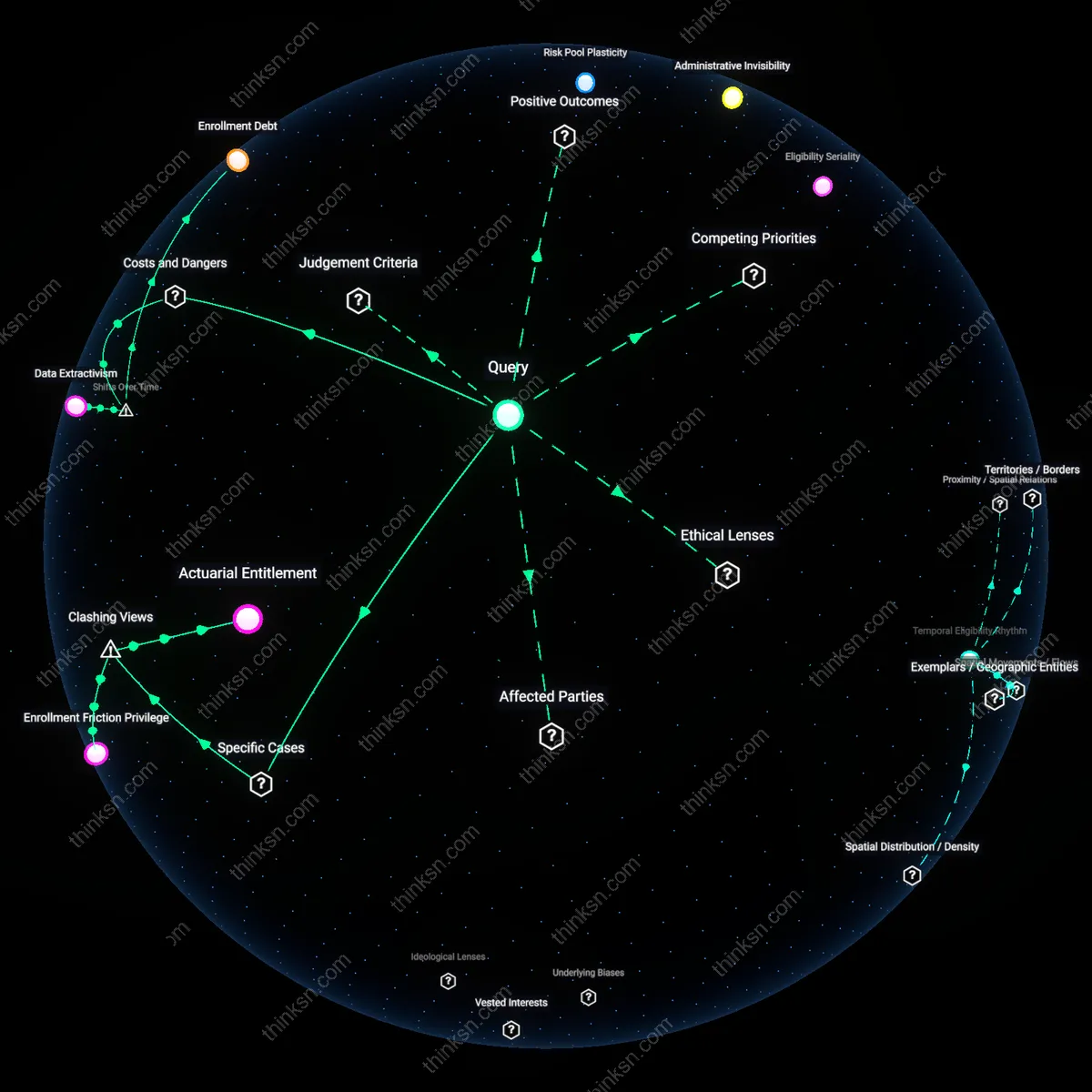
Analysis reveals 10 key thematic connections.
Key Findings
Temporal Discount Disparity
Healthy 30-year-olds experience greater anxiety from unclear out-of-pocket maximums because they disproportionately discount future health spending, making ambiguous cost ceilings feel like unbounded future liabilities. Younger adults, perceiving illness as temporally distant, rely more on financial heuristics that treat uncertain caps as open-ended obligations, while older adults with chronic conditions anchor spending projections in recurrent, observed patterns of care, rendering the maximum less probabilistic and more operational. This mechanism operates through intertemporal decision-making frameworks in health financial planning, where uncertain distant outcomes are weighted less, paradoxically increasing anxiety when those outcomes lack clear boundaries. The overlooked dynamic is that temporal discounting doesn’t reduce concern—it amplifies it when uncertainty obstructs risk closure, a shift that contradicts standard models assuming ignorance reduces perceived burden.
Actuarial anxiety
Healthy 30-year-olds experience greater anxiety from unclear out-of-pocket maximums because the post-1990s rise of consumer-driven health plans shifted financial risk to individuals, privileging market efficiency over predictability—whereas older adults, socialized under pre-1980s employer-based or Medicare systems, expect institutional protection. This shift created a new psychological condition among young, fiscally autonomous adults who must anticipate worst-case scenarios without institutional guarantees, revealing how neoliberal health policy reframes prudence as personal failure. The non-obvious insight is that anxiety here stems not from illness but from the structural demand to simulate one’s own catastrophic risk in a deregulated market.
Temporal privilege
Older adults with chronic illnesses, particularly those who reached medical eligibility during or after the 1965 creation of Medicare, benefit from a historically conditioned expectation of stable care access, whereas healthy 30-year-olds entering the system post-2010 Affordable Care Act confront a fragmented, opaque cost structure without long-term enrollment continuity. The ACA’s preservation of private insurers retained complex cost-sharing mechanisms that appear arbitrary to transient enrollees but are legible to those who have navigated the system across decades. This differential clarity is not cognitive but temporal—produced by sustained exposure to bureaucratic patterns now eroded for younger cohorts, exposing a generational inequity in institutional learning.
Moralized numeracy
Beginning in the 1980s, conservative policy frameworks redefined health cost transparency as a function of individual moral responsibility, reframing the ability to calculate out-of-pocket exposure as a sign of discipline—thus pathologizing confusion among the young as a deficit rather than a design flaw. In contrast, chronically ill older adults, often framed in welfare-state ideologies as ‘deserving’ dependents, are culturally exempt from this expectation to cognitively master their costs. The residual tension—where clarity becomes an ethical benchmark—emerges precisely when fiscal autonomy is ideologically weaponized against transient, healthy bodies presumed capable of optimization.
Temporal privilege dissonance
Healthy 30-year-olds in Western insurance markets experience heightened anxiety over unclear out-of-pocket maximums because they occupy a liminal financial and temporal space where future risk feels abstract yet immediate fiscal control is paramount, a dissonance amplified by actuarial individualism in U.S. healthcare that treats health as a personal project of optimization; this contrasts with older adults in East Asian systems, where chronic illness management is embedded in familially supported, state-adjacent care networks that normalize sustained medical expenditure, making cost uncertainty less destabilizing. The systemic trigger is the fusion of neoliberal health responsibility with weak collective risk-pooling, which renders transient health a site of existential financial peril rather than a passage within a lifespan trajectory, revealing how cultural constructions of adulthood and responsibility intensify actuarial uncertainty for the young and healthy. What is underappreciated is that anxiety stems not from ignorance of risk but from the pressure to govern invisible futures under rules that appear arbitrary yet bind tightly.
Moral economy of deservingness
In predominantly Protestant-influenced healthcare contexts like the U.S., unclear out-of-pocket calculations provoke disproportionate distress among healthy young adults because their cultural framing of healthcare access is tied to moral deservingness—where being prudent, employed, and healthy should insulate one from catastrophic costs—whereas in many Indigenous or Ubuntu-informed systems across Sub-Saharan Africa, illness is seen as a collective burden, so cost opacity is interpreted as systemic betrayal rather than personal failure; older adults with chronic conditions, especially in countries with communitarian medical ethics, have already reconciled cost insecurity as part of a socially recognized suffering that invites solidarity, not blame. The enabling condition is a moral economy that equates health with virtue and financial discipline, so when rules are unclear, young adults perceive a breakdown in just reciprocity, triggering anxiety about being penalized despite 'doing everything right.' The non-obvious insight is that anxiety arises not from cost alone but from the collapse of an implicit social contract promising fairness in exchange for compliance.
Biographical foreclosure pressure
Urban, educated 30-year-olds in global North contexts—especially in individualistic, high-productivity cultures like Germany or Japan—face acute anxiety over ambiguous out-of-pocket limits because they are in a phase of biographical investment where healthcare costs threaten planned life sequences such as home-buying or childbearing, while older adults managing chronic illness in countries with universal chronic care frameworks, such as Sweden or Taiwan, operate within adjusted expectations where medical spending is integrated into long-term planning via institutional signaling and continuity of care. The specific systemic dynamic is the misalignment between opaque, market-based financial triggers in insurance and culturally mandated timelines for adult achievement, such that uncertainty doesn't just risk money but forecloses normative life milestones; this pressure is exacerbated by digital healthcare interfaces that present worst-case scenarios without narrative resolution. The overlooked cause of anxiety is not medical risk but the inability to project a coherent life story under conditions of actuarial ambiguity.
Information Asymmetry Burden
Health insurers design out-of-pocket maximums with complex eligibility rules that exclude common services, which healthy 30-year-olds—more likely to be new insurance buyers—cannot anticipate, leaving them exposed to surprise costs; this contrasts with chronically ill older adults, who, through repeated claims experience and provider guidance, learn which expenses count toward the maximum over time. The mechanism operates through payer-specific benefit designs that leverage regulatory tolerance for variable cost-sharing structures, making transparency non-essential for compliance. The non-obvious insight is that insurers' adherence to letter-of-the-law disclosure meets legal standards while preserving strategic ambiguity, which disproportionately affects inexperienced but low-utilization users who lack the experiential data to decode it.
Predictability Privilege
Older adults with chronic conditions routinely interact with providers who help them map treatment costs to insurance thresholds, creating a de facto advisory system that stabilizes financial expectations, while healthy 30-year-olds, lacking such guidance, must parse opaque plan documents alone when rare high-cost events occur. This dynamic is sustained through clinical ecosystems where physicians act as financial interpreters—especially in Medicare and long-term care settings—translating benefits into actionable cost pathways. The underappreciated reality is that medical expertise doubles as economic navigation for the chronically ill, granting them a form of predictability that younger, healthier individuals, navigating infrequent care episodes without institutional support, are structurally denied.
Visibility Penalty
Employers and health plan marketers emphasize the out-of-pocket maximum as a headline benefit in high-deductible plans targeted at healthy young workers, making its opacity feel like a broken promise rather than a nuanced feature, whereas older adults, conditioned by decades of incremental cost exposure, view insurance as partial protection, not a calculable shield. This phenomenon is amplified by consumer-facing materials that simplify the maximum into a clean number without context, leveraging behavioral expectations of transparency in financial products. The overlooked mechanism is that the more a cost ceiling is promoted as a safety net, the greater the psychological backlash when its boundaries prove indistinct—especially among those who trusted the surface message because it aligned with their low-use reality.