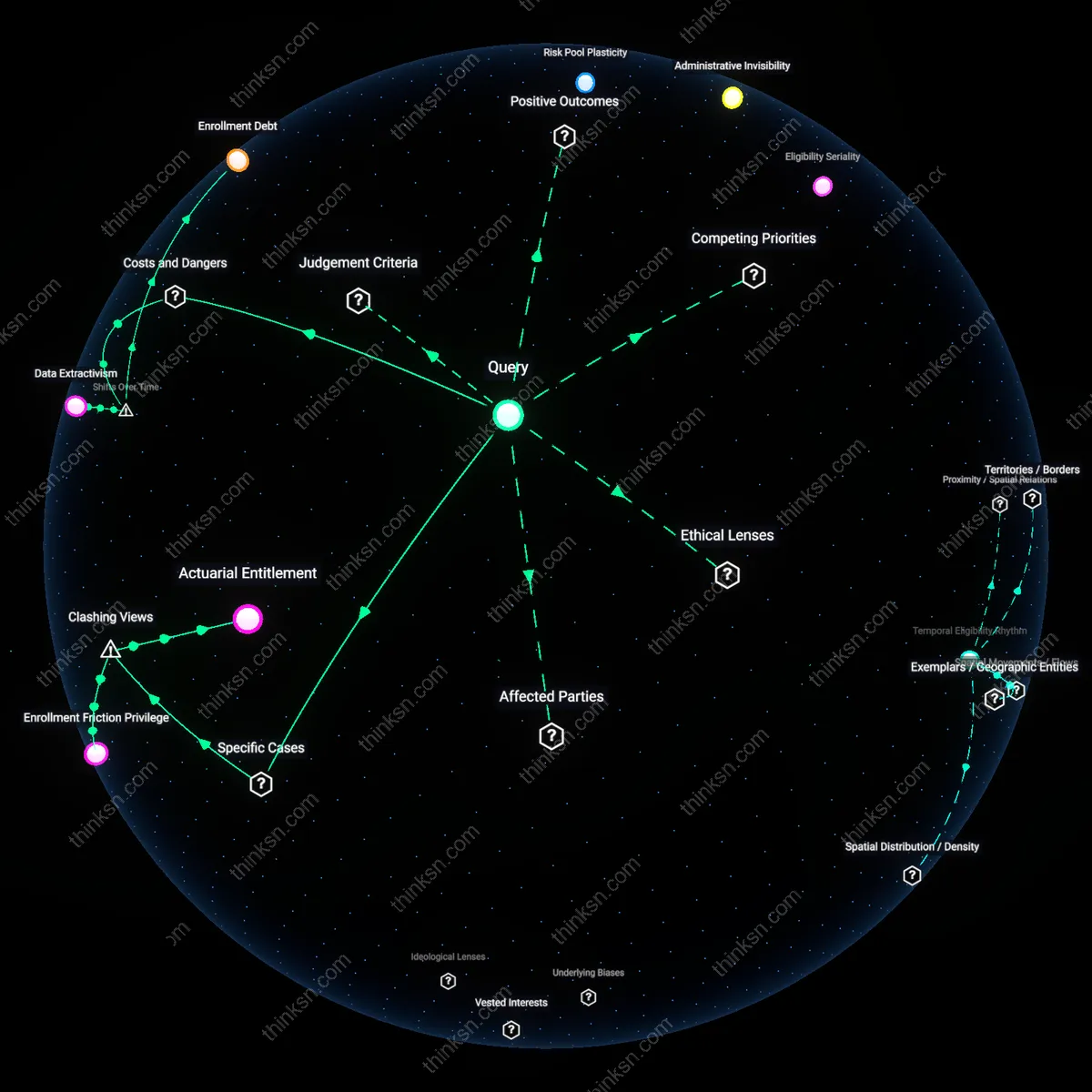
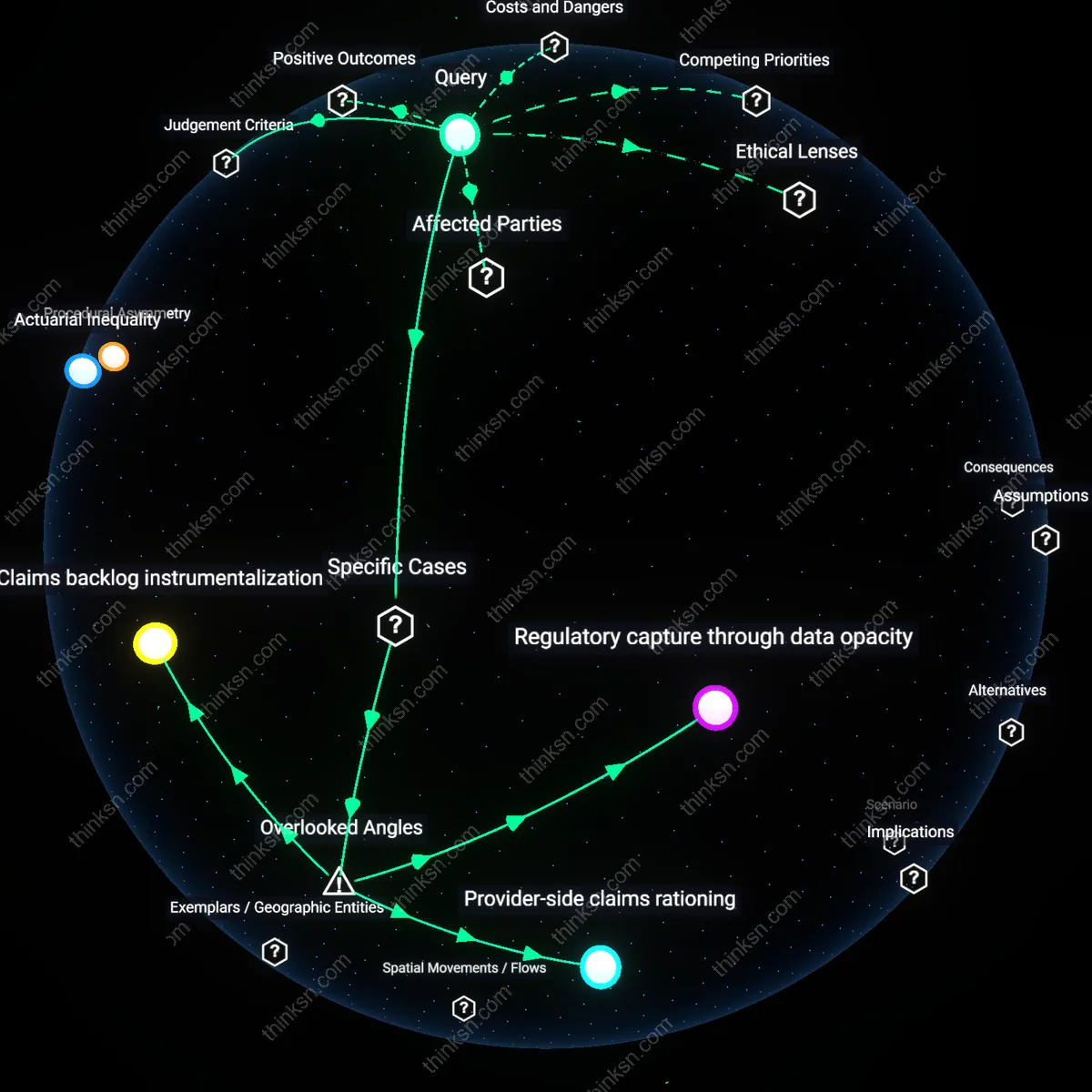
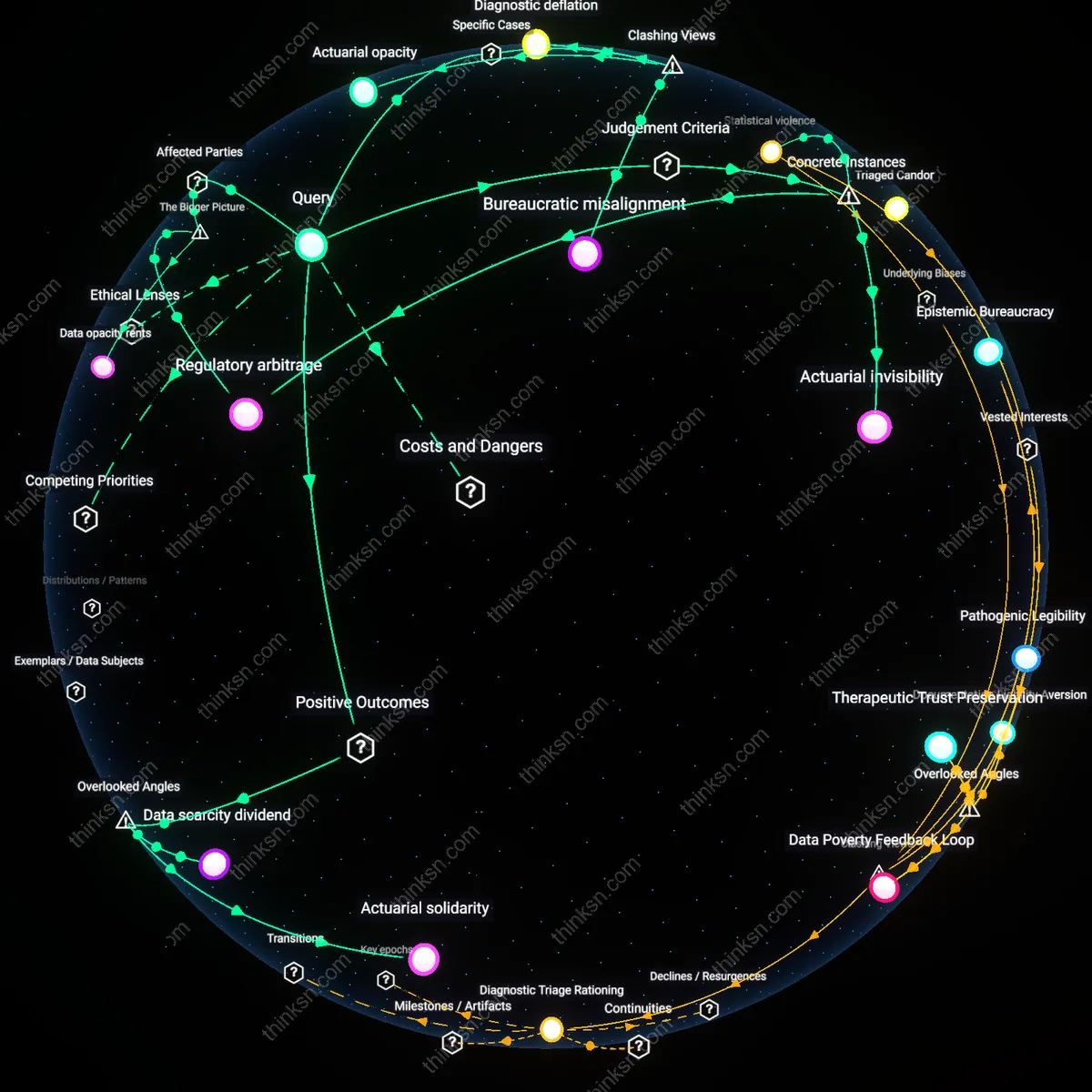
Administrative Legibility
Automated enrollment increased insurers' perception of individuals as data-saturated administrative units rather than risk profiles, originating in the U.S. Medicaid expansion under the Affordable Care Act around 2014, where federal mandates required states to implement coordinated eligibility systems across health and human services. These systems, such as the Modular Medicaid Information Technology Systems (MMIS), automatically verified income, residency, and household status using real-time federal databases like the Common Verification Interface, shifting the insurer’s gaze from episodic underwriting to continuous bureaucratic legibility. The overlooked dimension is that insurers began to rely not on medical risk but on the stability and continuity of administrative data trails—people became insurable not because they were healthy, but because their lives were consistently documented across government systems. This reframes risk assessment as a byproduct of surveillance integration, not clinical prediction.
Temporal Eligibility Rhythm
Automated enrollment reshaped insurers’ temporal perception of individuals by anchoring coverage to algorithmic eligibility cycles rather than life events, first systematized in California’s County Enrollment Offices during the 2015–2017 Medi-Cal modernization, where batch-processing algorithms reassessed thousands of enrollees monthly using IRS and DMV data feeds. Unlike pre-automation models where enrollment followed discrete life changes like job loss or marriage, automated systems imposed a recurring, invisible rhythm of qualification that insurers now assume as behavioral baseline. The overlooked dynamic is that insurers increasingly expect individuals to maintain compliance with data verification on fixed cycles—people are seen as temporally synchronized or desynchronized with administrative time, not just medically risky. This produces a latent expectation of bureaucratic punctuality, altering how insurers interpret lapses in coverage.
Data Collateral
Insurers began treating personal data not as a means to assess risk but as a form of collateral securing enrollment stability, a shift crystallized in the federal Health Insurance Marketplace’s use of proxy verification during the ACA’s rollout, when incomplete applications were auto-approved using third-party data imputation from credit reporting agencies and tax records. This practice, institutionalized after 2016 due to political pressure to minimize disenrollment, meant that individuals’ eligibility depended less on truthful self-reporting and more on the fungibility of their data across domains—e.g., credit history standing in for income. The underappreciated factor is that insurers now implicitly condition coverage on the existence of dense, transferable data trails across commercial and state systems; people without such data are not seen as high-risk but as administratively nonexistent. This transforms data abundance into a quiet prerequisite for personhood in insurance markets.
Data-Driven Actuarial Gaze
Automated enrollment reframed individuals as modular risk profiles manipulable in real time by actuarial systems, replacing episodic underwriting with continuous classification. Insurers now segment populations not through individual medical interviews or paper forms but through algorithmic triage of demographic, behavioral, and claims data flowing from integrated digital sources like payroll systems, credit databases, and health record exchanges. This shift—from discrete enrollment events to ongoing risk reprocessing—allows carriers to treat personhood as a variable input calibrated across time, which most people now associate with seamless sign-up processes but fail to recognize as a silent reallocation of actuarial authority from human adjusters to backend scoring engines.
Invisible Eligibility Architecture
Automated enrollment transformed how insurers perceive eligibility by embedding access rules within silent, standardized software protocols rather than negotiable human assessments. Before digital systems, enrollment often involved broker-mediated discretion—exceptions could be argued, forms resubmitted, and borderline cases appealed. Now, legacy laws like the Affordable Care Act and ERISA-compliant employer plans execute eligibility through coded logic in systems like BenefitFocus or ADP, filtering who qualifies based on unchallengeable fields such as FTE status, salary band, or union affiliation. This invisible architecture—familiar to employees who suddenly gain or lose coverage after job changes—feels routine, but masks how insurers increasingly view people not as clients but as data packets that either conform to a rule-set or vanish from the risk pool.
Temporal Insurance Identity
Automated enrollment redefined personal identity in insurance as a time-stamped eligibility trajectory shaped by algorithmic triggers rather than static biographical facts. Where once an insurance relationship felt like a fixed status—achieved after application and maintained until cancellation—automated systems now render it as a sequence of discrete, revocable states governed by dynamic inputs like payroll frequency, dependent verification cycles, or federal subsidy thresholds. Employees at companies using Workday or Oracle Benefits learn this through abrupt mid-month coverage changes, revealing that insurers no longer see them as continuous individuals but as temporally bounded enrollment instances that can be activated or suspended without notice—something the public accepts as administrative routine but which recasts personhood as an interruptible service.
Actuarial Relevance Compression
Automated enrollment shifted insurers’ perception of individuals from episodic risk carriers to continuously qualifying data streams, enabling real-time eligibility filtering. Insurers now rely on algorithmic systems—fed by credit histories, prescription records, and public benefit databases—to preemptively segment populations before any human interaction, embedding actuarial logic into access itself. This systemic integration of upstream data flows compresses the temporal and conceptual space between personal identity and insurability, privileging statistical coherence over individual circumstance. The non-obvious effect is that exclusion becomes administrative rather than clinical—coded into onboarding algorithms, not underwriting decisions.
Bureaucratic Intimacy Displacement
Automated enrollment displaced insurers’ relational engagement with beneficiaries from case-based adjudication to infrastructure-dependent verification, shifting trust from documentation to data pipelines. Insurers now depend on state and federal data exchanges—notably Medicaid’s eligibility systems and the Affordable Care Act’s Marketplaces—to authenticate income, citizenship, and household status, outsourcing moral and procedural certainty to third-party infrastructures. This entanglement means insurers assess people less through medical risk and more through alignment with bureaucratic data norms, elevating compliance with digital verification over clinical need. The underappreciated consequence is that the insurer’s gaze is redirected from the individual to the seamlessness of institutional data flows.
Risk Pool Temporalization
Automated enrollment redefined how insurers value demographic cohorts by accelerating entry and exit from coverage, transforming risk pools into dynamic, time-sensitive aggregates rather than static populations. Because auto-enrollment and auto-renewal systems—especially in Medicaid expansion states—trigger coverage based on periodic data matches, insurers now model profit and loss around churn velocity and enrollment latency, not just morbidity. This forces actuarial models to prioritize temporal behaviors (e.g., how long a low-income enrollee stays on the rolls) over traditional health indicators. The systemic shift lies in treating time in coverage as a proxy for risk, fundamentally altering how insurers assess the worth of individual lives within algorithmically managed lifespans.
Risk Pool Plasticity
The implementation of automated enrollment in California’s Covered California exchange after the ACA led insurers to treat demographic cohorts as dynamically adjustable rather than fixed risk categories. By continuously enrolling individuals through algorithmic triggers tied to income changes or life events, the system blurred traditional actuarial boundaries, forcing insurers to recalibrate risk models in real time rather than relying on static enrollment snapshots. This shift revealed that automated systems don’t just streamline access—they reshape how risk is temporally constructed, making previously rigid population segments fluid and responsive to policy feedback loops. The non-obvious insight is that enrollment automation altered not just who gets covered, but how predictability itself is distributed across insurer decision architectures.
Administrative Invisibility
When Kentucky modernized its Medicaid enrollment through kynect in 2013, the state’s insurers increasingly relied on backend data-matching with federal tax, wage, and benefits databases to infer eligibility, reducing face-to-face verification. This created a class of enrollees whose presence in risk pools was mediated entirely by administrative silence—no denial, no approval, just automated continuation—leading insurers to treat continuous enrollment as a default condition rather than an achievement. The mechanism eroded the distinction between active participation and passive retention, revealing how automation redefines individual visibility by making non-interruption the primary mode of engagement. This shift is significant because it shows how insurers began to assess population value not through active enrollment behavior but through absence of system friction.
Eligibility Seriality
New York’s automated recertification system, launched through the NYC Human Resources Administration’s ACCESS HRA platform, sequences eligibility determinations across months rather than treating them as discrete annual events, causing insurers to anticipate coverage lapses as cyclical patterns rather than one-off dropouts. By exposing individuals to repeated, algorithmically timed reevaluations, the system produces recurrent churn that insurers now model as a structural feature of enrollment, not an anomaly. This mechanizes how insurers perceive time in individual risk assessment, converting lifespan transitions into procedural intervals governed by the rhythm of the system. The underappreciated consequence is that people are no longer seen as entering or leaving coverage but as moving through algorithmically defined stages of conditional inclusion.