Do Rent Controls and Zoning Laws Sabotage Housing Quality?
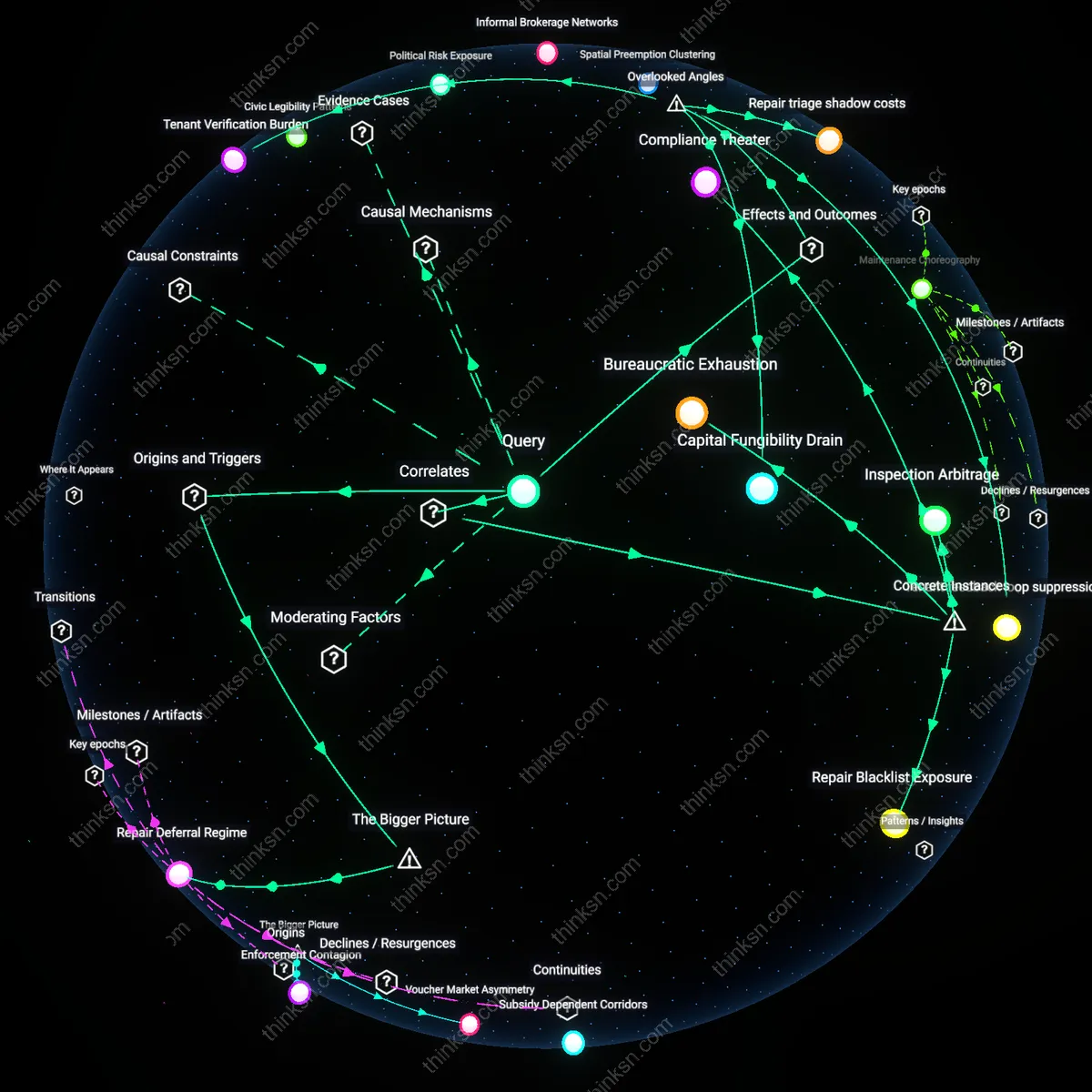
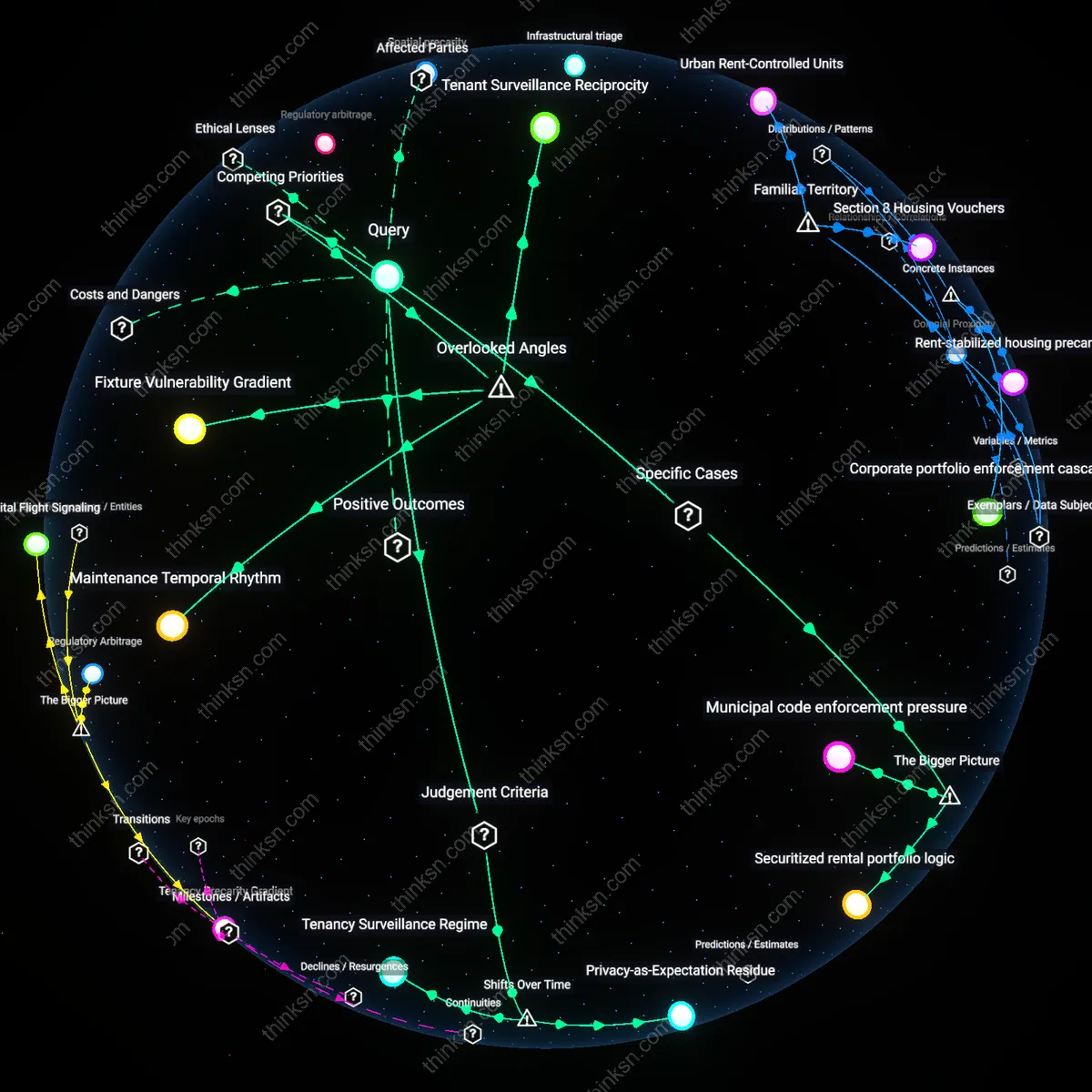
Analysis reveals 12 key thematic connections.
Key Findings
Deferred Code Enforcement
Combined rent-control and inclusionary zoning policies create unintended incentives for landlords to lower maintenance standards by enabling landlords to exploit asymmetries in municipal code enforcement timing, where violations are addressed only after rent-regulated tenants file complaints—often deterred by fear of retaliation or displacement. Municipal housing inspectors in cities like New York or San Francisco operate reactively, not proactively, allowing landlords to delay repairs indefinitely so long as tenants remain silent; this creates a perverse dependency on tenant vulnerability to maintain noncompliant conditions without immediate penalty. This dynamic is overlooked because policy debates focus on landlord income margins rather than the temporality and initiation of enforcement, obscuring how regulatory inertia becomes a strategic asset for cost minimization.
Cross-Subsidy Illiquidity
Landlords subject to both rent control and inclusionary zoning may reduce maintenance on non-subsidized units to indirectly compensate for revenue losses, particularly when the mandated cross-subsidy within the same building—from market-rate to below-market units—fails to cover rising operational costs due to rigid rent caps. In cities like Los Angeles or Boston, where zoning mandates set aside units at below-market rents and local rent controls limit annual increases on existing tenants, property owners lack liquidity to replenish capital reserves, making deferred maintenance a silent form of dividend extraction. This mechanism is rarely analyzed because fiscal impacts are assessed at the building level, not segmented by unit-type cash flow, hiding how cross-unit financial stress manifests physically in building quality.
Compliance Recalibration
The interaction of rent control and inclusionary zoning incentivizes landlords to reclassify routine maintenance as 'non-essential' under internal capital planning systems, recalibrating what meets minimum compliance thresholds in response to compressed and predictable revenue streams established by overlapping regulations. In jurisdictions such as Washington, D.C., where inclusionary zoning requires affordable units and rent stabilization limits rent adjustments, landlords employ automated facility management software that re-weights repair priorities using compliance risk scores—effectively downgrading aesthetic or comfort-related issues that don’t trigger immediate legal liability. This subtle shift in maintenance governance is underappreciated because it appears procedurally neutral, yet embeds cost-cutting into administrative logic rather than overt neglect.
Deferred stewardship
Rent-control and inclusionary zoning policies enacted in the 1980s New York City context created immediate downward pressure on rental income while mandating long-term affordability, leading landlords of mixed-income buildings to systematically delay non-essential repairs as a liquidity management strategy. This behavioral shift emerged particularly after the 1984 Emergency Tenant Protection Act amendments, which expanded rent stabilization without corresponding public maintenance subsidies, transforming landlord asset management from value-preserving maintenance to cost-smoothing over time. The non-obvious outcome was not outright neglect but a calculated deferral of upkeep, especially in units unlikely to turnover soon, revealing a temporal misalignment between regulatory obligations and capital reinvestment cycles.
Compliance substitution
The integration of inclusionary zoning into San Francisco’s 2002 Planning Code, coupled with strict rent control, led developers to reinterpret physical maintenance as a flexible variable within broader compliance accounting, where avoided repair costs could offset mandatory below-market unit production. As construction-era profit margins compressed in the mid-2000s, landlords began treating maintenance budgets not as fixed operational necessities but as transferable resources within a regulatory ledger, redirecting funds to meet inclusionary quotas while maintaining technical adherence to habitability standards. This shift—from maintenance as upkeep to maintenance as fungible compliance input—reveals how policy bundling in the early 2000s recast building conditions as negotiable variables within a new financialized regulatory regime.
Maintenance arbitrage
In post-2015 Los Angeles, where the Rent Stabilization Ordinance was extended and inclusionary requirements tightened under Measure JJJ, small-scale landlords began selectively reducing maintenance expenditures in rent-controlled units while intensifying upkeep in market-rate portions of the same buildings to attract higher-income tenants and offset losses. This spatial differentiation in upkeep, emerging distinctly after 2016 enforcement expansions, exploited regulatory asymmetries—where habitability standards were minimally enforced if not formally violated—allowing owners to practice maintenance as a form of spatial risk pricing. The underappreciated dynamic is not generalized decay but a deliberate, policy-responsive allocation of maintenance capital that mirrors financial arbitrage, born from the temporal divergence between rising regulatory mandates and stagnant cost-recovery mechanisms.
Maintenance Deflection
Landlords reduce property upkeep when rent-control limits income while inclusionary zoning mandates low-cost units, because the combined pressure shrinks operating margins and weakens profit-linked maintenance incentives. The mechanism operates through fixed-cost allocation in regulated buildings, especially in mid-tier urban housing markets like Los Angeles or Boston, where landlords face occupancy mandates without public subsidies to offset upkeep. What’s underappreciated is that owners aren’t simply cutting corners—they’re rationally reallocating limited funds away from deferred, non-compliance-exposed investments like garden landscaping or paint jobs, which the public nonetheless associates with neglect.
Compliance Substitution
Regulated developers prioritize zoning bonuses over long-term asset quality because inclusionary mandates can be satisfied through density increases or fees-in-lieu, which redirect focus from unit-by-unit upkeep to regulatory accounting. In cities like San Francisco or Seattle, developers exploit this by minimizing reinvestment in existing rent-controlled stock to fund new affordable projects and meet quotas, effectively substituting maintenance spending for compliance capital. The non-obvious dynamic is that inclusionary policies don’t directly degrade buildings—they reframe capital allocation rules in ways that make disinvestment feel administratively rational, even when physical deterioration undermines community goals.
Rent-Regime Arbitrage
Property owners in high-demand neighborhoods strategically allow visible decline to accelerate rent-controlled turnover, enabling faster reversion to market rates post-vacancy—especially where rent-control exemptions apply to substantially renovated units. This occurs most acutely in transit-adjacent buildings in cities like New York or Washington, D.C., where landlords withhold routine repairs to encourage tenant departure, betting that future rent uplifts outweigh present savings. The underappreciated reality is that inclusionary zoning reinforces this logic by raising land value, inadvertently rewarding absentee owners who treat regulated units as temporary, depreciating stepping stones to redevelopment.
Capital replacement deferral
Combined rent-control and inclusionary zoning policies correlate with observable declines in building maintenance because landlords under thin operating margins shift deferred capital expenditures to manage regulatory cost pressure, particularly in mid-tier multifamily markets like those in Los Angeles and Seattle where below-market rent obligations coincide with mandatory set-asides; this dynamic emerges not from outright neglect but from actuarial recalibration of investment timelines by property managers responding to compressed cash flows, revealing how regulatory accretion alters intertemporal capital allocation without triggering formal code violations.
Regulatory arbitrage space
When rent control limits revenue and inclusionary zoning imposes construction mandates, landlords in high-demand cities like New York or San Francisco respond by exploiting gray areas in housing quality enforcement to effectively 'downgrade' unit desirability without eviction, thereby reducing tenant expectations and maintenance demands—this occurs because underfunded housing inspection agencies prioritize habitability over quality, creating a strategic environment where lowered upkeep becomes a rational adjustment to regulatory asymmetry, exposing how compliance incentives can reshape physical conditions without explicit rule-breaking.
Housing quality discounting
Landlords facing binding rent caps alongside inclusionary zoning requirements tend to reclassify ongoing maintenance as discretionary rather than essential spending, particularly in neighborhoods undergoing gentrification where long-term appreciation outweighs short-term tenant retention—this shift occurs because financial models increasingly price in depreciation as a feature, not a flaw, allowing owners to extract value through future disposition rather than rental yield, illustrating how property investment logics evolve when regulatory constraints rewire time-value calculations in housing markets.