Is Withholding Rent Due to Pests Legal Protection Against Eviction?
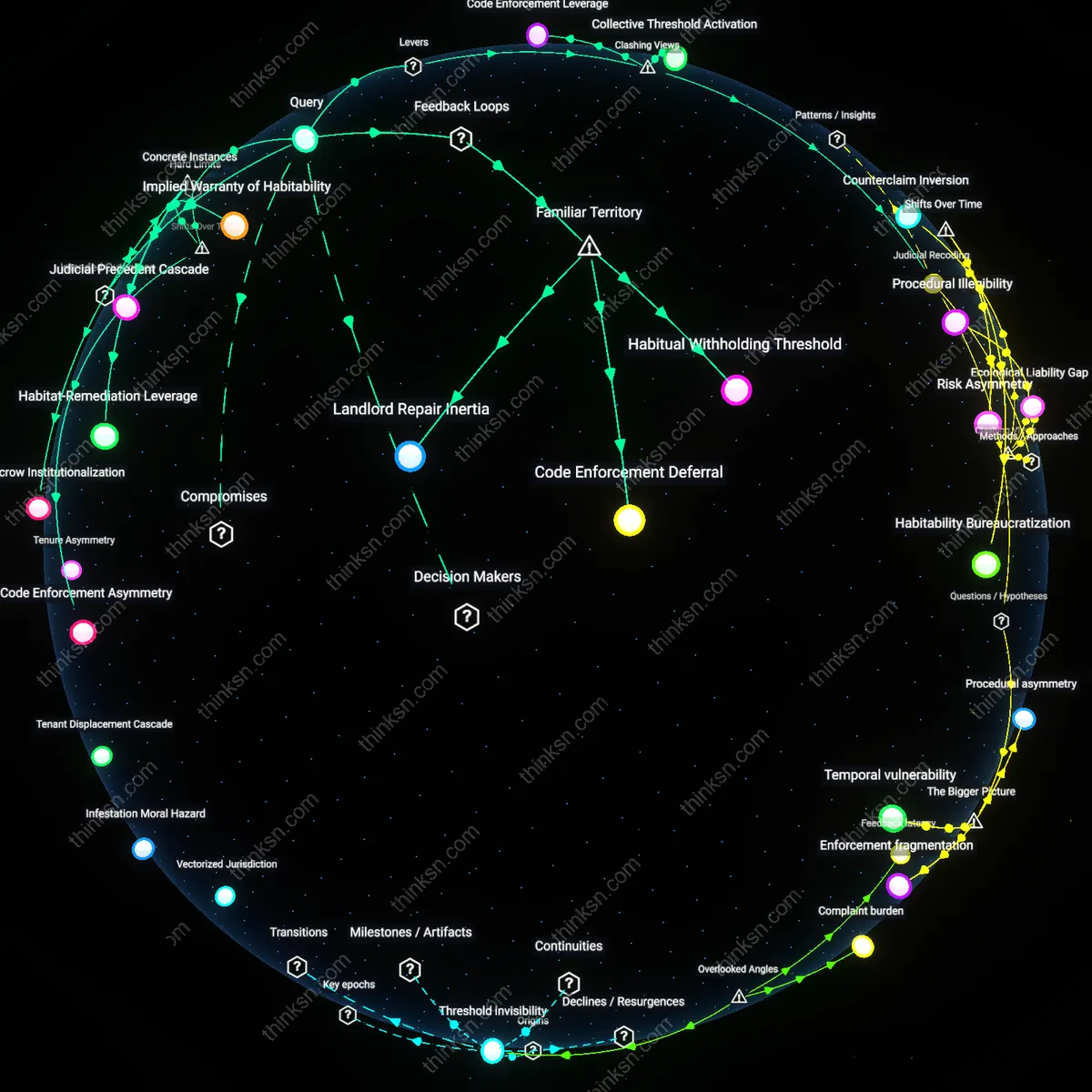
Analysis reveals 12 key thematic connections.
Key Findings
Implied Warranty of Habitability
Tenants gained legal protection against eviction for rent withholding during pest infestations only after the 1970s judicial recognition of the implied warranty of habitability in U.S. residential leases, which redefined housing contracts to include baseline health and safety standards not contingent on landlord-tenant agreements. This doctrine shifted liability onto landlords by presuming that rental units must be fit for living—a departure from the common law principle of 'caveat tenant'—and allowed courts to validate rent withholding as a remedial response to verifiable infestations, especially in cities like New York and Washington, D.C., where housing codes were aggressively enforced. The non-obvious dimension is that this protection emerged not through legislation but through incremental judicial reinterpretation of contract law in response to urban housing crises, thereby embedding public health norms into private tenancy.
Code Enforcement Asymmetry
Legal safeguards for tenants withholding rent due to pests became unevenly effective only after municipal housing code reforms in the 1990s converted health inspections into potential eviction triggers, privileging landlords who could rapidly remediate visible violations over tenants in prolonged infestation disputes. In cities like Chicago and Los Angeles, local codes began mandating corrective timelines for pest control, but enforcement relied on tenant complaints—creating a system where documented reporting became a prerequisite for legal defense, yet also exposed tenants to retaliatory eviction if landlords acted first. The underappreciated consequence of this procedural shift is that tenant 'protection' now depends less on the severity of infestation than on bureaucratic navigation speed, producing a de facto hierarchy of enforceability along lines of literacy, language, and access to legal aid.
Emergency Housing Intervention
Following the post-2008 foreclosure crisis and subsequent rise of institutional landlords, courts in states like Nevada and Georgia began recognizing pest-related rent withholding as a justifiable emergency intervention only when public health agencies formally declared dwellings 'uninhabitable,' marking a shift from tenant-initiated claims to state-validated crises. This trajectory reflects a broader movement toward treating extreme housing disrepair as a public health externality rather than a private contract dispute, exemplified by ordinances in Atlanta and Las Vegas where vector-borne disease risks from rodent or roach infestations triggered city-led evacuations and temporary rent escrow programs. The overlooked implication is that legal safety now accrues primarily during systemically visible breakdowns—when infestations threaten broader communities—leaving isolated or stigmatized tenants without equivalent recourse despite identical conditions.
Code Enforcement Leverage
Tenants can invoke municipal housing code enforcement to compel repairs and block eviction by shifting the dispute from landlord discretion to public regulatory mandate. Local housing inspectors in cities like New York or Chicago have statutory authority to issue vacate orders or repair mandates when vermin infestations violate habitability standards, thereby creating a legal shield against eviction for nonpayment—because the tenant’s rent withholding is recast as a justified response to illegal living conditions. This works through administrative rather than judicial channels, exploiting a gap between property law norms and public health regulation, which most tenants and even legal aid providers underutilize. The non-obvious insight is that the tenant’s leverage lies not in court defenses but in triggering third-party bureaucratic action that reorders power relations.
Judicial Recoding
Courts in jurisdictions with implied warranty of habitability rulings—such as Massachusetts or California—can retroactively reframe rent withholding not as breach but as contractually justified reallocation of payment obligation to abatement or self-help repair. When tenants document pest infestations and formally notify landlords before diverting rent into escrow accounts under state-specific procedures, judges often classify the act as compliance with implied lease terms rather than default, undermining eviction petitions. This mechanism operates through doctrinal exceptions that prioritize dwelling fitness over rent flow, revealing that perceived eviction risk is often a bluff where landlords count on tenants’ ignorance of procedural counters. The friction lies in rejecting the intuitive view that rent withholding is inherently unlawful, exposing it instead as a lawful market correction when legally scaffolded.
Collective Threshold Activation
Organized tenant unions in rent-controlled or high-turnover buildings can transform individual rent withholding into a protected group action by invoking labor-adjacent solidarity doctrines and bulk negotiation under local tenant protection laws, as seen in Minneapolis or Oregon’s statewide rental codes. When coordinated across units, pest complaints cease being isolated grievances and become evidence of systemic neglect, triggering mandatory mediation, eviction moratoria during dispute resolution, or city-funded remediation—insulating participants from unilateral retaliation. This functions through policy thresholds that activate enhanced safeguards only when harm is collective, exposing that legal protection is not a matter of individual rights but of actionable scale. The dissonance is that solitary tenants lose by design, while group noncompliance becomes a sanctioned regulatory tool.
Habitual Withholding Threshold
Tenants often withhold rent when pest infestations breach perceived habitability standards, triggering a reinforcing feedback loop where landlords accelerate eviction to reclaim income, which in turn increases tenant desperation and resistance, destabilizing the rental relationship. This dynamic operates through local housing courts and informal negotiations, particularly in rent-controlled or high-turnover urban markets like New York or Los Angeles, where tenants collectively anticipate that visible neglect justifies nonpayment. What’s underappreciated is that the very predictability of this sequence—infestation, complaint, withholding, eviction threat—creates a systemic rhythm that sustains informal norms about tolerance limits, even when legal codes are unclear or unevenly enforced.
Code Enforcement Deferral
Local housing code enforcement agencies become de facto mediators when tenants report pest infestations, creating a balancing feedback loop that delays eviction by validating health hazards and compelling landlord action through inspection mandates. In cities like Chicago or Philadelphia, tenants leverage 311 complaints to trigger municipal inspections, which generate paper trails that courts often recognize as evidence of good faith, thereby reducing immediate eviction risk. The non-obvious insight is that reliance on bureaucratic responsiveness—not legal rights per se—becomes the actual safeguard, embedding tenant survival in the slow, habitual motion of municipal machinery rather than statutory protection.
Landlord Repair Inertia
Landlords frequently delay extermination to avoid costs or signal dominance, reinforcing a cycle where tenant withholding provokes eviction filings, which then force court-mandated repairs as a condition of case dismissal, effectively making the judicial system the primary enforcer of habitability. This plays out in housing courts in cities like Detroit or Baltimore, where judges routinely convert eviction cases into compliance timelines, knowing that full eviction would strain shelter systems. The underappreciated reality is that the threat of eviction, rather than nullifying tenant leverage, becomes a procedural pivot point that habitually extracts repairs—turning legal vulnerability into a coerced negotiation.
Habitat-Remediation Leverage
In New York City’s 2018 Adams v. Certain Apartments case, tenants successfully withheld rent and repelled eviction by documenting bedbug infestations through the city’s 311 system and leveraging HPD’s own inspection data to trigger mandatory remediation orders, revealing that municipal code enforcement infrastructures can be weaponized by tenants as legal counterforce when they systemically log violations, which transforms passive complaints into active judicially recognized obligations to repair, exposing the underappreciated role of municipal data capture as a co-actor in habitability disputes.
Rent-Escrow Institutionalization
In the 2005 Chicago Housing Authority (CHA) settlement following the Lockewood Apartments class action, tenants facing eviction for nonpayment due to rodent infestations gained court-authorized rent deposit into a supervised escrow account while repairs lagged, establishing that structured financial mechanisms—when embedded in consent decrees—can suspend eviction eligibility during remediation delays, demonstrating that financial intermediation, not just legal defense, can become a judicially sanctioned tool for housing stability when systemic disrepair is proven.
Judicial Precedent Cascade
Following the 2010 California appeals court decision in Green v. Superior Court, where tenants’ rent withholding during an uncontrolled cockroach infestation was upheld due to the landlord’s failure to comply with Civil Code § 1941.1, lower courts across the state began applying a 'material breach' standard that prioritized habitability over payment timelines, revealing that appellate rulings can generate operational thresholds in trial courts where pest control neglect is reclassified as landlord default, thereby reversing the presumptive burden of eviction eligibility.