How Delayed Repairs Reveal Power Dynamics in Low-Income Housing?
Analysis reveals 11 key thematic connections.
Key Findings
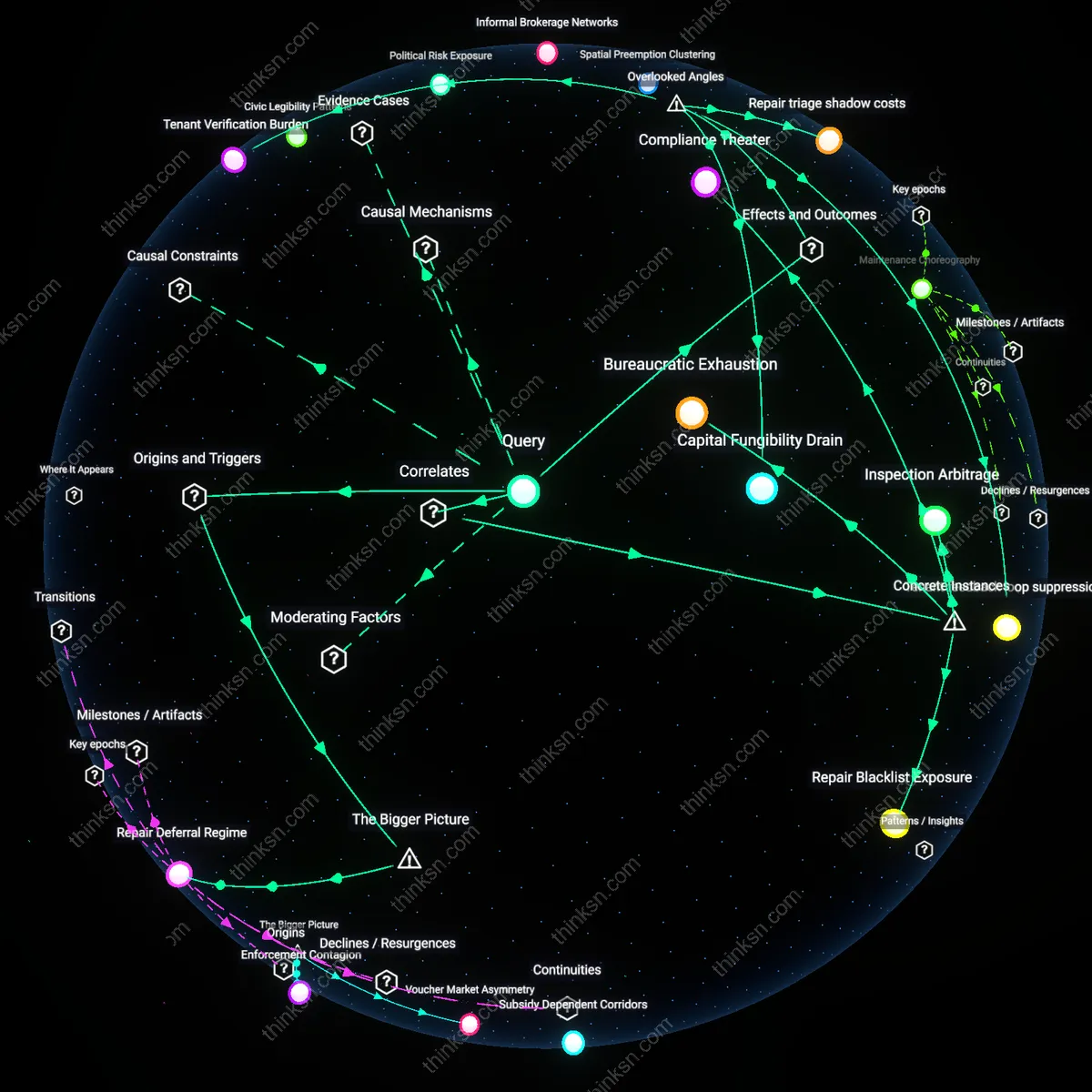
Repair Deferral Regime
Housing-authority funding caps directly force delayed habitability repairs by legally binding public agencies to ration maintenance spending, such that systemic underfunding—originating in federal budget constraints and municipal fiscal policies—becomes an operational mandate in low-income neighborhoods; this triggers a repair deferral regime where essential fixes are deprioritized not due to landlord indifference alone, but because public funds are legislatively capped, a condition underappreciated given its institutionalization of delay as fiscal compliance. Evidence indicates this mechanism persists even when landlords report willingness to cooperate, revealing that public-administrative constraints—not just private-market failures—drive repair latency.
Repair Logistical Choking
Funding caps force housing authorities to compress repair procurement cycles, which overwhelms understaffed public works offices and creates bureaucratic pileups in low-income neighborhoods where landlords rely on public contracts; this administrative congestion—not landlord malice or tenant passivity—is the proximate cause of prolonged repair delays. The mechanism operates through the mismatch between fixed compliance timelines and variable municipal staffing, a dynamic hidden beneath surface-level blame on funding levels or landlord behavior; overlooked because policy analysis focuses on budget totals rather than throughput capacity in procurement pipelines. This reveals that repair stagnation is often a function of internal public-sector logistics, not just external market forces.
Capital Fungibility Drain
Landlords in capped funding environments exploit the fungibility of housing authority subsidies by diverting allocated repair capital toward non-habitable assets—like façade improvements for tax abatements—while deferring structural repairs in low-income units; this occurs because oversight rarely tracks capital displacement across property portfolios. The shift happens at the portfolio level, where landlords legally reallocate savings from public programs to higher-return investments elsewhere in their holdings, a practice obscured by tenant-facing audits that examine single properties. This financial repositioning—masked as compliance—is a hidden mechanism by which market power subverts repair outcomes despite apparent fund disbursement.
Tenant Verification Burden
Repair delays intensify when housing authority protocols require tenants to document deterioration through photo logs and time-stamped reports, a burden that disproportionately falls on elderly, non-native, or disabled residents in low-income neighborhoods, leading to underreported needs and stalled funding triggers; landlords exploit this gap by avoiding proactive reporting, knowing delayed documentation delays obligations. This procedural dependency on tenant bureaucracy—a byproduct of audit-driven funding systems—is rarely analyzed as a structural delay mechanism, yet it gives landlords passive control over repair initiation without overt refusal. The power asymmetry thus operates through administrative design, not just resource constraints.
Repair triage shadow costs
Funding caps force housing authorities to prioritize emergency repairs over habitability issues, causing landlords to defer maintenance they expect will eventually be absorbed by public resources, which inflates repair backlogs through a hidden cost-shifting mechanism. Housing authorities in cities like Baltimore and Detroit, operating under fixed HUD capital fund allocations, cannot address non-urgent but critical habitability problems such as chronic mold, broken heating systems, or pest infestations—landlords anticipate this bottleneck and strategically delay their own investments, waiting for public intervention that may never come. This creates a gray zone of deteriorating conditions that are severe enough to harm residents but not acute enough to trigger emergency protocols, a dynamic rarely captured in official maintenance logs or compliance audits. The non-obvious insight is that the financial logic of triage produces ‘shadow costs’—not in the budget, but in incremental health deterioration and lost tenant agency—which are externalized onto vulnerable renters and only visible through longitudinal tenant interviews or ethnographic monitoring.
Rental portfolio risk buffering
Landlords with geographically concentrated portfolios in low-income neighborhoods leverage localized market power to treat delayed repairs as a risk management tool, effectively using habitability decay as a buffer against revenue instability. In areas like South Los Angeles or North St. Louis, where a single owner may hold dozens of Section 8-accepting units, minor repair deferrals across multiple properties generate cash flow reserves that hedge against tenant turnover or voucher payment delays, a strategy insulated by fragmented inspection regimes and low reporting rates among marginalized tenants. This behavior is invisible in aggregate compliance data but detectable in property management patterns where repair timing correlates not with severity, but with broader portfolio cash flow needs. The overlooked dynamic is that habitability neglect functions not merely as negligence, but as a deliberate, distributed financial instrument—repairs become a flexible liability that landlords time to match income cycles, undermining both tenant well-being and the intended function of voucher programs.
Tenant feedback loop suppression
Chronic underfunding of housing authorities erodes their capacity to act on tenant complaints, which in turn conditions landlords to ignore repair requests, creating a self-sustaining cycle where reporting becomes functionally futile for residents. In jurisdictions such as Cleveland and Memphis, where housing authority legal teams are overburdened and code enforcement relies on complaint-driven triggers, landlords learn that failure to repair rarely results in penalties or lease terminations, especially when tenants fear retaliation or eviction for asserting claims. Over time, tenants cease reporting issues altogether—not due to lack of concern, but based on accumulated experience that action is unlikely, which starves public agencies of the data needed to prioritize interventions or justify increased funding. This suppressed feedback loop distorts policy indicators, making habitability problems appear less prevalent than they are, and prevents systemic recognition of repair delays as an emergent governance failure rooted in eroded trust and performative accountability.
Bureaucratic Exhaustion
Housing-authority funding caps in Baltimore led to prolonged repair delays because annual federal allocations could not cover the backlog of structural issues in public housing, and landlords exploited this by scheduling minimal compliance work only when inspectors were scheduled, as seen in the 2019 HUD lawsuit against the Baltimore Housing Authority for systemic mold and lead hazards. The capped budget created a fixed-pie scenario where deferred maintenance accumulated, and landlords—aware of sparse enforcement—timed repairs to pass inspections without sustained investment. This reveals how regulatory timing, not just underfunding, enables neglect. The non-obvious insight is that landlords do not simply ignore repairs but strategically align minimal effort with inspection cycles, turning bureaucratic rhythms into tools of deferral.
Inspection Arbitrage
In post-Katrina New Orleans, the combination of capped Low-Income Housing Tax Credit funding and a consolidated landlord market enabled repair delays because rebuilding contracts were concentrated among a few developers who leveraged political access to reset compliance deadlines, as evidenced by the ongoing failures in the redevelopment of the C.J. Peete public housing complex. With limited developers experienced in subsidized construction and rigid funding timelines, repairs stalled when contractors prioritized more profitable projects and treated housing authority mandates as negotiable. The key mechanism was the ability of dominant contractors to stretch schedules without penalty, exploiting the lack of alternative labor pools. What’s underappreciated is that market power here functioned not through rent-setting but through scheduling control—landlords dictated pace, not price, due to labor and capital bottlenecks.
Compliance Theater
In the South Bronx under New York City’s HPD-administered HEAP program, capped capital funds and landlord dominance in high-poverty districts produced repair delays not through outright refusal but via performative fixes—temporary patches reported as permanent solutions—documented in the 2021 tenant lawsuit against Marlboro Management over recurring boiler failures in 4500 Webster Avenue. With fixed funding pools and no penalties for recurrent violations, landlords submitted invoices for short-term interventions while awaiting costlier system upgrades indefinitely. The dynamic functions through the misclassification of emergency repairs as capital improvements, allowing landlords to deplete funds without closure. The overlooked reality is that repair delays are sometimes co-produced by administrative categories that enable landlords to ‘comply’ on paper without material resolution.
Repair Blacklist Exposure
In Baltimore City, landlords who repeatedly fail habitability repairs while receiving public housing subsidies are rarely penalized, and tenants who file formal complaints are statistically more likely to be denied future rental applications across multiple property management firms, indicating that enforcement gaps enable coordinated landlord retaliation; this pattern reveals a shadow coordination system where repair delays function not as isolated neglect but as signals in an informal tenant risk-rating network, sustained by weak sanctioning despite documented code violations. The non-obvious mechanism is that funding constraints on oversight agencies—like the Baltimore Housing Authority’s underfunded inspection units—do not merely slow repairs but generate usable data for landlords to identify and exclude 'troublesome' tenants, turning repair delays into a tool for market control.