Does Rent Control Stabilize Tenants or Encourage Short-Term Rentals?
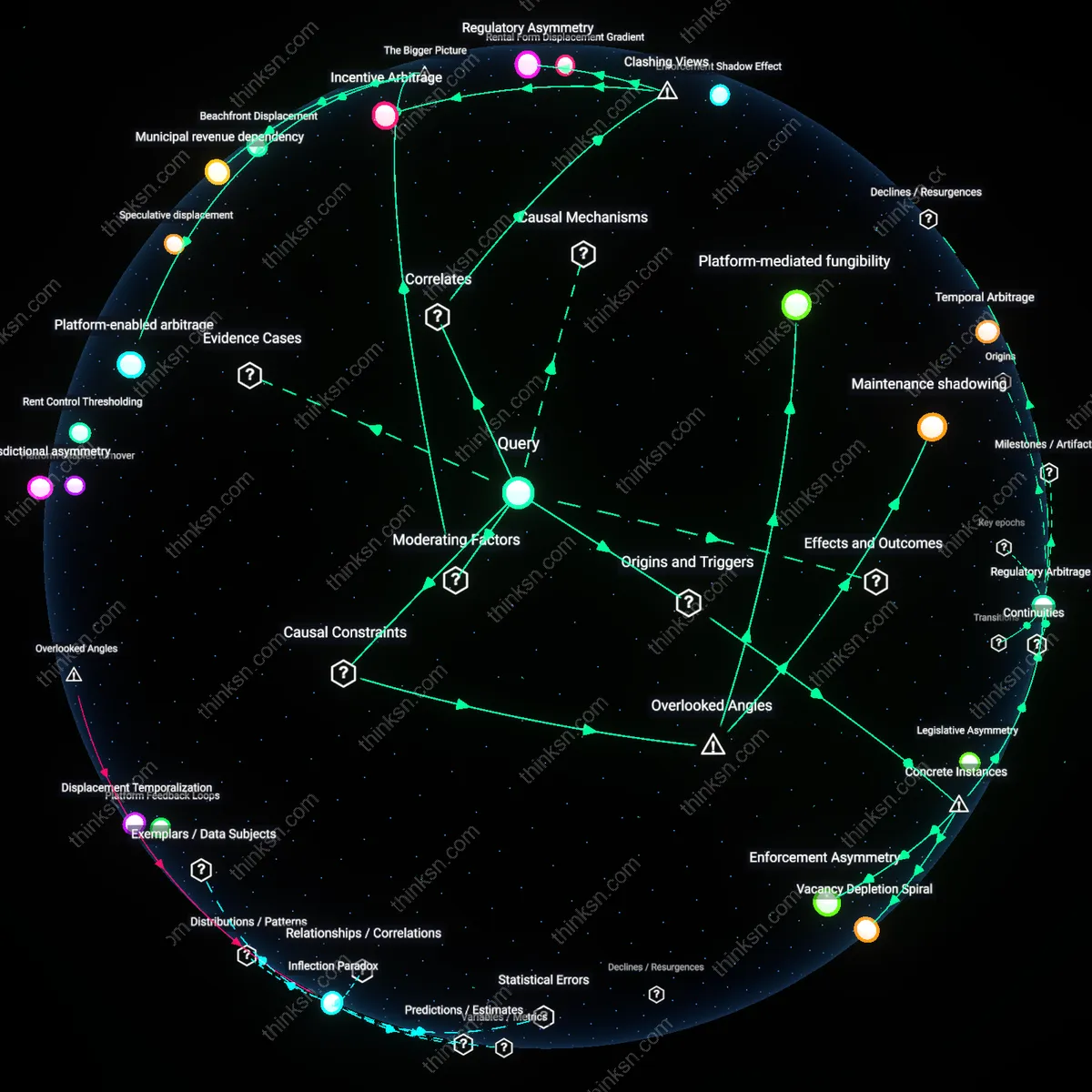
Analysis reveals 10 key thematic connections.
Key Findings
Regulatory Arbitrage
Rent control in San Francisco has exacerbated tenant instability by incentivizing landlords to convert long-term units to unregulated short-term rentals on platforms like Airbnb. When Proposition J (1979) capped rent increases for existing tenants but excluded new units or vacant properties from strict controls, it created a loophole where landlords profit more by evicting tenants and re-entering units into the unregulated market. This regulatory misalignment between long-term protections and short-term flexibility enables property owners to exploit gaps, reducing housing availability for stable residency. What is underappreciated is that rent control’s stabilizing intent is subverted not by noncompliance, but by rational compliance within fragmented regulatory tiers.
Vacancy Depletion Spiral
In New York City’s postwar rent stabilization system, tenant turnover has become a trigger for deregulation, leading landlords to systematically disinvest or harass tenants to force exits and convert units to market-rate or short-term rentals. Because rents can be permanently increased after a tenant leaves—especially if the unit exceeds income thresholds under the 1994 Vacancy Decontrol Law—landlords have a structural incentive to minimize long-term occupancy, counteracting the stability rent control promises. The case of real estate firms like Heritage Management, which converted hundreds of stabilized units in Brooklyn to illegal Airbnb rentals, reveals that the system’s design encourages erosion from within. The non-obvious insight is that stability depends not just on rent limits, but on the cost of vacancy to the landlord.
Enforcement Asymmetry
In Barcelona, where rent control was imposed in 2020 as a temporary emergency measure during the housing crisis, tenant stability deteriorated due to uneven enforcement between long-term and short-term rental regulations. While rent increases were capped in the Eixample district, penalties for illegal tourist apartment conversions remained minimal and inconsistently applied, allowing landlords to reclassify entire buildings as ‘tourist lodgings’ and bypass tenant protections. The city’s prosecution of only 11% of reported short-term rental violations between 2020 and 2022—despite over 5,000 suspected illegal units—reveals that legal frameworks fail when oversight capacity does not match regulatory ambition. The overlooked point is that control efficacy hinges not on statute but on the state’s ability to monitor and sanction noncompliant inventory in real time.
Enforcement asymmetry
Rent control undermines tenant stability when short-term rental enforcement is selectively applied, because city agencies often prioritize code violations in residential buildings over vacation rental crackdowns due to political pressure and limited resources. Landlords in high-demand neighborhoods, like San Francisco’s Mission District, exploit this gap by advertising units on platforms like Airbnb with minimal risk of penalty, effectively hollowing out long-term affordable housing. This dynamic reveals the non-obvious reality that regulatory design matters less than enforcement capacity and political will in determining housing outcomes.
Platform-enabled arbitrage
Rent control destabilizes tenancies when landlords use digital short-term rental platforms to bypass tenant protections, because apps like Airbnb lower the transaction costs of converting regulated units into informal hotels, especially in tourist-heavy zip codes like New Orleans’ French Quarter. The real estate ecosystem—including property managers, cleaning services, and review algorithms—creates a self-reinforcing market for evicting or pressuring tenants to leave, which intensifies displacement where platform activity is dense. This shift illustrates how technology can reconfigure traditional landlord incentives, turning regulatory protection into a vulnerability.
Municipal revenue dependency
Rent control fails to ensure tenant stability when cities become financially dependent on tourism taxes generated by short-term rentals, because municipal budgets in places like Santa Monica and Asheville increasingly fund public services through transient occupancy taxes, creating a fiscal incentive to tolerate illegal conversions. City councils may pass rent control laws under housing advocacy pressure, but weaken enforcement to avoid undermining a key revenue stream, particularly in off-season periods where rental turnover maximizes income. This exposes how local fiscal structures can silently override housing stability goals, aligning government action with market extraction over tenant protection.
Incentive Arbitrage
Rent control reduces legal rental returns, pushing landlords toward short-term rentals where price caps don’t apply, thereby increasing tenant displacement in flexible housing markets like San Francisco and Seattle. This shift occurs not through overt eviction but through regulatory leakage—landlords exploit zoning ambiguities and platform-mediated markets (e.g., Airbnb) to reclassify long-term units, weakening housing continuity despite stability intentions. The non-obvious mechanism is not landlord hostility but rational adaptation to divergent regulatory regimes, revealing how well-intentioned controls can foster opportunistic compliance rather than secure tenure.
Regulatory Asymmetry
Short-term rental platforms thrive in rent-controlled cities because enforcement resources target tenant violations more aggressively than commercial zoning breaches, allowing landlords in cities like Los Angeles and Portland to operate de facto hotels with minimal oversight. This enforcement tilt arises from bureaucratic incentives—housing inspectors prioritize rent overstay or subletting fines over harder-to-prove commercial use—enabling landlords to convert units not by defiance but through institutionalized neglect of cross-agency coordination. The overlooked reality is that rent control’s stability promise collapses not from lawbreaking but from bureaucratic misalignment that treats housing as a tenancy issue, not a land-use conflict.
Platform-mediated fungibility
Rent control undermines tenant stability when the ease of listing rent-controlled units on platforms like Airbnb transforms long-term leases into short-term arbitrage opportunities, bypassing physical renovation or legal conversion. The mechanism hinges on digital platforms reducing transaction costs for illegal short-term rentals, allowing landlords to treat regulated units as functionally interchangeable with unregulated tourist housing in cities like Barcelona or Lisbon, where a single landlord can manage dozens of units with automated tools. This erodes tenant stability not through formal eviction but through functional obsolescence of long-term leases, a shift rarely captured in housing statistics that assume physical vacancy rather than digital repurposing. The overlooked reality is that platform infrastructure, not zoning or ownership structure, becomes the hidden enabler of de facto deregulation.
Maintenance shadowing
Tenant stability declines under rent control when landlords preserve regulatory compliance on paper by maintaining a nominal long-term tenant while pocketing rent-controlled benefits and independently profiting from short-term rentals of shared spaces or adjacent units. This occurs in multi-unit buildings in cities like Berlin or Toronto, where a landlord-resident occupies the lease, blocks inspections, and uses unpermitted renovations to monetize short-term occupants without violating tenancy law directly. The causal bottleneck is the inability of regulators to detect occupancy patterns that appear compliant but systematically erode living conditions for nominal tenants. Most policy debates assume occupancy is either legal or illegal, missing how compliance can be performative — landlords sustain the form of rent control while hollowing out its function through spatial and social pressure tactics hidden in plain sight.