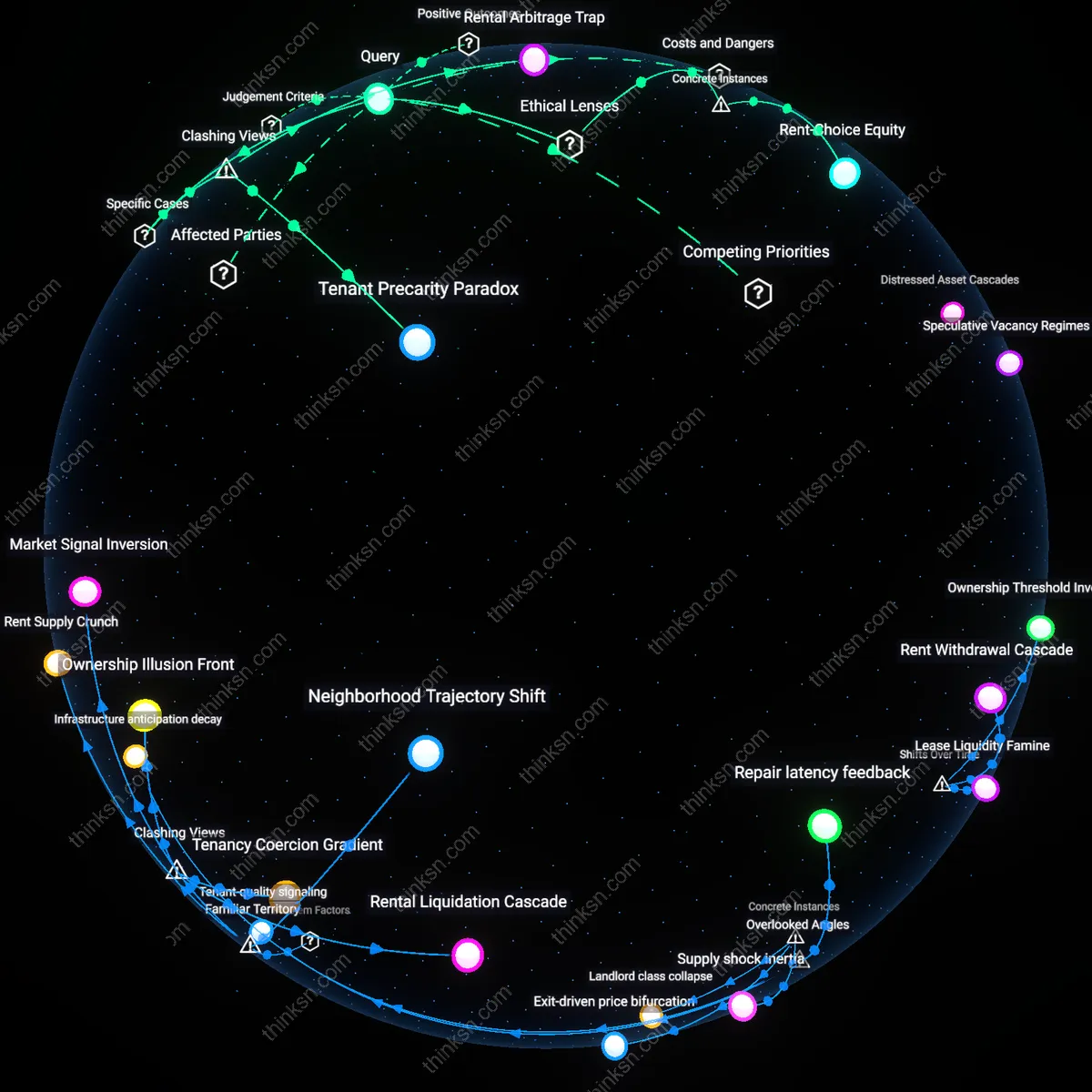
Lease Enforcement Cascade
Tenants withholding repair payments trigger formal lease violations, which landlords use to initiate evictions under standard rental contracts in cities like New York or Chicago, where rent compliance is legally tied to maintenance obligations. This mechanism activates a rigid enforcement chain in municipal housing courts, where nonpayment—regardless of justification—defaults to tenant liability, reinforcing landlord control through procedural dominance. The non-obvious reality is that repair disputes are rarely adjudicated on merit because the legal system prioritizes contractual compliance over habitability conditions, making defiance structurally self-defeating.
Maintenance Default Spiral
Widespread refusal to pay for landlord-covered repairs causes a withdrawal of capital from aging rental portfolios, especially in low-margin markets like Memphis or Buffalo, where property owners operate with thin reserve buffers. Without repair funds—whether withheld or simply uncirculated—critical systems like boilers, roofs, and plumbing decay irreversibly, accelerating building devaluation. The underappreciated dynamic is that tenants’ collective action inadvertently amplifies disinvestment, transforming protest into material decline, which then justifies rent reductions or abandonment, harming the very residents who initiated resistance.
Habitability Bargain Collapse
When tenants universally reject financial responsibility for repairs, the implicit social contract underpinning rental housing unravels—specifically, the understanding that landlords provide habitable shelter in exchange for rent, codified in places like Section 8 agreements or local code enforcement policies. This collapse reveals that regulatory enforcement relies on tenant reporting and cooperation; mass noncompliance removes the feedback loop that triggers inspections or fines. The overlooked truth is that the system functions not through law alone, but through the routine participation of tenants in their own regulation, making refusal a form of invisible system failure, not empowerment.
Repair deterrence
Collective refusal by tenants to fund landlord-mandated repairs triggers immediate deterioration in building maintenance, as property owners lacking cash flow delay or cancel essential work. This occurs in cities like New York or Chicago, where rent-controlled units already strain landlord profit margins, and absentee owners rely on tenant de facto subsidization of upkeep; the dynamic reveals how informal cost-shifting sustains housing stock—until collective noncompliance disrupts the equilibrium. The non-obvious insight is that tenant payments for repairs—though legally illegitimate—are systemically functional, making their withdrawal destabilizing despite being contractually justified.
Liability displacement
Landlords, facing unmet repair obligations, reassign responsibility through legal and bureaucratic channels, such as declaring buildings unsafe and petitioning municipal authorities to seize control under nuisance abatement laws. In cities with vacant property receivership programs—like Detroit or Philadelphia—this enables private owners to offload deteriorating assets to public agencies, converting private maintenance failures into public housing liabilities. The critical mechanism is the strategic invocation of code enforcement by landlords themselves, revealing how property abandonment can be an offensive tactic, not just a passive outcome, when tenant resistance disrupts expected capital flows.
Jurisdictional arbitrage
When tenant collectives withhold repair payments in jurisdictions with strong tenant protections, landlords respond by shifting investment to areas with weaker enforcement, such as suburban municipalities or unincorporated counties lacking rental inspection regimes. This capital repositioning—observed historically during rent control expansions in California and Oregon—demonstrates how local regulatory resilience is undermined by regional economic interdependence, where actors exploit policy asymmetries to preserve profit. The underappreciated force here is not evasion per se, but the structural capacity of property owners to leverage spatial fragmentation in governance to neutralize localized tenant gains.
Maintenance Informalization
Such collective refusal would accelerate the informalization of building upkeep, mirroring the shift observed in post-industrial U.S. cities like Detroit in the 1980s–90s, where municipal disinvestment and landlord abandonment transformed repair responsibility into a patchwork of tenant self-reliance, barter networks, and scavenged materials, revealing that when formal enforcement collapses, nonpayment doesn’t eliminate maintenance but displaces it onto socialized, invisible labor, exposing the hidden economies that emerge when legal accountability erodes but buildings must still function.
Landlord Exit Spiral
Mass refusal to fund landlord-covered repairs would initiate an exit spiral among marginal operators, akin to the withdrawal of private landlords from federally assisted housing after the 2008 foreclosure crisis, where sustained reduction in recoverable maintenance income accelerated asset divestment in already-declining markets, exposing how tenant financial resistance can compress the lifecycle of speculative ownership, hastening the transition from private tenancy to municipal receivership or nonprofit stewardship in weakened housing sectors.
Municipal Risk Backlogs
Local governments would quietly absorb repair costs to prevent structural failures that threaten public safety and liability exposure. Because building code enforcement agencies track deteriorating housing stock in high-density rental zones, a sudden spike in unaddressed repairs triggers risk assessments that redirect emergency mitigation funds—originally earmarked for natural disasters—to covertly subsidize landlord obligations. This shift is typically invisible, as municipalities reclassify interventions as 'public hazard abatements' rather than tenant-backed claims, thereby preserving legal plausible deniability while stabilizing the housing infrastructure. The overlooked mechanism here is that cities, not just landlords or tenants, are silent underwriters of rental habitability, and their risk-avoidance calculus can preemptively crowd out collective tenant action by internalizing its consequences.
Insurance Asymmetry Leverage
Property insurers would accelerate premium hikes and coverage exclusions in buildings where tenant nonpayment coalitions emerge, effectively penalizing landlords through risk-pool adjustments that indirectly pressure tenant retention. Since most rental properties are bundled into portfolio insurance contracts, a cluster of delinquent repair claims in one geographic area triggers algorithmic repricing across entire portfolios, making it cost-prohibitive for institutional landlords to maintain coverage unless they bypass tenant disputes and unilaterally fund repairs. This dynamic is rarely acknowledged because tenant movements focus on lease terms and not on the backstage insurance underwriting models—such as predictive claims scoring—that actually govern capital flow for maintenance. The real constraint on collective refusal may thus stem not from legal enforcement but from actuarial feedback loops that make neglect financially contagious.
Material Supply Chain Signaling
Distributors of building materials would begin tailoring inventory and delivery routes in response to neighborhood-level repair refusals, creating de facto scarcity that undermines self-organized tenant repair efforts. As bulk orders from contractors decline in areas with widespread nonpayment, regional suppliers reallocate stock to more profitable zones, which disproportionately affects tenants attempting DIY fixes due to their lack of trade accounts and delivery access. This logistical bottleneck reveals that repair capacity is not just a legal or financial issue but a spatially distributed infrastructure—one controlled by just-in-time supply networks that respond to market signals before policy or protest can intervene. The hidden dependency lies in the fact that the means of habitation are physically gated by commercial distribution systems that are indifferent to justice claims but highly sensitive to consumption patterns.
Rent Strike Alchemy
Collective refusal to pay for mandated landlord repairs transforms tenant debt from a tool of individual control into a currency of collective leverage, shifting the risk calculus in housing courts where mass non-compliance overwhelms eviction processing capacity, as seen in New York City Housing Court backlogs during 2020-2022 rent strikes. This mechanism flips the dominant narrative that nonpayment inherently weakens tenant position, revealing how synchronicity in default can destabilize the procedural predictability landlords and courts rely on, exposing the underappreciated role of judicial throughput as a structural pillar of property control.
Maintenance Debt Transference
When tenants collectively withhold repair payments meant for landlords, they inadvertently trigger insurance recalibrations that reclassify maintenance lapses as systemic risk factors, prompting carriers like FM Global or Zurich to raise premiums or exclude structural remediation in commercial real estate portfolios across urban markets such as Chicago and Oakland. This contradicts the intuitive assumption that tenant action only affects landlord liquidity, instead unveiling how distributed physical neglect can migrate up financial chains to alter risk modeling in asset-backed lending, a dynamic obscured by the conventional focus on lease-level enforcement rather than capital-market sensitivity to localized decay.
Repair Rights Inversion
Organized tenant refusal to fund statutorily mandated landlord repairs activates obscure building code enforcement prerogatives, enabling municipal agencies like Philadelphia’s Department of Licenses and Inspections to impose liens on delinquent properties that take priority over first mortgages, thereby subordinating bank claims to habitability compliance. This dismantles the common framing of tenant resistance as legally defenseless, exposing a latent municipal power to reposition public safety mandates above private debt obligations—a juridical hierarchy rarely invoked but structurally decisive when collective nonpayment triggers automated code violation cascades.