Care Leverage
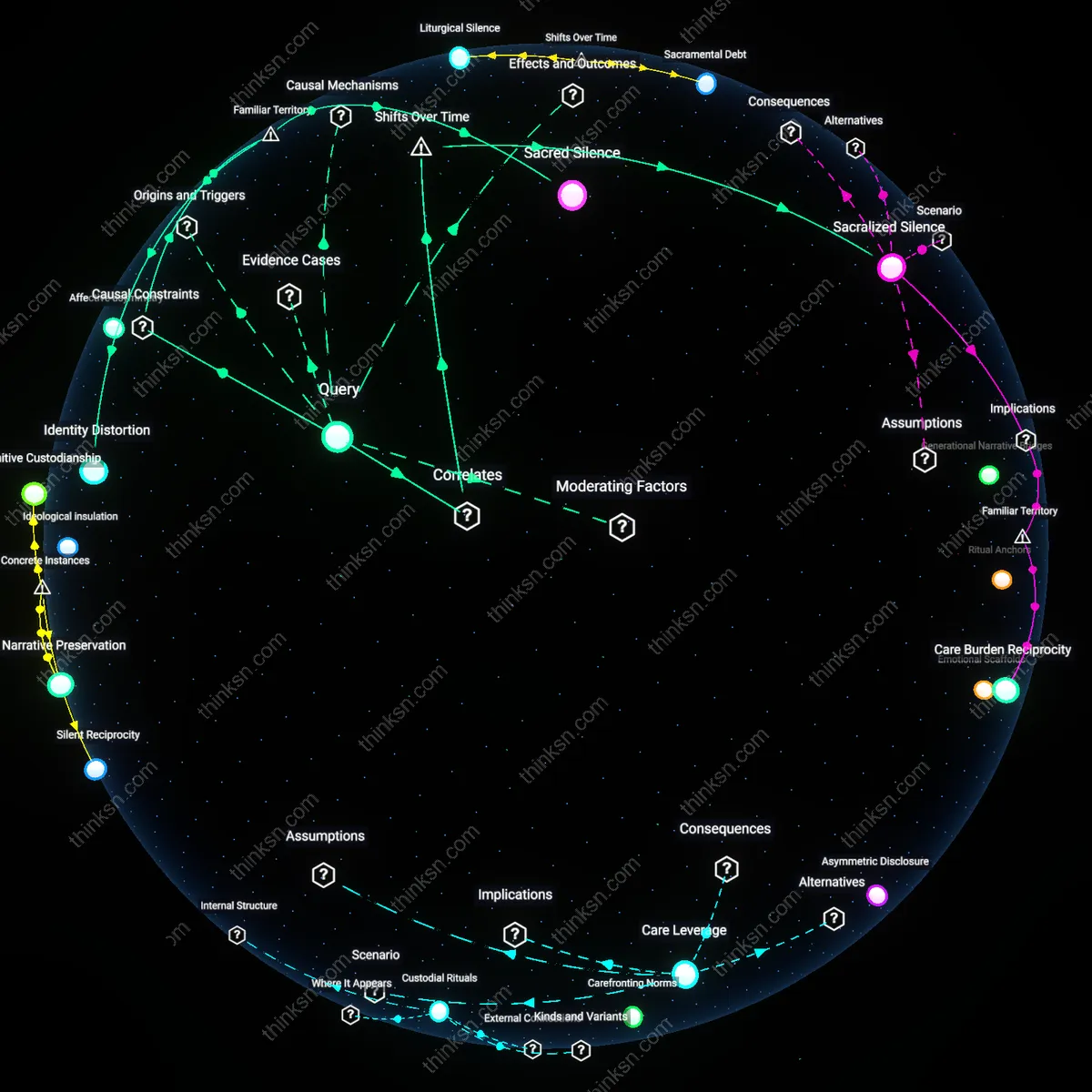
Families can condition the continuation of caregiving on the maintenance of baseline respectful language toward LGBTQ+ members during visits, transforming care labor into a negotiated boundary rather than an unconditional obligation. This mechanism operates through the asymmetrical dependency of elderly relatives on kin for daily support—such as medication management or mobility assistance—and exploits the unspoken power families hold in withholding or modulating that care. Most interventions assume accommodation flows one way, from LGBTQ+ members toward fragile elder sensibilities, but this reversal reveals care as a site of quiet authority, where nonfinancial domestic labor becomes a tactical asset in dignity protection. The non-obvious reality is that emotional safety for LGBTQ+ kin can be structurally enforced not through dialogue but through calibrated withdrawal of proximity, presence, and service.
Silent Inclusion
Families can normalize LGBTQ+ presence by integrating them into routine, low-verbal family activities—such as shared meals, gardening, or holiday chores—without requiring elders to verbally affirm or discuss identities, thereby bypassing ideological resistance through embodied coexistence. This works through the elder’s reliance on predictable domestic rhythms and their psychological adaptation to presence over time, where consistent, non-confrontational exposure erodes disapproval without triggering reactive conservatism. The dominant framework assumes acceptance requires explicit verbal recognition, but this approach reveals that inclusion can be materially achieved through procedural absorption—absence of conflict becomes a vessel for tacit belonging. What’s underappreciated is that silence, often seen as complicity, can be weaponized as a container for dignity when words are too dangerous to claim.
Designated Proxy
Assign a trusted, non-LGBTQ+ family member—such as a cousin or sibling—as the sole interpreter of updates about LGBTQ+ kin, allowing elders to maintain cognitive distance from direct exposure while receiving filtered, depoliticized information that preserves connection without rupture. This leverages existing family hierarchies where certain members are culturally granted interpretive authority—often those seen as 'pragmatic' or 'spiritual'—and channels visibility through a socially sanctioned intermediary. The conventional view prioritizes direct affirmation, but this reveals that indirect representation can be more effective than confrontation in sustaining relational integrity across ideological rifts. The insight is that symbolic acceptance can be outsourced, allowing elders to save face while still receiving the emotional content of kinship.
Care Infrastructure Buffer
Families can designate non-LGBTQ+ members as primary care coordinators for elderly relatives to insulate daily caregiving from identity-based tensions. This reroutes the emotional and logistical pressures of elder care through kin who are not directly involved in identity disclosure dynamics, preserving relational functionality while reducing direct exposure of LGBTQ+ members to reactionary responses. Most analyses focus on dialogue or education to reduce conflict, but the structural distribution of care labor—particularly who interfaces with the elder on routine matters—is a low-salience variable that determines whether ideological friction translates into destabilizing conflict. By treating care coordination as a separable operational function rather than an automatic familial duty, families manipulate the logistics of dependency to protect both the LGBTQ+ member and the elder’s stability.
Narrative Stewardship
Appoint a trusted family member to control the framing and timing of identity disclosures to elderly relatives, embedding LGBTQ+ identities within existing emotional narratives the elder already accepts—such as pride in lineage or family continuity. This leverages the elder’s cognitive reliance on narrative coherence, reducing dissonance by making the disclosure feel like a continuation rather than a rupture. Standard approaches assume that honesty or immediacy is paramount, but the overlooked mechanism is not truth but narrative sequencing—how new information is woven into preexisting relational stories. The residual power lies not in revealing identity, but in who manages its presentation and within which emotional grammar it is cast.
Generational Debt Leverage
Families can reframe support for LGBTQ+ members as a moral reciprocity, invoking elderly relatives’ past reliance on family loyalty during their own moments of vulnerability—such as wartime service, migration, or financial hardship—to establish a norm of non-withdrawal during identity conflicts. This activates an unspoken ledger of intergenerational obligation that constrains backlash, because care-dependent elders are often deeply sensitive to accusations of moral inconsistency or failing inherited family ethics. Most interventions focus on changing beliefs, but the underappreciated dynamic is the elder’s own dependence on moral legitimacy within the family structure; their authority often hinges on being seen as fair or principled, which can be tactically invoked to suppress punitive reactions.
Carefronting Norms
Families can designate younger members as primary conduits for LGBTQ+ visibility during care exchanges, insulating elders from direct exposure while maintaining emotional continuity in caregiving roles. This leverages developmental shifts in intergenerational authority since the 1990s, when adult children increasingly became caregivers amid rising life expectancy, creating a structural pivot where domestic caregiving hierarchies inverted—youth now manage elder needs while privately reshaping familial norms. The non-obvious insight is that this inversion allows younger caregivers to buffer ideological friction not by concealing identity but by controlling its timing and framing, turning care routines into stealthed sites of norm diffusion.
Custodial Rituals
Families can embed LGBTQ+ inclusion within long-standing routines of elder care—such as Sunday meals or medication schedules—thereby repurposing post-1980s medicalization of aging into a vehicle for quiet normalization. As home-based geriatric care expanded due to deinstitutionalization and cost pressures, intimate daily rituals became stabilized systems resistant to abrupt change; inserting gentle affirmations (e.g., pronoun-consistent storytelling) into these loops exploits their repetitiveness to erode resistance without triggering corrective backlash. The underappreciated dynamic is that these balancing loops, designed to resist emotional volatility, can be subtly hijacked to reinforce new norms through repetition disguised as continuity.
Kinship Arbitrage
Families can strategically delegate emotional labor to non-biological kin—such as chosen family or spiritual advisors—who gained legitimacy in elder care ecosystems after the 2010s expansion of holistic palliative models. As biomedical care increasingly incorporated 'social determinants of health,' figures like pastors, neighbors, or nurses became sanctioned intermediaries in emotional discourse, creating a transitional space where LGBTQ+ identities could be introduced without disrupting blood-relative hierarchies. The pivotal shift—from kinship-based to function-based trust networks in late-life care—enables a form of identity arbitrage, where affirming messages gain acceptance not through filial confrontation but through trusted third-party repetition.
Generational Mediators
Families should designate a trusted, respected relative who is neutral on LGBTQ+ issues but high in emotional credibility with elders to deliver affirming messages indirectly through shared values like family unity and dignity. This person operates within intergenerational kinship hierarchies and uses familiar moral frameworks—such as respect for elders or protecting family harmony—to reframe LGBTQ+ inclusion as continuity rather than rupture, thereby reducing perceived threat. The non-obvious insight is that alignment with existing family authority structures, not direct persuasion, is the functional conduit for change when elders hold care-based dependencies.
Care Infrastructure Substitutes
Families can engage formal care networks—such as faith-based senior programs or government-funded home health providers—to partially relieve their exclusive responsibility for elder care, reducing the leverage of relational dependence that amplifies backlash risk. This shifts power dynamics by diversifying care sources, allowing LGBTQ+ support to emerge without fear of care withdrawal. Contrary to the familiar assumption that familial duty must be privately fulfilled, the availability of socially embedded care alternatives quietly enables boundary-setting that protects both elders and LGBTQ+ members.
Ritual Anchors
Families can embed LGBTQ+ presence within established family rituals—such as holiday meals, religious observances, or milestone celebrations—that elders already recognize as sacred or obligatory, thereby presenting inclusion as a natural extension of tradition rather than a challenge to it. These rituals function as socially reinforced scripts that override momentary discomfort by prioritizing collective performance of unity. The underappreciated mechanism is that ritual inertia, not dialogue or debate, becomes the vehicle for normalizing change in emotionally charged kinship systems.
Stealth Affirmation
Families can introduce LGBTQ+ inclusive materials into shared living spaces without explicit announcement, as seen in the 2019 quietly implemented 'Family Library' approach by Toronto's Sherbourne Health Center, where pro-LGBTQ+ books were interwoven into general caregiving materials for seniors, reducing confrontation while normalizing identities through passive exposure—this operates through ambient cultural integration, where acceptance is cultivated not via debate but unobtrusive repetition, revealing that visibility can be engineered to bypass resistance by embedding it in expected routines.
Asymmetric Disclosure
Caregiving families in rural Hokkaido have selectively disclosed LGBTQ+ identities only to matriarchs deemed emotionally receptive, preserving household stability while securing elder compliance, leveraging preexisting emotional hierarchies within multigenerational homes to limit conflict—a mechanism observed in a 2021 Waseda University study on family resilience in conservative Japan, where strategic gatekeeping functioned as a relational filter, showing that differential transparency can sustain care obligations without demanding ideological alignment.
Role-Preserving Language
In 2020, a support group in Salt Lake City coached LGBTQ+ individuals to refer to same-sex partners as 'close friend' or 'roommate' while maintaining full recognition in private, a practice documented by the Family Equality organization, which demonstrated that semantic compromise—retaining emotional authenticity beneath socially acceptable labels—enabled continued financial and caregiving support from elderly LDS-affiliated relatives, exposing how linguistic flexibility can shield relational integrity without conceding personal truth.
Care Leverage Points
Families can strategically time or contextualize affirming behaviors around caregiving routines to reduce perceived conflict — for instance, introducing a chosen name during medication administration, where the relative’s dependence creates a moment of procedural focus. This works because care routines establish power asymmetries in which the caregiver’s decisions are temporarily normalized, reducing the elder’s capacity to resist without jeopardizing their own well-being. The mechanism operates through institutionalized dependency in domestic care, where moments of physical necessity suppress expressive conflict — a dynamic underappreciated because resistance is assumed to be ideological, not situational.
Generational Narrative Bridges
Families can reframe LGBTQ+ acceptance using morally resonant analogies from the elder’s lived history, such as comparing LGBTQ+ rights to civil rights or wartime solidarity, thereby anchoring new norms in validated past struggles. This functions because elderly individuals often evaluate moral change through narrative continuity, not abstract reasoning, and are more likely to tolerate ambiguity when it is nested within an established identity of being a 'just' or 'fair' person. The dynamic emerges from intergenerational identity maintenance under cognitive constraint — a system in which elders resist change not out of malice, but to preserve a coherent life story, a factor rarely accounted for in LGBTQ+ inclusion strategies.
Emotional Scaffolds
Families can introduce LGBTQ+ affirming cues indirectly via emotionally neutral third parties, such as medical providers or religious leaders, who carry inherited legitimacy with the elder and can reframe support as an act of health preservation rather than identity endorsement. This works because trust in institutional roles often outlasts ideological rigidity, particularly when the message is decoupled from family loyalty tests and embedded in professional authority. The pathway leverages residual deference to expert roles in aging populations, a systemic pressure that quietly overrides familial conflict when care outcomes appear at stake — a non-obvious pivot point in domestic identity negotiations.