How to Honor a Parent’s Wish While Ensuring Their Safety?
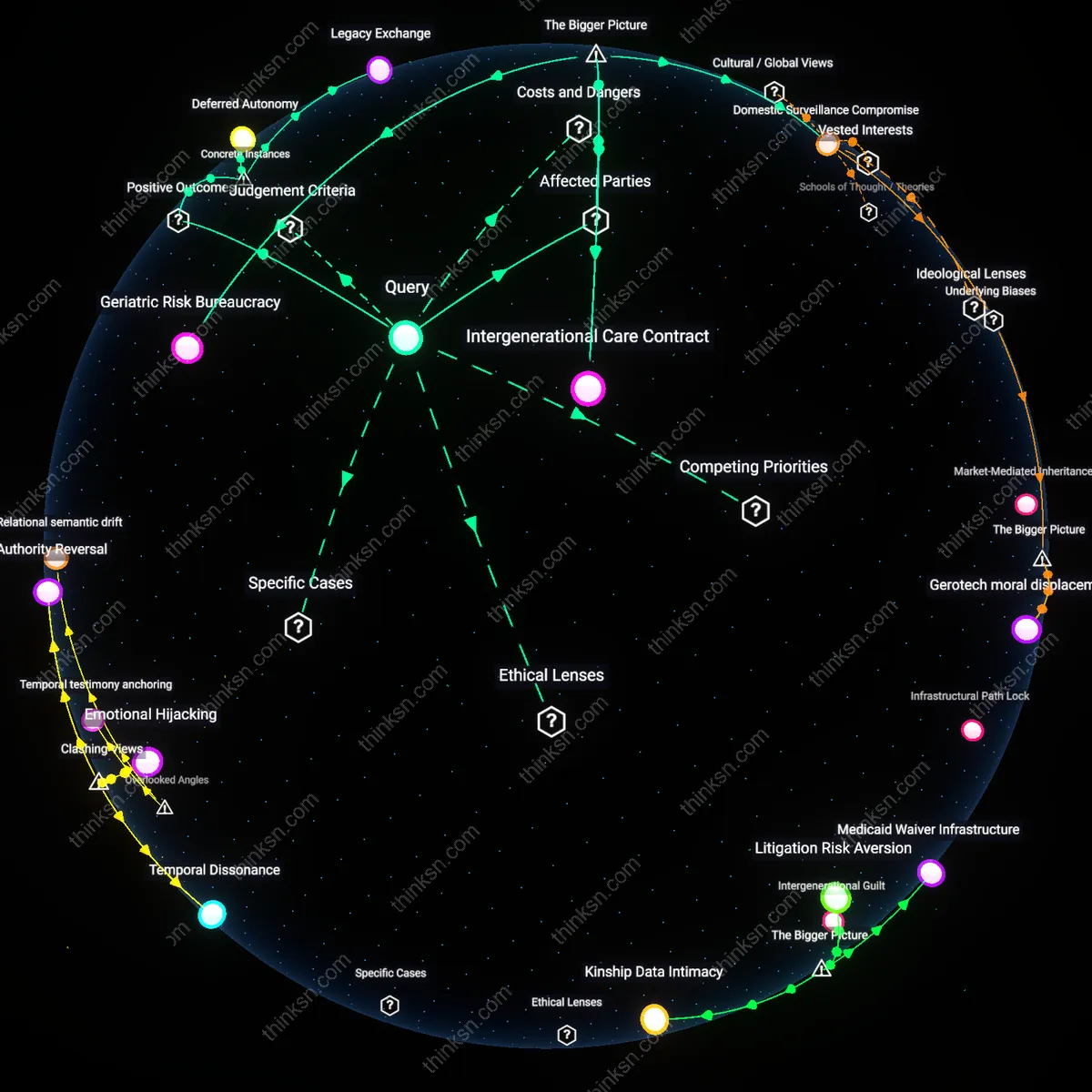
Analysis reveals 6 key thematic connections.
Key Findings
Intergenerational Care Contract
Adult children can honor both safety and autonomy by renegotiating the implicit intergenerational care contract through co-created safety agreements that integrate home modifications, remote monitoring, and family-supported routines. This approach works because adult children and parents jointly participate in a long-standing reciprocal arrangement—rooted in cultural expectations and past caregiving histories—where deviations like institutionalization rupture mutual understandings; by treating care as a negotiated, evolving obligation rather than a fixed outcome, families leverage trust built over decades to sustain independence without abandoning oversight. The non-obvious insight is that the moral distress stems not from logistical failure but from perceived betrayal of a relational contract, making its renegotiation more effective than unilateral risk management.
Geriatric Risk Bureaucracy
Adult children preserve moral integrity by engaging geriatric care managers to mediate transitions, transforming personal moral conflict into a systemic assessment of risk thresholds and eligibility criteria embedded in home- and community-based services (HCBS) programs. These professionals operate at the intersection of Medicaid waivers, local health departments, and elder safety protocols, reframing the decision as one governed by standardized assessments rather than familial judgment; this depersonalizes the recommendation and shifts the burden of justification from the child to an institutional authority. The underappreciated dynamic is that moral legitimacy in care transitions often derives not from emotional authenticity but from procedural authorization within a risk-managed elder care infrastructure.
Domestic Surveillance Compromise
Families can defer institutionalization by installing ambient monitoring technologies—such as motion sensors and AI-driven anomaly detection—that enable passive oversight while preserving the parent’s physical autonomy in their home, effectively substituting institutional vigilance with decentralized digital supervision. This works because commercial elder-tech companies have aligned with insurance providers and regional Area Agencies on Aging to subsidize these tools under 'aging in place' initiatives, creating a hybrid care model where data replaces direct human presence. The overlooked consequence is that moral integrity is sustained not through resistance to surveillance but through its domestication, turning the private home into a morally palatable, institutionally supported monitoring environment.
Deferred Autonomy
The Veterans Affairs’ Veterans Directed Home and Community-Based Services (VD-HCBS) program in Milwaukee enables veterans like Mr. Johnson, a 78-year-old with progressive dementia, to direct their own care through a budget they control, delaying institutionalization while ensuring safety through regular nurse visits and emergency response systems, revealing that structured fiscal agency in familiar environments can align parental self-determination with objectively monitored caregiving thresholds; this mechanism operates through the U.S. Administration on Aging’s cash-and-counseling model adapted for veterans, channeled via case-managed allocations that fund family-assisted home modifications and hourly aides, a non-obvious finding being that autonomy is preserved not by resistance to oversight, but by its conversion into a customizable, monitored, and portable entitlement.
Crisis Bridge Protocol
In 2017, the On Lok Lifeways program in San Francisco transformed elder care transitions by integrating geriatric mobile response teams that intervene during acute behavioral episodes in seniors refusing institutionalization, such as when Ms. Alvarez, a 92-year-old with paranoia and falls, received a 72-hour care stabilization unit deployment rather than police escort or forced admission, demonstrating that emergency clinical presence can convert rejection into engagement by offering temporary wrap-around services under the existing roof; this operates through PACE (Program of All-Inclusive Care for the Elderly) funding streams and licensed interdisciplinary teams who negotiate care agreements during de-escalation, revealing that perceived opposition to institutionalization often masks distrust in abrupt rupture rather than refusal of support itself.
Legacy Exchange
The Minka Project in rural Kyoto repurposed ancestral family homes (minka) into licensed small-scale care units where aging parents, like Mr. Tanaka of Nara Prefecture, agreed to relocate within their own village compound into a remodeled annex staffed by community-trained caregivers, thus satisfying cultural imperatives of filial presence while meeting safety standards, a model enabled by Japanese 2000-era Long-Term Care Insurance reforms that subsidize decentralized care infrastructure; this arrangement functions through intergenerational property succession negotiations where adult children contribute parent-held land or home assets in exchange for regulated, proximate supervision, exposing that moral integrity is maintained not by location per se but by continuity of relational and spatial narrative.