Careload Inflation
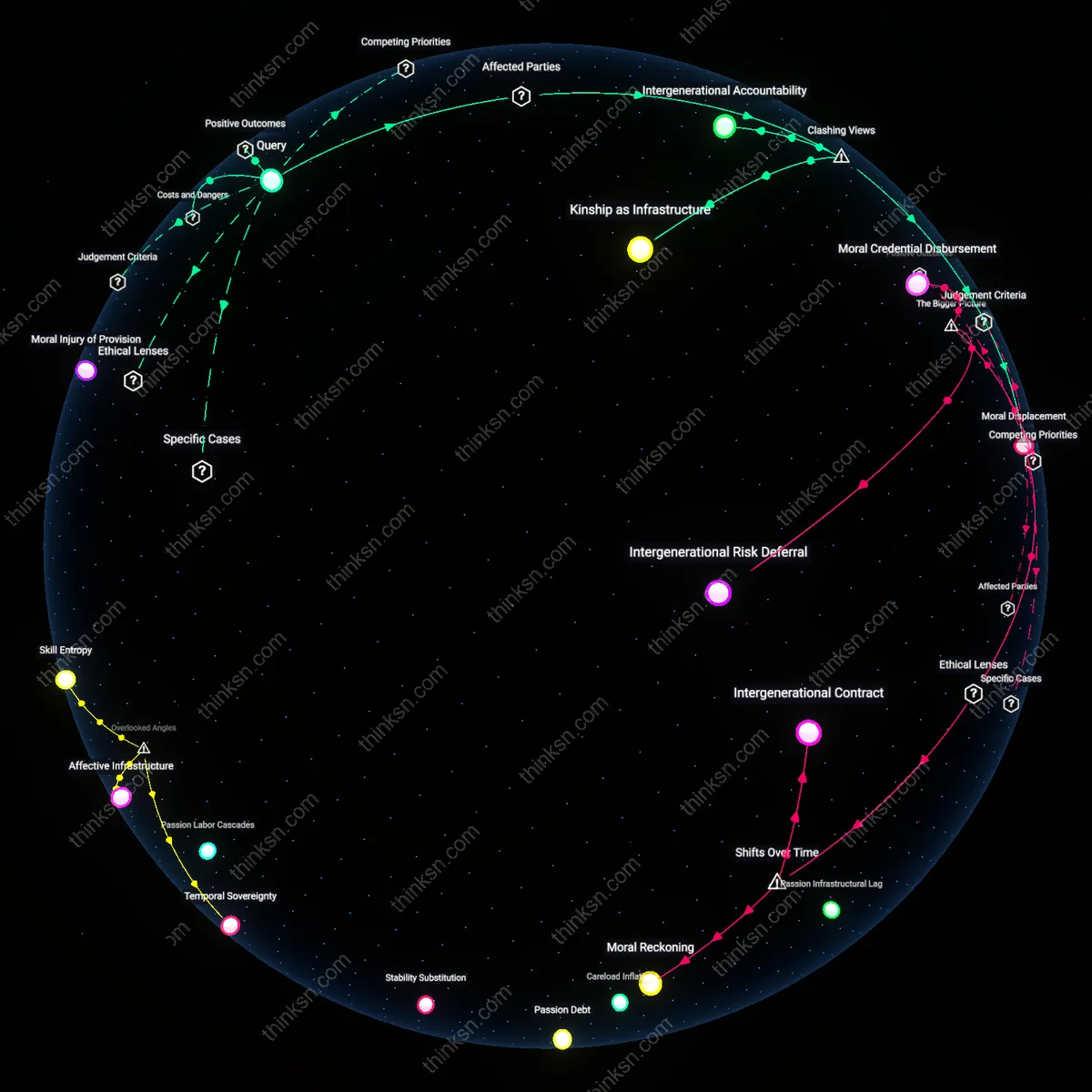
Passion-driven work in shared housing communities intensifies the demand for caregiving labor even as income stability declines, because emotionally intensive vocations—like art, activism, or trauma-informed healing—generate greater emotional residue that spills into communal domestic spheres. This creates a silent tax on caregivers, often women or elderly members, who manage both their own passion projects and the psychological aftermath of others', eroding the presumed harmony between autonomy and collectivism. The non-obvious outcome is not liberation from capitalist labor but a hidden redistribution of reproductive burden masked as personal fulfillment.
Passion Debt
When individuals in communitarian living arrangements prioritize passion over stable incomes, they inadvertently accumulate implicit obligations to the group—compensating for lost wages through extended service shifts, deferred personal projects, or heightened emotional availability—creating a moral economy where passion becomes a form of indebtedness. Unlike financial debt, passion debt is unquantified but socially enforced, binding members to the collective through guilt rather than rent, which destabilizes exit options and replicates coercive dynamics under the guise of mutual care. This reveals how economic risk-sharing can morph into affective leverage, subverting the autonomy such communities claim to enable.
Stability Substitution
In communal settings where shared housing and caregiving exist, passion-driven work does not eliminate the need for stability—it displaces it from individual income to relational predictability, making the continuity of personal relationships the primary economic infrastructure. When members shift to unstable creative livelihoods, the community begins to value emotional constancy and conflict avoidance over authenticity or artistic growth, leading to the suppression of dissent and risk-averse social norms that mimic corporate conformity. The irony is that the system designed to escape conventional labor discipline creates a new one, policed not by managers but by the unspoken demand to preserve group cohesion at all costs.
Care Infrastructure Externalization
Shared housing and caregiving networks will absorb the financial and emotional risks of unstable income when individuals pursue passion-driven work. In communities like intentional co-housing collectives in Portland or Barcelona’s eco-districts, where meals, childcare, and elder support are pooled, the household as an economic unit shifts from a private to a collective liability structure—making personal income volatility a managed externality rather than a familial crisis. This reframes what is usually seen as personal financial irresponsibility as a socially coordinated trade-off, revealing how moral judgments about work stability depend on the presence of invisible care buffers.
Passion Labor Cascades
When more people in tightly knit, resource-sharing communities shift to passion-driven livelihoods—such as artisan craft, permaculture, or community theater—it triggers a normative cascade where non-market values begin to set local economic expectations, as seen in Black Mountain, North Carolina or Findhorn, Scotland. This alters family support systems not by replacing them, but by redefining what counts as 'contribution,' where emotional mentorship or skill-sharing becomes currency, displacing income-based validation. The underappreciated consequence is that familial roles evolve from providers and dependents into curators of cultural capital, subtly eroding the wage-labor benchmark of worth.
Intergenerational Reciprocity Loops
In communities with established shared housing and caregiving, like certain Buddhist intentional communities in California or secular kibbutzim in Israel, trading stable income for meaningful work recalibrates family support as a temporally distributed exchange rather than immediate aid. Elders’ past contributions to communal infrastructure grant them claims on present care, while younger members’ passion projects are underwritten as future cultural or social dividends. What’s rarely acknowledged in mainstream discourse is that this transforms family obligation from a vertical lineage model into a cyclical, time-shifted economy of mutualism—where support flows not just upward or downward but across lifecycles.
Caregiving Surplus
Shared housing collectives in the Pacific Northwest during the 2010s enabled non-market labor reciprocity, allowing members to exit wage-dependent roles without collapsing family support—this emerged as communal caregiving infrastructures, once informal, became intergenerational anchors under late capitalist disinvestment in social services, revealing a non-market resilience that redistributes reproductive labor as collective wealth rather than private burden.
Passion Inflation
As creative-sector entrepreneurs in Berlin’s artist communes post-2015 increasingly equated meaningful work with legitimacy in social housing governance, passion became a currency for access to care networks, distorting familial support systems by privileging culturally validated 'vocations' like art or activism over other forms of contribution, exposing how autonomy in labor can replicate exclusionary hierarchies within ostensibly egalitarian communities.
Kinship Recalibration
In the wake of the 2008 financial crisis, cohousing models in Denmark evolved from elder-care experiments into multi-generational family surrogates, where wage withdrawal was sustainable only because legally codified caregiving rotations replaced filial obligation, demonstrating that when state and kinship responsibilities merge into designed community protocols, the emotional logic of family shifts from bloodline to structured mutualism.
Communal Reciprocity Threshold
In Auroville, India, residents who transition from salaried work to art, education, or spiritual practice rely on a collectively managed housing and childcare system that sustains passion-driven livelihoods only up to a critical mass—beyond which free-rider problems and resource strain weaken support structures. The community’s reliance on voluntary labor and donation-based funding created an implicit ceiling on participation; when too many members exited income-generating roles without replacing lost capital flows, the shared economy required recalibration. This reveals that alternative family support systems depend not just on available infrastructure but on a delicate balance between contributors and dependents within localized economies.
Passion Infrastructural Lag
In the Findhorn ecovillage in Scotland, early adopters of low-income spiritual and ecological work were supported by a well-developed shared housing and caregiving network built in the 1970s, but newer residents seeking similar transitions in the 2010s faced longer waiting lists for community housing and overwhelmed childcare collectives—demonstrating that passion-driven shifts can outpace the adaptive capacity of support systems. The original infrastructure was designed for gradual growth and stable demographics, not for waves of external entrants pursuing similar lifestyle changes. This shows that even functional communal safety nets suffer lag effects when demand shifts qualitatively or quantitatively, disrupting intergenerational caregiving continuity.
Temporal Sovereignty
Increased passion-driven work in communal settings would undermine the intergenerational transfer of temporal sovereignty, as elder care shifts from obligation-based scheduling to project-based coordination among peers. When income-stability dissolves, elders no longer rely on adult children’s predictable pay cycles to time medical visits, housing transitions, or medication renewals; instead, care rhythms align with fluctuating creative cycles—such as harvests of artistic output or communal sabbaticals—making support discontinuous and expectation-dependent. This reorders kinship not around duty but rhythmic attunement, a mechanism rarely modeled in family resilience literature, which presumes stable temporal anchors. The overlooked dynamic is that economic instability reintroduces time as a negotiated, rather than inherited, inheritance.
Affective Infrastructure
Passion-driven livelihoods in shared-housing enclaves would reposition emotional availability as the primary currency of caregiving, eroding the tacit reliance on financial proxies for responsibility. In stable-income families, money substitutes for presence—rent paid, insurance covered, groceries delivered—allowing physical absence to coexist with perceived reliability; but in passion economies, where cash flow is erratic, the only measurable contribution becomes time spent, mood regulated, or conflict soothed. This forces affective labor into the foreground as infrastructure, not add-on, altering family power dynamics around who can afford emotional generosity. Most analyses miss that when money stops masking absence, emotional consistency becomes both the metric and medium of kinship obligation.
Skill Entropy
As more individuals leave stable jobs for passion work within caregiving collectives, foundational domestic competencies—like budget forecasting, bureaucratic navigation, or crisis triage—decay from disuse, creating skill entropy that destabilizes community resilience during external shocks. These competencies are often silently maintained by marginally employed or traditionally minded kin who anchor the household in institutional logic; their exit into pure passion roles leaves care systems fluent in emotional reciprocity but brittle when facing legal, medical, or financial system interfaces. The overlooked dependency is that passion sustainability relies on the invisible maintenance of unglamorous procedural knowledge—routinized competence that rarely registers in discussions of communal autonomy, yet proves decisive in moments of rupture.