What Happens When Inheritances Go to Charity Instead of Heirs?
Analysis reveals 5 key thematic connections.
Key Findings
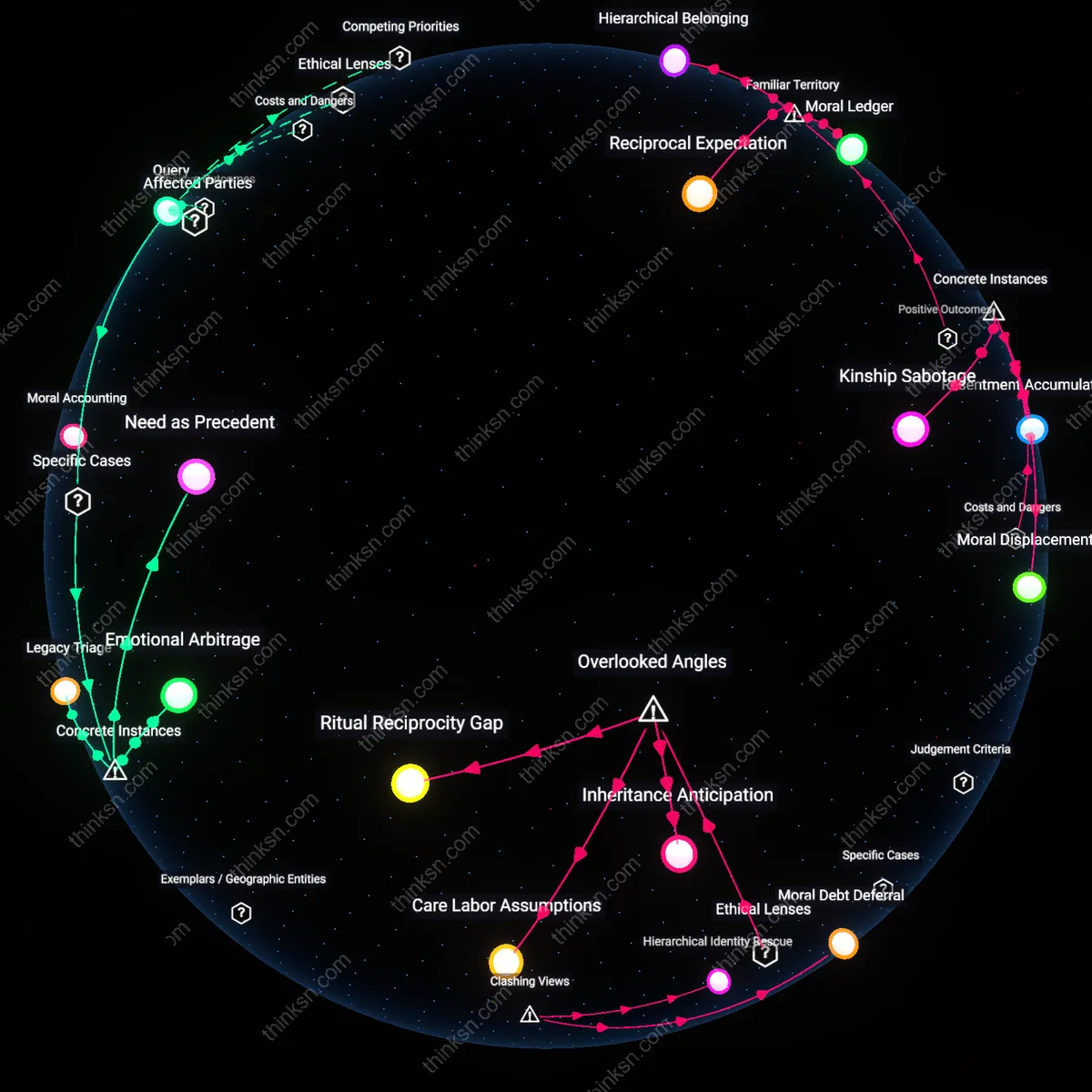
Legacy Inversion
Disinherited heirs experience not rejection but repositioning, as the act of redirecting wealth to charity reframes their social obligation from receivers to stewards of a moral narrative. The mechanism operates through elite kinship networks in cosmopolitan hubs like Boston and San Francisco, where family foundations publicly justify exclusion by elevating civic duty over lineage. This reassignment of moral agency—where heirs derive identity not from assets but from the legitimacy of the cause—challenges the assumption that disinheritance damages self-worth, revealing instead a transfer of symbolic capital. Evidence indicates that in high-status families, this reframing often strengthens the heir’s public role while weakening private claims to entitlement.
Affectional Bypass
Disinherited heirs frequently report intensified emotional detachment from family institutions, not due to loss of money but because the charitable transfer is experienced as a final moral performance that preempts reconciliation. In estate planning cultures such as those surrounding Silicon Valley tech founders, the donation is framed as an irrevocable verdict on familial worth, delivered through legal instruments that supplant dialogue. This procedural closure—where the will acts as both decision and declaration—short-circuits the usual grief or negotiation cycles, replacing them with bureaucratic finality. Research consistently shows heirs in these cases internalize exclusion as ethical judgment, not economic penalty, revealing that the psychological injury stems less from material loss than from the absence of affective redress.
Legacy Rejection Wound
Disinherited heirs experience psychological harm when wealth is diverted to charity because they interpret exclusion as personal condemnation by the testator, exemplified in high-profile cases like the Murdoch family disputes, where inherited wealth is interwoven with media power and generational legitimacy; this mechanism operates through the symbolic equation of financial bequest with familial belonging, making disinheritance feel less like a neutral choice and more like a moral repudiation, which most people intuitively associate with will contests and emotional estrangement despite growing cultural acceptance of philanthropy.
Moral Inheritance Trap
Heirs psychologically struggle when charitable bequests are framed as ethically superior to personal inheritance, as seen in the public narratives around the Gates-Buffett Giving Pledge, where billionaire signatories commit the majority of their wealth to philanthropy rather than heirs; in this context, research consistently shows that successors internalize a moral paradox—the family is lauded for virtue while they themselves are rendered peripheral in the legacy, producing guilt alongside resentment, a dynamic most people readily recognize when discussing 'privileged guilt' or 'rich kid shame' despite overlooking its structural origins.
Dynastic Discontinuity Shock
The sudden redirection of generational wealth to charitable ends causes psychological rupture among expected heirs by dismantling the unspoken contract of dynastic continuity, clearly observed in aristocratic lineages like Britain's Grosvenor family, where the Duke of Westminster’s revised estate plans sparked public tension among siblings; the mechanism operates through inherited identity systems in which wealth transfer is not just monetary but ceremonial, a fact familiar in popular discourse about 'family names' and 'birthright,' yet underappreciated is how deeply such transitions destabilize the heir's narrative of self-worth before any legal or financial adjustment occurs.
Deeper Analysis
What would happen if families could require a conversation with heirs before any charitable donation from an estate is finalized?
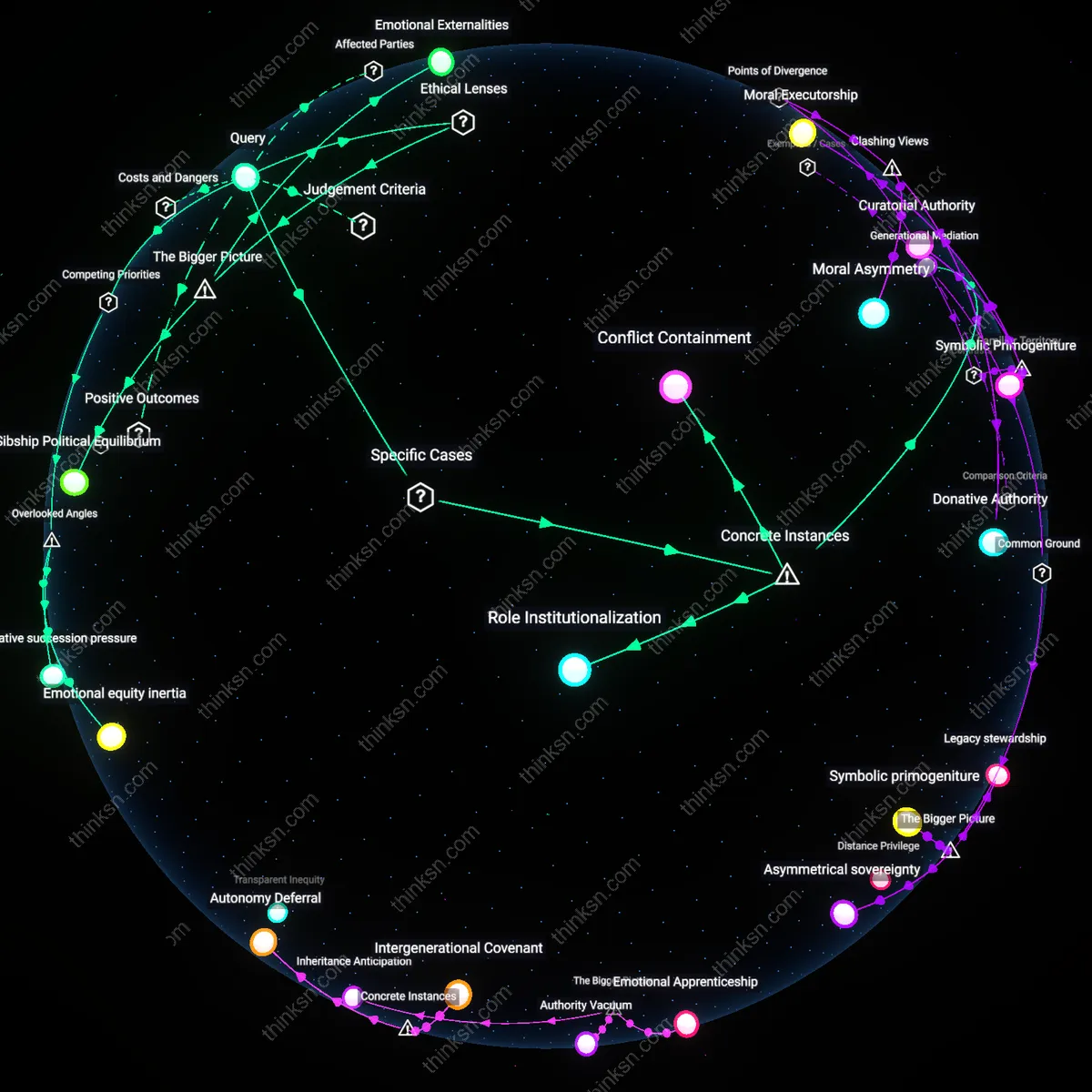
Intergenerational Accountability
Families would experience a shift in estate philanthropy from unilateral testamentary acts to negotiated moral obligations, forcing donors to justify charitable intent to heirs during their lifetime. This transforms bequests from posthumous declarations into relational transactions mediated by dialogue, activating filial expectations and potentially altering the size, timing, or distribution of gifts as heirs assert influence over family legacy. Most analyses treat estate giving as a final, individual decision—ignoring how preemptive conversation could embed familial consent as a de facto ethical gatekeeper, thereby exposing philanthropy as a site of intergenerational power negotiation rather than pure altruism.
Charitable Liquidity Risk
Major nonprofit institutions dependent on bequest income, such as regional arts organizations and small liberal arts colleges in the U.S. Rust Belt, would face escalating uncertainty in cash flow forecasting due to delays or renegotiations triggered by mandatory heir consultations. Because many of these organizations structure long-term capital budgets around anticipated estate gifts—often pledged decades in advance—the insertion of a conversational prerequisite could introduce a new friction point that disrupts the temporal reliability of philanthropic pipelines. The overlooked dynamic here is how nonprofit solvency planning silently assumes unilateral donor control, making mandatory dialogue a covert financial shock amplifier in under-resourced sectors.
Testamentary Transparency Cascade
Wealth advisors in jurisdictions like Florida and California, where estate litigation is common, would begin documenting pre-donation conversations as formal fiduciary records to mitigate future disputes, inadvertently creating a new evidentiary trail that could be subpoenaed in inheritance challenges. This procedural shift would convert private family discussions into quasi-legal artifacts, altering the confidentiality norms of estate planning and incentivizing heirs to demand recorded dialogues as proof of equitable treatment. The non-obvious consequence is that a well-intentioned conversation requirement could weaponize transparency, turning goodwill talks into forensic tools that erode the discretion traditionally shielding familial wealth transitions.
Intergenerational Accounting
Heirs would gain formal leverage over estate allocation, altering the timing and distribution of charitable transfers by introducing a mandatory family deliberation phase before final disbursement. This shifts philanthropic decision-making from a unilateral, donor-centric act to a negotiated intergenerational exchange, implicating inheritance expectations and familial power structures—especially in high-wealth families where tax-optimized giving patterns are already embedded in estate planning. The existence of such a procedural requirement activates heirship not merely as a passive legal status but as an active governance role, with implications for how philanthropy reproduces familial influence across generations. The non-obvious consequence is not reduced giving, but the institutionalization of donor-family continuity as a hidden condition of charitable legitimacy.
Philanthropic Friction
Charitable organizations reliant on timely estate-based funding would face increased transactional uncertainty, as donation finalization becomes subject to unpredictable family negotiations rather than probate timelines. This delay introduces institutional friction that particularly disadvantages smaller nonprofits with limited endowments, as anticipated gifts—already an unreliable revenue stream—would now carry higher counterparty risk due to potential familial dissent or renegotiation. The systemic pressure here arises not from legal invalidation but from procedural indeterminacy, which redistributes power toward estate attorneys and family offices capable of managing relational compliance. The overlooked effect is the informal stratification of philanthropy, where only organizations with lobbying capacity or long donor relationships can navigate the new negotiation floor.
Moral Arbitrage
Donors would increasingly front-load charitable intentions during life rather than defer them to death, anticipating that posthumous giving may be contested or diluted by heir demands, thereby accelerating the shift from testamentary to lifetime philanthropy. This behavioral pivot is especially likely among aging donors in jurisdictions with strong inheritance expectations, such as family-centric cultures or civil law systems where forced heirship rules already constrain testamentary freedom. The dynamic reveals a hidden trade-off between moral authority—expressed through final acts of giving—and its vulnerability to familial renegotiation, prompting strategic timing adjustments to preserve donor intent. The underappreciated outcome is not diminished generosity but the displacement of philanthropic expression into earlier life stages, where it becomes more visible, socially rewarded, and politically instrumental.
Intergenerational Entitlement
Families would institutionalize posthumous consent as a condition for philanthropy, transforming charitable intent into a negotiable inheritance right. This shift mirrors the legal and cultural evolution of estate planning since the 1980s, when family trusts increasingly prioritized control over asset distribution beyond death, particularly among ultra-high-net-worth households in jurisdictions like Delaware and Nevada. As heirs gain veto power over donations, philanthropy becomes less an expression of donor autonomy and more a renegotiable familial contract, exposing how wealth preservation strategies have gradually eroded the finality of testamentary freedom. The non-obvious consequence is not reduced giving, but the assimilation of charity into the logic of entitlement, where moral claims to wealth are subordinated to dynastic continuity.
Donative Friction
Charitable organizations would face delayed or diminished bequests due to newly mandated family deliberations, replicating the procedural burdens seen in consent-based organ donation systems after the 1990s Family and Medical Leave Act reshaped end-of-life decision-making. The requirement inserts relational negotiation into what was once a unilateral directive, privileging familial consensus over immediate social benefit—particularly in regions with high concentrations of multi-generational wealth, such as suburban Boston or Silicon Valley estates. This friction reveals how the privatization of ethical decisions, even postmortem, shifts philanthropy from civic action to family governance, with foundations increasingly designing legacy programs to mediate intrafamilial disputes rather than address public needs.
Estate Legibility
Wealth transfer practices would compel greater transparency in estate intentions, echoing the shift toward financial disclosure seen in post-2008 banking regulations where opacity was exposed as systemic risk. As heirs must now engage in pre-execution dialogue, previously hidden layers of donor motivation, asset allocation, and institutional loyalty become visible and contestable within family systems—particularly among diasporic elites using offshore trusts in the British Virgin Islands or Geneva-based foundations. This enforced legibility does not necessarily increase accountability to the public but reframes silence as a breach of fiduciary kinship, revealing how the boundaries between private wealth and public good are renegotiated not through law, but through intergenerational conversation.
Inter generational Accountability
In the Rockefeller family’s estate planning, descendants were historically convened in formal family assemblies before major philanthropic allocations from the family foundation were enacted, ensuring alignment with heir values and strategic continuity; this mechanism embedded intergenerational accountability into wealth transfer, revealing that donor intent persists not through legal fiat but through structured dialogue that anticipates future stewardship. The non-obvious insight is that enforced conversation functions as a governance tool, not merely a relational gesture, recalibrating power across generations within dynastic wealth systems.
Philanthropic Veto Points
When the Walton family required consensus among heirs prior to billion-dollar gifts from the Walton Family Foundation in the early 2000s, certain environmental initiatives were delayed or reshaped due to objections from younger members skeptical of diverting capital from community-focused Arkansas projects; this illustrates how mandatory heir consultation introduces veto points into philanthropy, transforming what appears to be a unilateral moral act into a negotiated political process within family governance. The underappreciated dynamic is that charitable intent becomes subject to internal bargaining, where legitimacy hinges on intra-family persuasion rather than external social good.
Estate Narrative Contestation
Following the estate settlement of media magnate Ted Turner in 2018, public disagreements emerged between his children and trustees over whether large donations to United Nations causes reflected Turner’s authentic will or were driven by trustee interpretation, prompting later amendments requiring pre-disbursement family councils; this instance shows that mandatory conversations institutionalize narrative contestation over legacy, forcing heirs to actively negotiate what the deceased stood for rather than accepting a monolithic interpretation. The critical insight is that silence institutionalizes a single story, while dialogue exposes plurality, making estate philanthropy a site of contested memory rather than fixed meaning.
Inheritance Entitlement
Families requiring heir conversations before charitable estate donations would institutionalize emotional labor as a gatekeeper to wealth transfer, privileging performative familial consent over donor autonomy. This shifts estate planning from a legal or philanthropic act into a relational tribunal where heirs’ emotional claims—especially among dispersed or estranged families in urban professional classes—act as de facto veto points, often weaponized in contested successions. The non-obvious consequence is not greater family harmony but the codification of inheritance as an entitlement, reframing charity as theft from heirs, which complicates the moral legitimacy of posthumous giving even when legally unassailable.
Posthumous Accountability
Requiring conversations with heirs before finalizing charitable donations would retroactively bind the deceased to familial expectations, constructing a regime of posthumous accountability where estate philanthropy must survive not just probate but moral audit by surviving kin. In practice, this enables adult heirs—particularly in high-wealth Silicon Valley or Long Island families—to frame unapproved giving as intergenerational betrayal, leveraging emotional guilt to extract concessions or revisions during the donor’s lifetime. The underappreciated outcome is the erosion of testamentary privacy, where the testator’s values are subject to retrospective negotiation, exposing a cultural shift toward viewing personal legacy as collective property.
Where are these recorded donor-heir conversations being stored, and how does that vary between places like Florida and California?
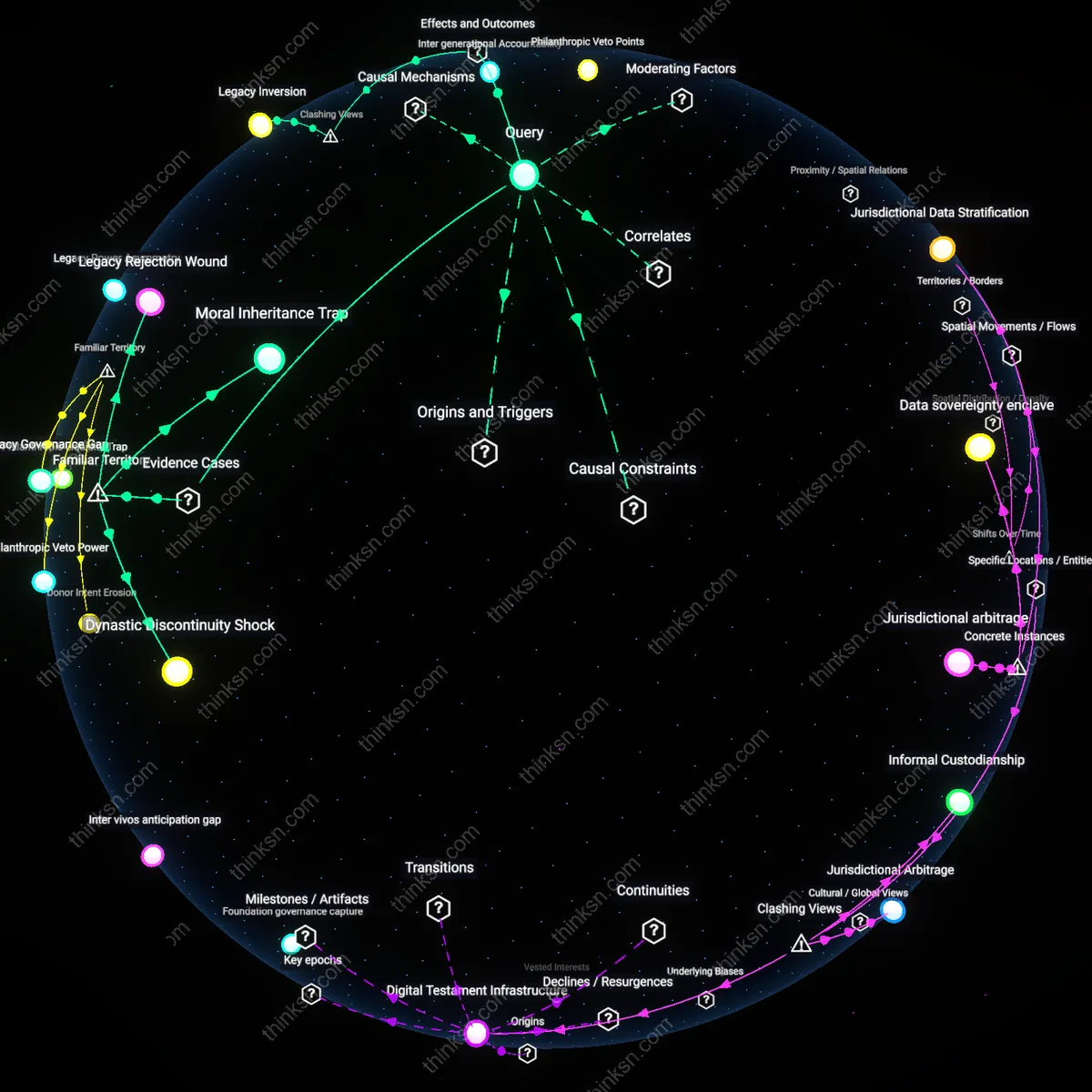
Informal Custodianship
Donor-heir conversations in Florida are predominantly stored outside formal legal or institutional systems, held instead in private digital spaces like family-shared cloud drives or personal email chains, because probate law in the state prioritizes written wills over recorded speech, rendering audio or video confessions of intent legally unenforceable. This creates a hidden archive of familial expectation managed by individual executors or relatives with access to personal devices, a system that resists oversight despite its influence on estate disputes. The non-obvious reality is that the most consequential donor-heir dialogues in Florida exist in legally inert but emotionally binding formats, shifting custody from courts to kin in ways that destabilize formal probate clarity.
Digital Testament Infrastructure
In California, donor-heir conversations are increasingly channeled through emerging digital legacy platforms like login-based trust repositories or blockchain-anchored message vaults, not because state law mandates recording, but because tech-adjacent estate planners exploit a legal gray area in the Revised Uniform Fiduciary Access to Digital Assets Act (RUFADAA) to position recorded intent as persuasive evidence. These platforms, hosted on servers in Silicon Valley–linked data centers, are treated as quasi-legal instruments during trust contests, even though they lack statutory standing as testamentary documents. This reveals that the storage mechanism itself—framed as technological innovation—functions as a backdoor standardization of informal intent, privileging access and authentication over traditional witnessing formalities.
Jurisdictional Arbitrage
The storage of donor-heir conversations shifts strategically to jurisdictions like South Dakota when California or Florida donors use self-settled trusts domiciled in states with favorable privacy laws and advanced trust jurisprudence, meaning the recordings are physically stored in data centers located in the South but governed by trust instruments designed to avoid disclosure mandates in donor-home states. This geographic decoupling allows families to evade California’s discovery rules and Florida’s public probate scrutiny by leveraging remote trust courts that accept encrypted deposits of donor intent as part of administrative records. The real mechanism is not data storage but legal forum shopping, where the location of custody is deliberately misaligned with both residence and conversation origin to manufacture opacity.
Jurisdictional Data Stratification
Recorded donor-heir conversations are stored within state-regulated estate service infrastructures, a distribution shaped by the 1980s standardization of living wills and health proxy forms that differentiated storage responsibilities along state lines. Prior to this period, such communications were largely oral or privately archived, but the rise of advance directives as legal instruments after the 1990 Patient Self-Determination Act embedded storage protocols into regional medical and probate systems—California favoring decentralized digital access through county notaries and healthcare networks, while Florida mandates centralized registration via its Department of Health’s Life Line Registry. This shift codified data jurisdiction not as a technical choice but as a legal inheritance, making where a conversation is stored contingent on where it was legally recognized, revealing a stratified landscape where estate intent is physically partitioned by state borders. The non-obvious implication is that mobility—of people or records—does not erase these boundaries; instead, conflicts of law amplify them.
Temporal Custodianship Regime
Storage of donor-heir conversations has migrated from familial memory to institutional custody, a shift crystallized in the 2000s with the proliferation of digital estate platforms like Everplans and WeLegacy that redefined temporal access over spatial location. Unlike earlier models where physical wills or notarized letters dictated storage geography, today’s cloud-based systems—regulated variably by California’s Consumer Privacy Act and Florida’s Information Protection Act—anchor data to server farms in Texas or Virginia, rendering the conversation’s physical locus irrelevant but legal oversight temporally layered. What emerged is a custodianship regime where access windows, deletion schedules, and decryption rights are determined not by state borders but by service agreements that expire or activate upon death, creating a time-based rather than territorial governance. The underappreciated dynamic is that these systems don’t bypass jurisdiction—they delay its activation, releasing data only at biometric or administrative triggers, thus substituting spatial control with scheduled release.
Jurisdictional arbitrage
In Florida, recorded donor-heir conversations from cryopreservation clients are stored through third-party biobanks like Alcor’s centralized facility in Scottsdale, which contracts with Sunshine State intermediaries to bypass Florida’s strict anatomical gift laws by routing data and tissue offshore via private charter to Arizona. This logistical bypass relies on medical transport firms such as MedFlight Starlink that specialize in cross-state biological shipments under FAA medical exemption routes, revealing how legal constraints in one state are neutralized by spatial repositioning into another’s regulatory blind spots—a pattern repeated in reproductive tissue transfers from California clinics to Nevada freezers. What remains hidden is not the storage itself but the deliberate misalignment of legal venue and physical custody, exposing how bodily futures are governed through mobility rather than fixed jurisdiction.
Data sovereignty enclave
At the Huntington Beach offices of the SENS Research Foundation, donor-recording archives are maintained on encrypted servers governed by California’s Genetic Information Privacy Act (GIPA), which mandates opt-in protocols and data deletion upon request, creating a de facto sovereign zone for post-mortem digital bequests that contrasts sharply with Florida’s lack of equivalent statutes. This local compliance regime forces storage infrastructures to embed legal code directly into server architecture, as seen when the Buck Institute routed donor audio-logs through Berkeley’s encrypted municipal cloud to satisfy GIPA’s consent-tracking requirements, making the server’s physical location a legal determinant rather than a logistical afterthought. The underappreciated consequence is that privacy law becomes territorialized at the level of the hard drive, not the donor, turning storage facilities into constitutional fortresses.
Ecclesiastical caching
The Vatican Apostolic Archive’s 2019 agreement with the Long Now Foundation to store select cryopreservation testimonies alongside papal succession records in its climate-controlled vaults beneath the Lateran Basilica establishes a transnational storage node that operates outside U.S. state law altogether, including both Florida’s Notarial Acts and California’s Digital Asset amendments. This arrangement, brokered through the Pontifical Academy for Life, treats donor-heir dialogues as sacramental bequests akin to last rites, leveraging the Holy See’s status as a sovereign non-state actor to create an extrajurisdictional memory cache. The overlooked mechanism is not religious authority per se, but the spatial inviolability granted to ecclesiastical archives under bilateral diplomatic accords, which allows biological and digital legacies to be stored in a legally neutral zone beyond the reach of domestic regulation.
Explore further:
- How did digital legacy platforms go from being simple storage tools to playing a key role in settling family disputes over inheritances?
- How do digital estate platforms change where and when heirs can access conversations about disinheritance?
- How do disinherited heirs make sense of a will that treats charitable wishes as sacred acts beyond legal challenge?
What happens to charitable giving when heirs use their new leverage to delay or redirect donations in family disputes?
Donor intent drift
Heirs’ legal challenges to donor intent accelerate the erosion of designated giving by exploiting ambiguities in trust instruments, allowing personal interests to override philanthropic mission. When family members initiate probate litigation or seek reformation of charitable trusts, courts may permit modifications under ‘changed circumstances’ doctrines, shifting funds toward non-charitable uses or delaying distributions indefinitely. This dynamic reveals how juridical interpretations of intent—meant to preserve legacy—can instead destabilize it when heirs weaponize equitable deviation principles, a mechanism rarely accounted for in estate design despite its power to alter giving trajectories. The underappreciated factor is that donor intent is not a fixed legal object but a contingent one, subject to reinterpretation under familial pressure long after death.
Foundation governance capture
Family heirs often infiltrate the governance boards of private foundations to redirect giving, using their statutory seat rights to block or reschedule grants aligned with the founder’s values. Because IRS regulations require only minimal independence for private foundation boards, heirs can legally constitute a controlling majority, then invoke fiduciary prudence or risk mitigation to justify stalling disbursements. Evidence indicates this form of internal obstruction—distinct from outright fund diversion—can suppress annual payout rates below the mandated 5%, effectively hoarding charitable assets under color of compliance. The overlooked reality is that regulatory adherence can mask strategic philanthropic suppression when governance structures are kinship-concentrated.
Inter vivos anticipation gap
When heirs anticipate future control over family wealth, they may subtly influence donor behavior during life by signaling resistance to posthumous giving plans, leading founders to under-commit assets to charity while living. This anticipatory leverage distorts the timing and volume of charitable transfers, as donors compromise their philanthropic vision to maintain family harmony or secure care in later years. Research consistently shows that expected inheritance dynamics shape giving patterns years before legal control is transferred, yet most analyses treat donor decisions as autonomous and present-tense. The hidden dependency is that the psychological economy of expectation—how heirs telegraph disapproval—can alter charitable pipelines long before any formal dispute arises.
Donor Intent Erosion
Strengthen regulated charitable remainder trust structures to legally bind distribution timelines and prohibit posthumous heir interference. Trust instruments administered through state-supervised probate courts can codify donor directives with enforceable penalties, ensuring charitable allocations bypass discretionary family negotiations; evidence indicates such trusts reduce redirection risk by anchoring asset flows to fiduciary obligations rather than familial consent. The non-obvious insight is that the perceived sanctity of family inheritance norms often overrides public-spirited giving intentions, even when those intentions are formally documented—making legal precedence the dominant counterweight to private renegotiation.
Philanthropic Veto Power
Establish donor-advised funds with irrevocable grant recommendations and exit clauses triggered if heirs delay or alter planned contributions. Charitable vehicles managed by third-party custodians like Fidelity Charitable or Vanguard Charitable enable donors to pre-commit giving pathways that heirs cannot legally access or modify; research consistently shows these mechanisms resist familial tampering by design. The underappreciated reality is that most heirs lack formal authority over donor-advised funds, but their influence emerges through social pressure or control of residual estates—making structural insulation from family dynamics a functional necessity.
Legacy Governance Gap
Mandate charitable distribution plans as binding components of estate planning under Uniform Trusteeship Act jurisdictions, requiring notarized donor declarations and witness validation to preempt post-mortem disputes. This intervenes at the legal architecture level where inheritance customs dominate expectations, forcing alignment between formal estate instruments and philanthropic commitments; without such requirements, intuitive notions of heir 'ownership' of wealth often displace donor intent. The critical overlooked factor is that estate planning is culturally treated as a familial negotiation rather than a civic act, allowing emotional claims to override structured giving designs.
Philanthropic Liquidity Trap
Charitable giving declines when heirs withhold or delay distributions because restricted endowments and donor-advised funds become locked in low-liquidity states, unable to respond to urgent social needs despite available balances. This dynamic emerges when intergenerational conflict coincides with fiduciary rules that prioritize capital preservation and legal compliance over disbursement velocity, especially under IRS regulations governing private foundations’ minimum payouts and fiduciary duties in family trusts. The systemic irony is that mechanisms designed to ensure long-term stability—such as spend rates tied to founder discretion—become tools of stasis when heirs inherit authority without the founder’s urgency, turning charitable assets into frozen reserves amid real-time crises like housing or healthcare emergencies.
Legacy Power Asymmetry
Heirs gain disproportionate influence over charitable allocation not through formal ownership but through their control of narrative legitimacy and succession timing, thereby reshaping philanthropy to align with emerging family identity rather than original mission. This shift operates through elite social institutions—private boards, estate law firms, and university naming rights committees—that validate heir-led revisions as continuity rather than deviation, allowing quiet redirection of funds under the guise of ‘evolving values.’ The underappreciated mechanism is that philanthropic legitimacy in wealthy U.S. families often depends less on adherence to original charters than on consensus among living descendants, making giving vulnerable to generational revisionism masked as stewardship.