Civic Symbol Repertoire
A secular vigil of witness organizes collective presence through symbolic acts like silence, candle-holding, or signage that mirror liturgical forms but derive authority from civic, not sacred, codes. These rituals are structured by urban governance norms—such as permitting public assembly in designated zones—and rely on NGOs, activist collectives, or community coalitions to coordinate logistics, timing, and messaging, replacing clerical leadership with facilitators trained in de-escalation and inclusivity. Unlike religious rituals, which draw cohesion from theological doctrine and ecclesial hierarchy, secular vigils depend on shared moral grammar (e.g., human rights frameworks) to unify participants, making them legible across pluralistic societies. This reveals how civic life sustains ritualized dissent through a curated aesthetic vocabulary that functions like a religion without metaphysics—its power lies in recognizable form emptied of dogma.
Secular Sacramentality
A secular vigil of witness incorporates bodily and spatial practices—candle lighting, name-reading, silent standing—that replicate the sensory and temporal rhythms of religious liturgies, creating a sacred-like atmosphere without invoking divine presence. These acts are choreographed not by liturgical calendars but by the temporal urgency of media cycles and political deadlines, with organizers timing vigils to coincide with court dates, legislative votes, or anniversary dates of trauma. The ritual’s emotional resonance emerges from repetition, proximity, and sensory minimalism, which enable participants to experience moral solidarity as a visceral, almost transcendent, state. The overlooked insight is that these rituals do not merely imitate religion—they establish a parallel economy of the numinous, where the sacred is displaced onto collective memory and ethical commitment, revealing a systemic demand for spiritual form even in avowedly secular movements.
Ceremonial Scaffold
A secular vigil of witness organizes silence, candles, and public gathering without liturgical authority, structuring participation through spatial choreography rather than doctrinal sequence. In post-1960s Western urban centers, as state funerals and public memorials distanced themselves from church oversight after the cultural secularization of trauma response, the vigil retained ceremonial forms—like candlelight processions and moments of silence—while draining them of salvific meaning; the mechanism is civic ritual substitution, where local governments or activist coalitions replicate the sensory architecture of religious wakes to lend gravity to collective grief, yet operate through municipal permits and symbolic consensus rather than sacramental logic. This shift reveals how the emotional efficacy of ritual was decoupled from theological content during the professionalization of crisis public relations in the late 20th century, making the form itself the residual vessel of legitimacy.
Mourning Infrastructure
The internal structure of a secular vigil consists of decentralized nodes—spontaneous shrines, social media tributes, and temporary memorials—that cumulatively form a distributed network replacing centralized religious officiation. Following the 1985 bombing of the Rainbow Warrior and the emergence of transnational environmental activism, such events began incorporating real-time digital testimony and global livestreams, transforming what was once a localized, time-bound gathering into an asynchronous, polycentric display; the mechanism is technological mediation, where smartphones and platforms like Twitter enable symbolic presence without physical co-location, operating through viral affect rather than priestly intercession. This transition marks a rupture from the temporality of religious ritual cycles—such as feast days or mourning periods—toward an on-demand, perpetually renewable witness culture shaped by digital memory economies.
Witness Protocol
Secular vigils deploy standardized performative scripts—moments of silence, reading names of victims, candle exchanges—that mirror the structural sequencing of religious liturgies but are codified by NGOs and human rights organizations rather than theological institutions. In the wake of the 1990s Balkan conflicts, international advocacy groups like Amnesty International formalized these practices into training manuals for community-led remembrance, institutionalizing a modular, replicable format that could be franchised across secular and pluralistic settings; the mechanism is procedural bureaucratization, where emotional authenticity is preserved through strict adherence to ritualized steps, operating via organizational templates rather than doctrinal inheritance. This shift reveals how the authority of religious ritual has been supplanted not by spontaneity but by technocratic standardization in the global governance of collective memory.
Symbolic infrastructure
A secular vigil of witness relies on pre-existing public spaces and civic signage to function as a site of collective memory, just as religious rituals depend on consecrated ground—because the permission to gather and the visibility of the act depend on municipal bylaws, transportation access, and the tacit recognition of certain locations as 'neutral' yet symbolically charged. This infrastructural dependency is rarely acknowledged in discussions of secular ritual, which tend to focus on intent or speech rather than the material politics of placement—yet without access to this symbolic infrastructure, such vigils cannot achieve public resonance, revealing that their efficacy is co-produced by urban governance and spatial semiotics rather than collective will alone.
Emotional choreography
Secular vigils are organized through implicit scripts of bodily comportment—such as standing in silence, holding unlit candles, or turning away from media cameras—that mimic the affective pacing of religious liturgies but are coordinated through peer-led cues rather than ordained leaders, because participation depends on mutual self-regulation within emotionally volatile contexts. This choreography is rarely documented or named, yet it prevents disintegration into chaos or spectacle, functioning as a hidden operating system for emotional coherence; overlooking it leads analysts to mistake secular witnessing as spontaneously authentic rather than carefully staged through micro-practices of restraint and mimicry that are learned from media representations of grief rituals.
Temporal buffer zones
The organization of a secular vigil depends on its placement within a narrow window between traumatic visibility and narrative closure—typically 48 to 72 hours after a publicized incident—because media attention, public availability, and emotional urgency align only briefly, and organizers must synchronize with this fleeting convergence to gain traction. This temporal precision is structurally akin to the fixed liturgical calendars of religious commemorations, yet it remains invisible in analyses that treat timing as logistical rather than constitutive; failing to recognize this buffer zone's role obscures how secular witnessing is not just a response to trauma but a tactical intervention calibrated to the rhythms of attention economies and bureaucratic response cycles.
Civic ritual scaffold
A secular vigil of witness organizes silent presence in public space as a direct moral claim on collective attention, modeled on religious all-night prayer watches but stripped of doctrinal content. It relies on citizen participants, often survivors or allies, occupying symbolic locations like government plazas or sites of trauma, using duration and stillness as performative weight; this mirrors the liturgical structure of religious vigils but replaces divine invocation with embodied testimony. The non-obvious aspect is that its power derives not from spontaneity but from mimicking the temporal and spatial discipline of religious ritual—curfews, candle-lighting sequences, processional silence—thereby borrowing legitimacy from the very forms it secularizes.
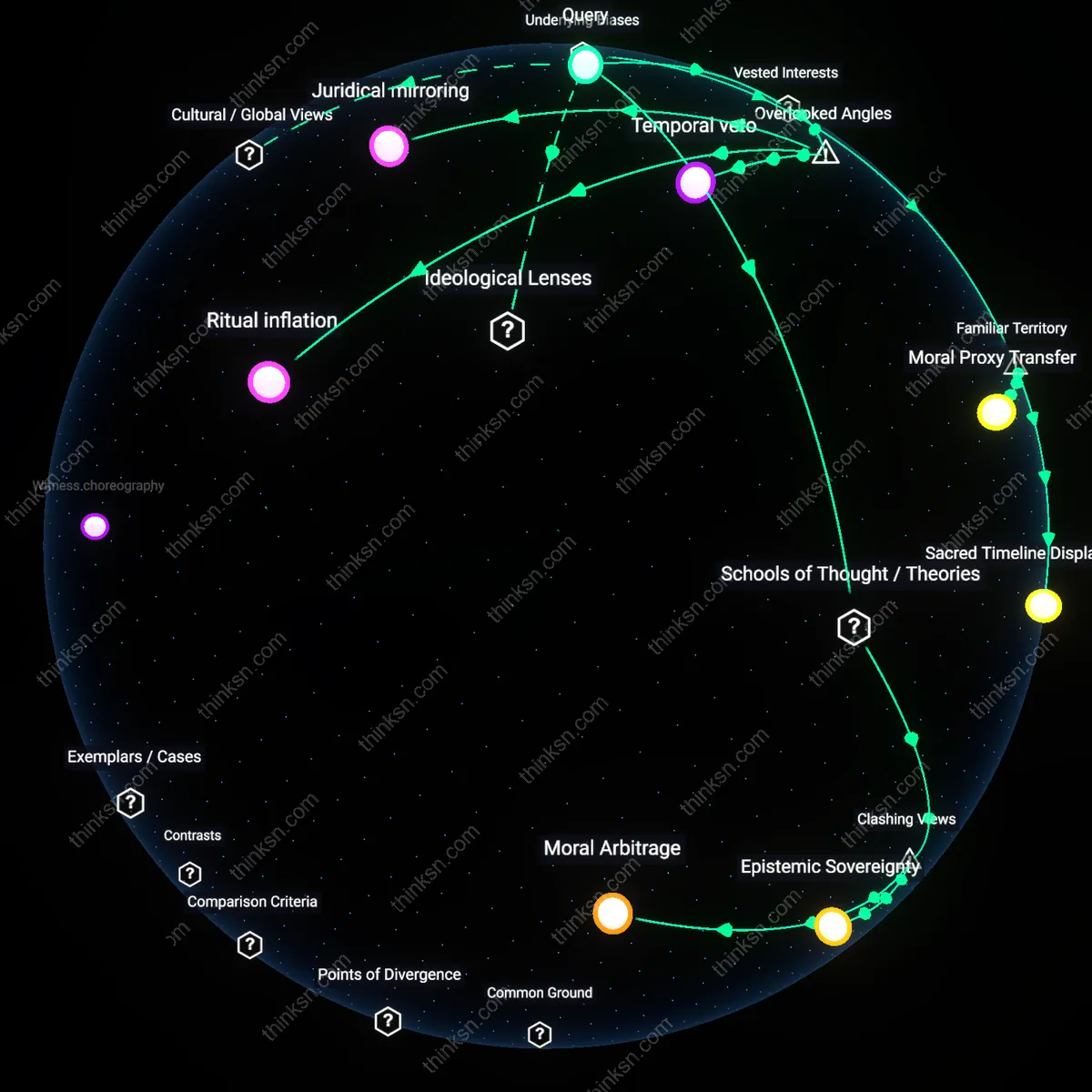
Witness choreography
A secular vigil of witness includes coordinated acts of personal disclosure, such as reading names of victims or sharing survivor statements, structured like a litany but grounded in autobiographical truth rather than scripture. Organizers—typically advocacy groups or trauma-informed facilitators—script these utterances to unfold in a sequence that builds emotional resonance without clerical mediation, substituting communal listening for sacramental grace. The underappreciated reality is that this format replicates the narrative arc of religious confession and redemption, yet frames moral authority as emergent from individual voice rather than institutional doctrine, making the ritual’s legitimacy dependent on perceived authenticity.
Public grief infrastructure
A secular vigil of witness is organized through the provisioning of material and emotional support systems—barricades, medics, grief counselors, water stations—that mirror the logistical backbone of large religious pilgrimages or retreats, but serve to sustain political endurance rather than spiritual purification. These elements are invisibly essential; unlike the overt symbolism of candles or silence, this operational layer enables the event to function as a 24-hour civic occupation, revealing that the secular parallel to religious ritual depends not just on symbolism but on institutionalized care labor. The insight is that the secular form does not reject ritualism but re-embeds it within municipal-scale logistics typically associated with protest, not penance.
Secularized Performativity
A secular vigil of witness in Berlin’s annual Rosa-Luxemburg Memorial Week includes choreographed silence, collective candle-lighting, and the recitation of historical manifestos by lay participants, organized by the Rosa-Luxemburg-Stiftung without any liturgical framework—demonstrating that such events replicate religious ritual’s somber cadence not through belief but through routinized bodily discipline. This structure relies on state-adjacent cultural foundations to standardize affect, treating political memory as a liturgical text to be enacted annually, thereby revealing that the power of witness lies less in personal conviction than in the mechanized reproduction of solemnity. The non-obvious insight is that secular witness rituals often depend on the aesthetic scaffolding of religion while actively rejecting its metaphysics, exposing a performative secularism that mimics without believing.
Counter-Canon Embodiment
In Minneapolis, in the months following George Floyd’s killing, ad hoc vigils at the intersection of 38th and Chicago—organized by local residents and Black Visions Collective—functioned as secular witness through the physical occupation of space, chalk inscriptions of names, and community storytelling, directly contesting police memorials’ formalized, hierarchical structure. These rituals inverted traditional memorial logic by refusing centralized coordination or fixed duration, treating witness as an emergent property of collective grief and resistance rather than a scheduled observance. This challenges the assumption that effective ritual requires institutional orchestration, revealing instead that secular witness can derive authority from deliberate informality and the subversion of ceremonial order.
Absence Infrastructure
The empty chair installations during the International Day of the Disappeared in Santiago, Chile, organized by the Agrupación de Familiares de Detenidos Desaparecidos, constitute a secular vigil where the absence of the body becomes the central ritual object, meticulously coordinated through familial networks and human rights NGOs without invoking spiritual presence. The ritual’s organization mirrors Catholic All Saints’ Day processions in timing and public route but replaces prayer with forensic documentation readings, positioning bureaucratic evidence as liturgy. This reframes secular witness not as a stripped-down version of religion but as a parallel epistemic system where administrative proof, not faith, consecrates memory—exposing that the sacredness of witness may reside in archival rigor rather than emotional expression.