Why Do Alternative Facts Thrive Despite Media Scrutiny?
Analysis reveals 8 key thematic connections.
Key Findings
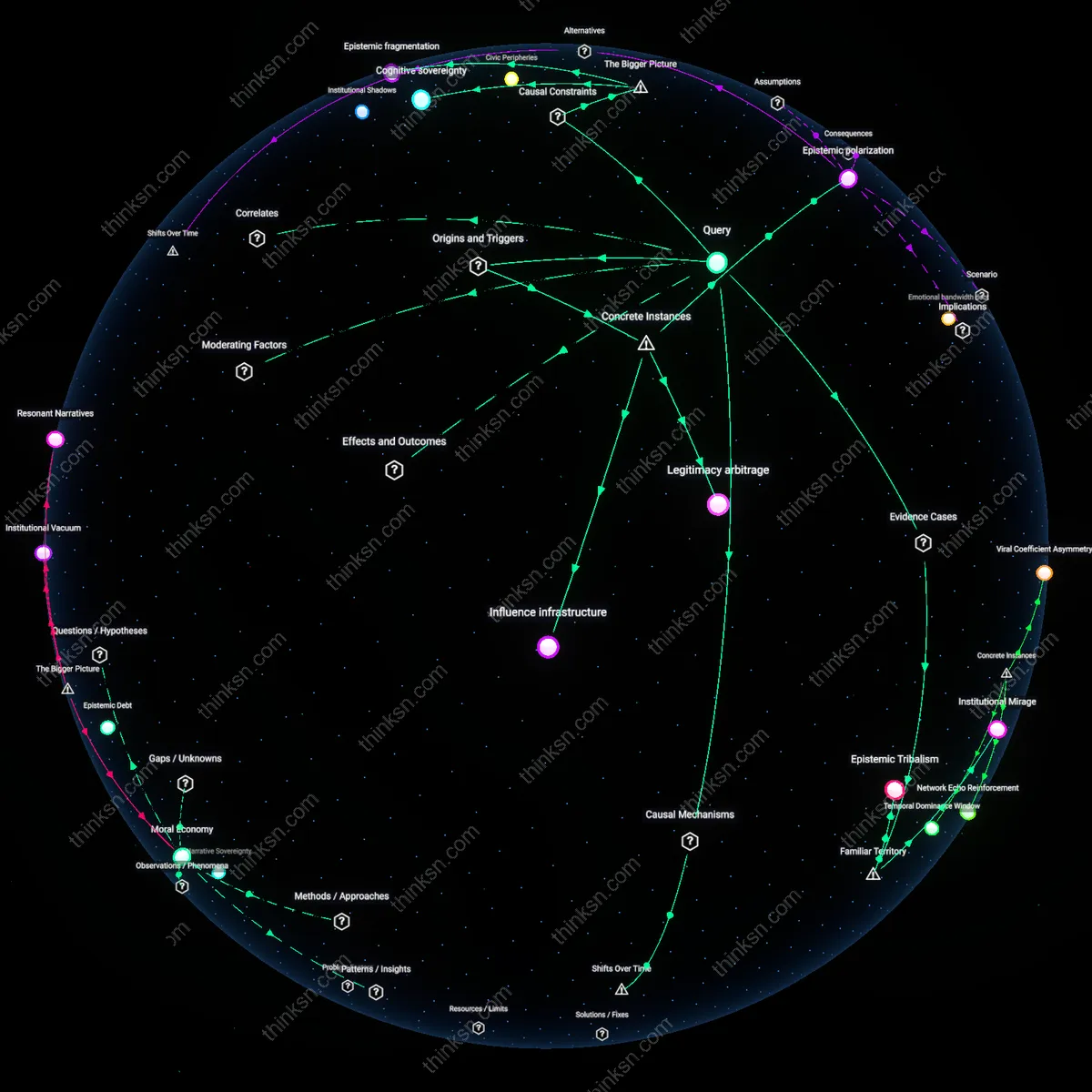
Epistemic polarization
The 2016 U.S. presidential election campaign and subsequent press briefings by Kellyanne Conway popularized 'alternative facts' as a defense of demonstrably false claims, revealing that entrenched belief systems resist factual correction even when media scrutiny intensifies. This dynamic persists not because misinformation escapes detection, but because audiences already aligned with partisan worldviews interpret contradictory facts as institutional bias, transforming verification into evidence of elite deception. The mechanism operates through identity-protective cognition, where belief preservation supersedes accuracy, making the rebuttal of facts more effective than their affirmation. What is underappreciated is that rigorous fact-checking, rather than curbing alternative facts, can amplify their appeal by confirming out-group hostility.
Influence infrastructure
The coordinated dissemination of 'alternative facts' during the 2016 Brexit referendum by actors such as Leave.EU and Cambridge Analytica illustrates how digital microtargeting systems enable tailored narratives to bypass traditional media gatekeepers entirely. These systems rely not on public debate but on algorithmic amplification of emotionally resonant falsehoods within enclosed information environments, rendering external verification irrelevant to recipients. The mechanism functions through private data networks that predict and manipulate voter behavior, decoupling belief formation from shared evidence. The non-obvious insight is that stricter journalistic standards apply only to public discourse, while influence now operates largely through invisible, automated channels that evade scrutiny by design.
Legitimacy arbitrage
The invocation of 'alternative facts' by Brazilian President Jair Bolsonaro during the 2022 election—where he alleged widespread voter fraud in the electronic ballot system despite audit confirmation—exemplifies how political actors exploit institutional ambiguity to delegitimize inconvenient outcomes. By positioning themselves as challengers to corrupted 'expert' consensus, leaders gain support by framing verification processes as tools of a captured elite. This mechanism works through strategic overloading of official channels with counter-claims, forcing institutions into defensive postures that appear evasive or conspiratorial. The underappreciated dynamic is that factual accuracy becomes secondary to the perception of procedural fairness, allowing alternative facts to persist by eroding trust faster than truth can be verified.
Temporal dislocation
The endurance of 'alternative facts' emerged decisively after the 2010s normalization of real-time media churn, which disrupted the historical sequencing of claim, verification, and correction, collapsing time into a single performative present. In earlier eras, fact-checking followed assertion with enough delay to allow narrative settlement, but in the social media era, the speed of dissemination outpaces verification, making corrections function as just another competing claim. This compression of epistemic time enables actors to exploit the interval between viral circulation and debunking as a permanent operational zone—one where facts are perpetually 'in dispute' by design. The non-obvious insight is that the shift isn’t about belief in falsehoods but about the strategic weaponization of temporal lag, turning delay into a structural vulnerability.
Cognitive sovereignty
The rhetorical persistence of 'alternative facts' is driven by users' psychological need to preserve personal identity in the face of disconfirming evidence. When individuals encounter media verification that contradicts their worldview, especially on polarized issues, the backlash effect triggers deeper entrenchment—where correction actually strengthens belief in falsehoods. This operates through identity-protective cognition, seen in partisan audiences who interpret fact-checks as elite coercion, thus converting verification into a marker of cultural betrayal. The mechanism is sustained by algorithmic amplification of identity-affirming content on social platforms, making cognitive consistency more valuable than factual accuracy. What is non-obvious is that stricter verification does not fail due to ignorance, but succeeds too well at signaling out-group authority, thereby activating resistance as a form of self-rule.
Epistemic fragmentation
Alternative facts endure because dominant media verification practices inadvertently legitimize competing truth regimes through asymmetric engagement. When mainstream outlets fact-check false claims, they amplify their visibility while structurally framing them as contestable—affording parity between evidence-based claims and ideological assertions in the name of neutrality. This occurs in broadcast formats that adhere to journalistic norms of balance, such as dualistic debate segments, where disproven claims are presented alongside verified facts under the rubric of 'fairness.' The system rewards controversy over coherence, incentivizing bad-faith actors to generate provable falsehoods knowing they will be recycled into public discourse. The non-obvious consequence is that verification, rather than eliminating falsehoods, embeds them as permanent features of pluralistic discourse, institutionalizing doubt as a political resource.
Epistemic Tribalism
Political identity supersedes factual accuracy in media consumption. Audiences like those consuming Fox News or certain far-right online communities maintain beliefs not because they lack access to verified information but because rejecting mainstream narratives reinforces group belonging. This mechanism operates through social validation systems where shared skepticism of institutions becomes a loyalty signal, making falsifiable claims functionally irrelevant. The non-obvious element is that stricter media verification inadvertently strengthens this dynamic by deepening the perceived bias of fact-checkers, turning accuracy into a partisan litmus test.
Institutional Mirage
Mainstream media’s claim to objectivity amplifies perceptions of hidden bias when discrepancies arise, as seen in audience reactions to outlets like The New York Times or CNN during polarized events such as election coverage. The mechanism is performative neutrality—attempting to balance narratives lends false equivalence to fringe claims, inadvertently legitimizing them. People rely on familiar cues of fairness rather than epistemic rigor, so the very practice of verification, when inconsistently applied, mimics the behavior it seeks to correct. The non-obvious insight is that the ritual of fact-checking can simulate credibility while enabling doubt, making the institution part of the problem it aims to resolve.