When Does AI Promise Outweigh Traditional Roles for Paralegals?
Analysis reveals 6 key thematic connections.
Key Findings
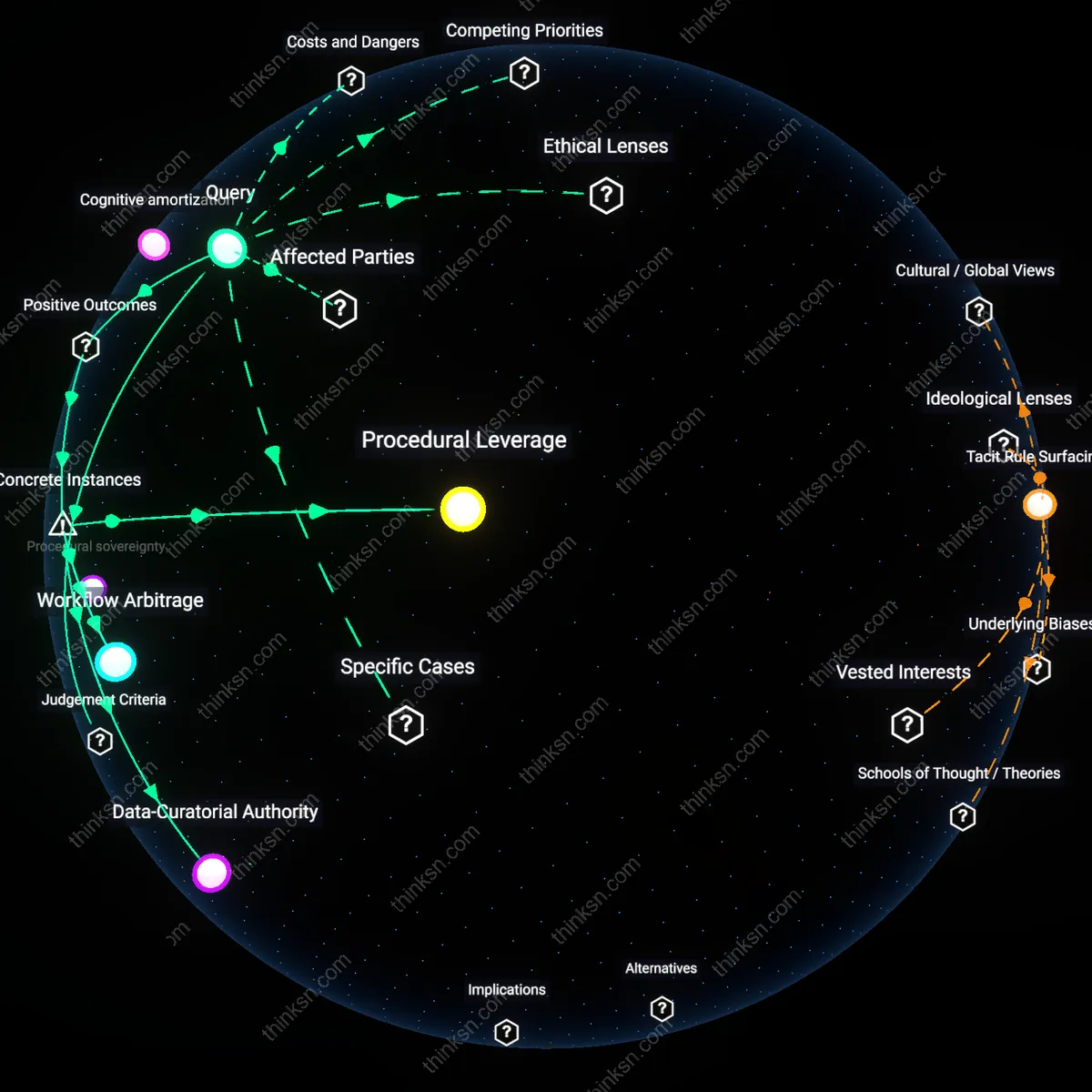
Procedural sovereignty
A paralegal gains procedural sovereignty when they master the configuration of AI document automation systems, allowing them to redefine workflow gatekeeping in litigation support. This shift becomes advantageous not when efficiency peaks, but when the paralegal—positioned between legal strategy and technical implementation—begins to control which documents trigger review, how versioning is governed, and when client data flows into drafting pipelines, thus exercising quiet authority over case tempo. Most analyses overlook that AI automation does not just replace tasks but redistributes procedural control, and the paralegal’s ascent into project management coincides with their acquisition of this hidden jurisdiction over sequence and access in legal processes.
Cognitive amortization
The transition benefits the paralegal when the cognitive labor of debugging AI-generated document anomalies exceeds the cost of manual drafting across multiple cases, creating a tipping point where managing the system becomes cheaper than executing within it. Paralegals who repeatedly correct jurisdiction-specific inconsistencies in AI output—such as outdated statutory citations in real estate disclosures—eventually accumulate tacit knowledge that, when systematized, becomes the foundation for training new models or adjusting prompt logic. What is missed is that their value does not lie in speed but in the amortization of learned errors over time, transforming individual corrections into reusable procedural memory, a dynamic absent from cost-benefit models focused on immediate throughput.
Latent compliance topology
Advantage emerges when the paralegal, through daily friction with AI document tools, becomes the de facto interpreter of unspoken regulatory boundaries embedded in templates, such as HIPAA-mirroring data handling in non-healthcare agreements or ADA-inspired accessibility formatting in public notices. These hidden compliance contours are rarely documented but are enforced through institutional risk avoidance, and the paralegal who maps them—by noting which AI outputs get rejected by senior counsel for 'tone' or 'format' reasons—discovers an invisible compliance architecture. Standard analyses miss that AI automation does not reduce compliance burden but displaces it into stylistic and structural norms, making the paralegal’s pattern recognition the critical infrastructure for regulatory stealth adherence.
Procedural Leverage
A paralegal at Clifford Chance in London gained procedural leverage by leading the firm’s implementation of AI-driven lease abstraction tools in 2021, shifting from document review to managing the workflow integration that reduced property transaction processing time by 40%. This shift succeeded because the paralegal possessed granular knowledge of both drafting conventions and operational bottlenecks, allowing precise calibration of the AI’s output for partner review. The non-obvious insight is that frontline legal support staff, not tech specialists, are best positioned to align AI outputs with existing procedural standards, turning executional familiarity into strategic influence.
Data-Curatorial Authority
In 2023, a paralegal at the U.S. Department of Justice’s Antitrust Division assumed data-curatorial authority by organizing and labeling thousands of legacy merger filings to train an internal AI model for detecting competitive risk patterns. Because the paralegal understood both evidentiary relevance and classification hierarchies, the resulting dataset improved the model’s accuracy more than subsequent algorithmic refinements. This case reveals that the transition to AI project management becomes advantageous when legal support roles pivot from processing documents to governing the quality and structure of training data—transforming custodial responsibility into a technical gatekeeping function.
Workflow Arbitrage
A paralegal at Baker McKenzie’s Singapore office achieved workflow arbitrage in 2022 by redirecting AI-automated due diligence outputs into accelerated client reporting cycles during cross-border M&A deals, effectively compressing a two-week review phase into three days. The advantage emerged not from overseeing the AI development, but from resequencing downstream tasks—such as compliance tagging and jurisdictional flagging—based on predictable AI output formats. This instance underscores that AI project management becomes valuable when paralegals exploit temporal gaps in legacy workflows, using machine consistency to reengineer human task allocation and deliver asymmetrical time savings.