Former Regulators as Auditors: Credibility Boon or Conflict?
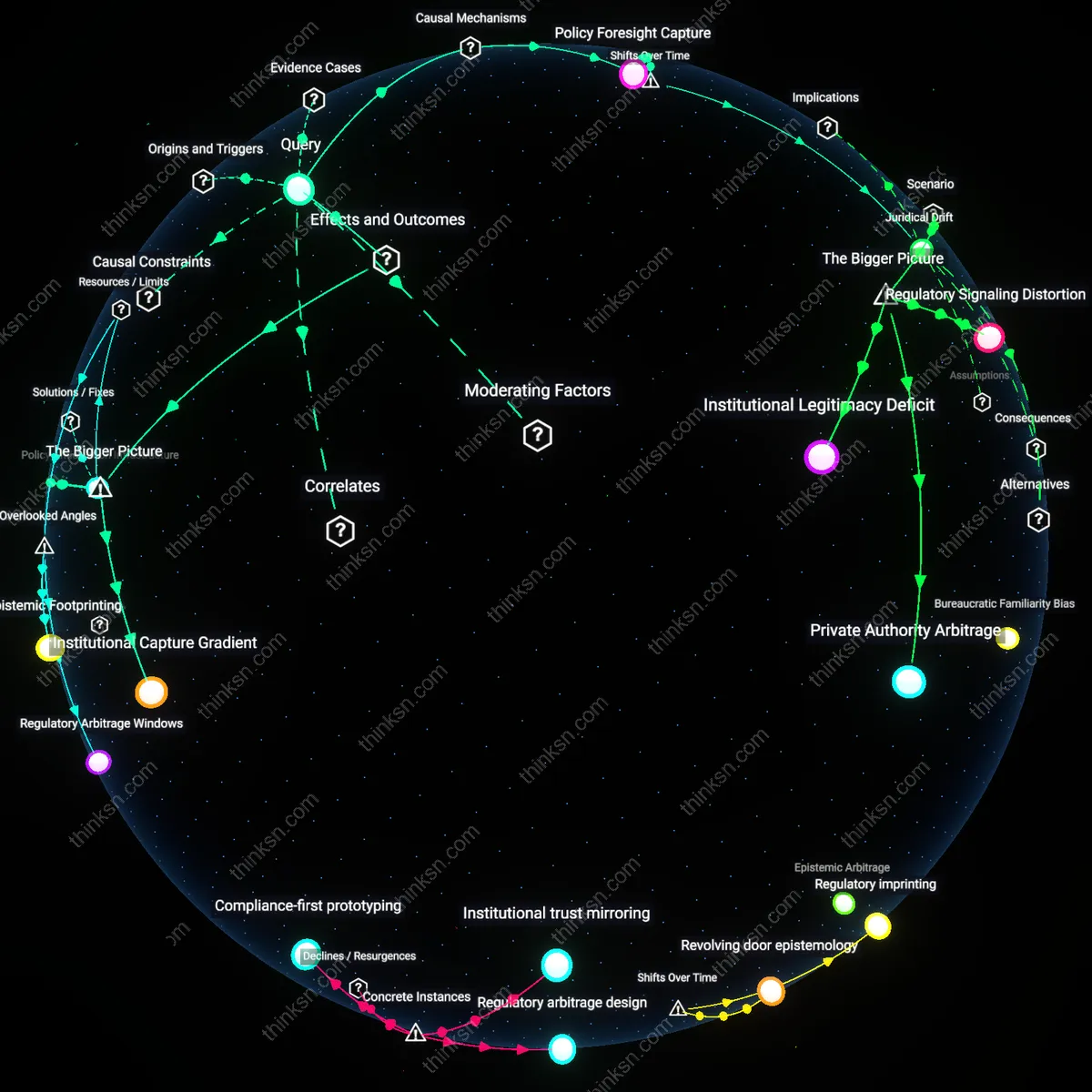
Analysis reveals 10 key thematic connections.
Key Findings
Regulatory Apprenticeship
Staffing corporate compliance teams with former regulators since the 1980s financial deregulation era has enhanced enforcement credibility by institutionalizing a mechanism of anticipatory conformity, where firms internalize regulatory logic not through coercion but through embedded expertise. This shift—from adversarial compliance to preemptive alignment—emerged as agencies like the SEC and Federal Reserve contracted during neoliberal reforms, leaving firms to self-police; former regulators, familiar with inspection protocols and enforcement thresholds, became conduits for projecting state scrutiny inward. The non-obvious outcome is that credibility is not derived from independence but from the imitation of state capacity, transforming compliance into a form of regulatory apprenticeship where private actors learn to perform public oversight.
Revolved Scrutiny
The post-2008 financial crisis marked a turning point where hiring former regulators became both a reputational shield and a structural vulnerability, as firms like JPMorgan and Goldman Sachs increasingly staffed compliance units with ex-examiners from the OCC and CFPB to signal rigor while simultaneously exploiting insider knowledge of enforcement weak points. This created a new equilibrium in enforcement dynamics—less about deterrence and more about managed exposure—where the credibility of audits is calibrated not by impartiality but by the precision of regulatory foresight. The underappreciated shift is that the revolving door, once seen as a corruption risk, has evolved into a formalized system of 'revolved scrutiny,' normalizing insider access as a compliance asset.
Compliance Temporality
Beginning in the mid-2010s, multinational tech firms facing GDPR and antitrust scrutiny began recruiting former EU competition officials, marking a shift from reactive compliance to time-shaping governance, where ex-regulators compress investigative timelines by anticipating regulatory rhythms before they materialize. Unlike earlier eras when compliance followed rulemaking, today’s teams use institutional memory of procedural lags, policy debates, and political cycles to pre-empt sanctions by aligning audits with the likely trajectory of future enforcement. The key insight is that credibility now stems not from neutrality but from temporal advantage—producing a new governance modality where compliance is no longer synchronized with regulation but attempts to stay chronologically ahead of it.
Regulatory Revolving Door
Staffing compliance teams with former regulators undermines enforcement credibility by embedding regulatory capture into corporate governance structures. These individuals bring not only expertise but also institutional loyalties and risk aversion cultivated within agencies pressured to avoid disrupting powerful industries—leading to softer internal enforcement trajectories that mirror lax public oversight. The mechanism operates through informal norms of deference and shared identity between former colleagues now split between regulator and regulated, which systematically depresses the aggressiveness of audits. This reveals that the very individuals trusted to strengthen internal oversight often serve as conduits for weakening it—a dynamic rarely acknowledged given the surface-level appeal of regulatory experience.
Strategic Amnesty
Former regulators on audit teams inadvertently enable organizational forgetting by framing past violations as legacy issues resolved through procedural upgrades, not ongoing systemic failures. Their presence lends authority to narratives of reform that absolve current leadership of responsibility, allowing firms to avoid structural changes while branding compliance as achieved. This operates through the regulatory habit of closure—trained to accept corrective action plans over punitive measures—which corporations exploit to neutralize internal dissent and external criticism. The danger lies not in overt corruption but in the quiet institutionalization of non-punishment, exposing how the logic of regulatory pragmatism becomes a tool for corporate impunity.
Asymmetric Accountability
Hiring former regulators introduces a conflict of interest by aligning internal audit outcomes with the reputational and networked self-interest of those ex-regulators, because individuals who once enforced rules may now be incentivized to validate corporate behavior that mirrors their prior regulatory philosophies, thereby reducing scrutiny on practices they once oversaw; this occurs through a system of reciprocal legitimacy in regulatory communities where past decisions must be defended to preserve career mobility, a mechanism rarely acknowledged because it transforms audit functions from independent verification into recursive justification.
Credibility-Compliance Tradeoff
The use of former regulators in corporate audits creates a zero-sum tension where enhanced external credibility comes at the cost of internal independence, because firms in highly regulated sectors like finance or pharmaceuticals leverage ex-regulators’ reputations to reassure investors and regulators, but this strategic signaling depends on suppressing audits that might challenge established regulatory doctrines those individuals helped create; this dynamic is sustained by market pressures for predictable compliance outcomes, revealing how organizational legitimacy is often purchased through the neutralization of adversarial scrutiny.
Regulatory Temporal Debt
Placing former SEC enforcement officials into audit roles at firms like Lehman Brothers during the mid-2000s weakened audit scrutiny because these hires carried forward unresolved temporal obligations to prior regulatory networks, creating blind spots in retrospective risk assessment. The mechanism operated through informal expectation cycles—former regulators avoided aggressive post-hoc challenges to decisions they had indirectly sanctioned in prior roles, especially in cases involving complex structured finance products under Rule 144A. This dynamic reveals how time-lagged accountability gaps can embed compliance inertia in audit functions, a factor typically ignored in favor of overt conflict checks. The non-obvious insight is that regulatory movement across sectors accumulates deferred ethical reckoning, which undermines ex post review efficacy.
Enforcement Theater Calibration
Hiring ex-FDA compliance officers into audit teams at pharmaceutical giants such as Pfizer post-2010 increased the performative rigor of internal audits while systematically deprioritizing punitive outcomes, as seen in the delayed response to off-label promotion audits in the Neurontin case. These individuals optimized audit processes for procedural defensibility rather than corrective action, shaping enforcement patterns to align with historical regulatory leniency norms they had helped normalize. The overlooked mechanism is the calibration of audit 'theater'—the extent to which compliance rituals mirror enforcement credibility without enforcing change—thereby preserving regulatory harmony over substantive disruption. This shifts the standard conflict vs. credibility binary by exposing mimicry as a strategic compliance artifact.
Institutional Tone Contagion
Embedding ex-OCC supervisors into internal audit units at JPMorgan Chase during the 2012 'London Whale' oversight period reproduced a hierarchical risk-assessment culture that suppressed upward reporting of model weaknesses, mirroring the chain-of-command deference typical in agency settings. The causal pathway operated not through personal bias or financial conflict, but through implicit communication protocols favoring consensus over challenge, which dampened audit dissent despite technical red flags. This cultural transmission of risk tolerance—often missed in ethics frameworks focused on individual recusal—demonstrates how institutional affect becomes encoded in audit practice. The residual insight is that compliance credibility is corroded not by who is hired, but by how their prior institutional emotional logic reshapes inquiry norms.