Are Elderly YouTube Medics Gambling with Their Health?
Analysis reveals 5 key thematic connections.
Key Findings
Diagnostic authority
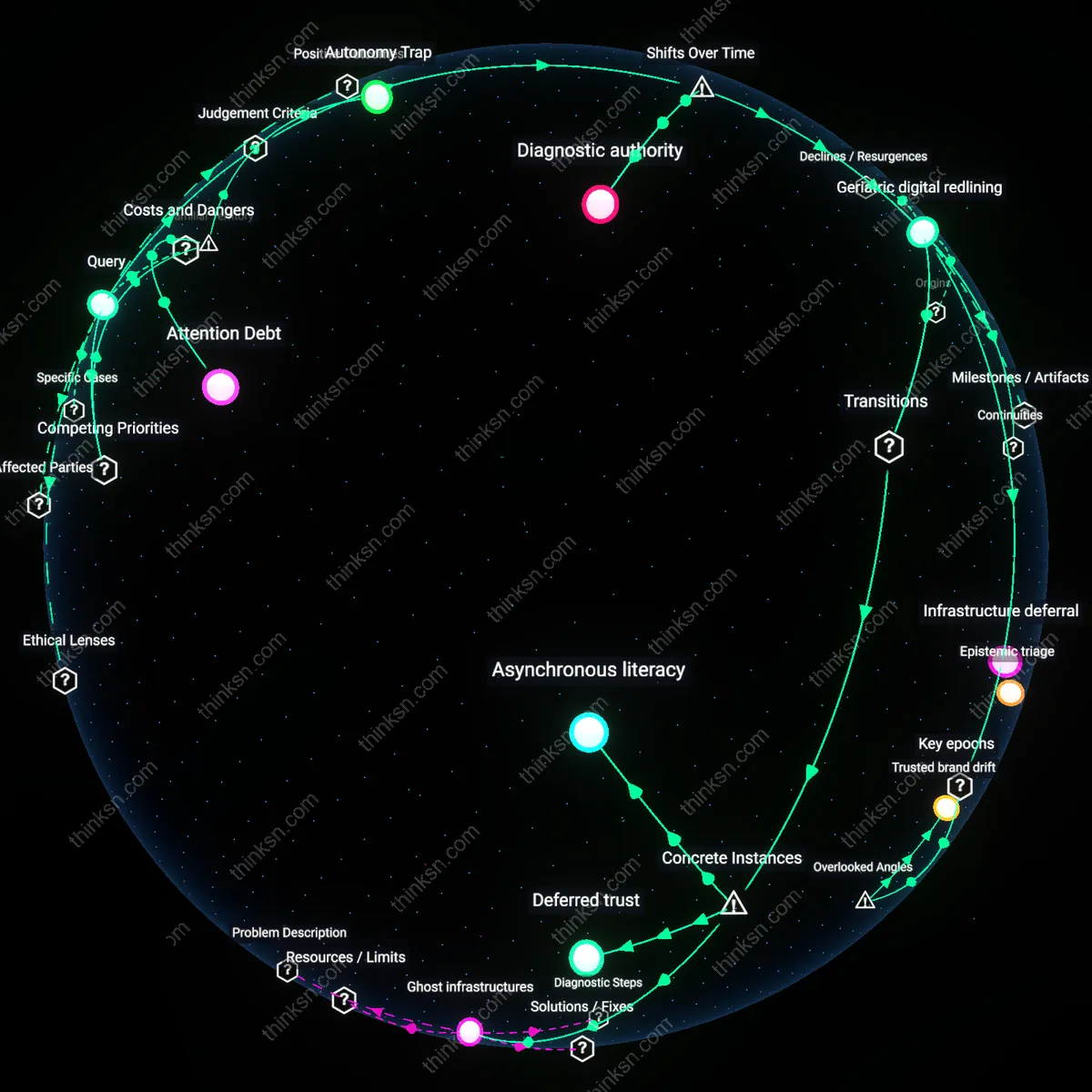
YouTube erodes physician-led diagnostic authority by enabling elderly patients to bypass clinical gatekeeping, a post-2010 shift driven by algorithmic personalization that privileges engagement over epistemic rigor; this transition reconfigures medical legitimacy not through regulatory evolution but through infrastructural capture, where recommendation systems supersede institutional credentialing in shaping health decisions. The mechanism—scalable, unmoderated user-generated content—exploits longitudinal trust in visual media, transforming passive viewers into self-referencing diagnostic agents without disclosing the erosion of clinical temporality, such as longitudinal patient history or contextual risk assessment. What is underappreciated is that this shift does not merely introduce misinformation but reorganizes the epistemology of care around immediacy and affect, replacing deferred professional judgment with real-time algorithmic affirmation.
Geriatric digital redlining
The reliance of elderly users on YouTube for medical guidance reproduces geriatric digital redlining, a condition emerging prominently after the 2008–2012 Medicare digital literacy cuts that withdrew public health outreach funding just as private platforms scaled telehealth content; this transition replaced state-mediated health equity initiatives with commercially driven information ecosystems, disproportionately exposing low-income seniors to monetized misinformation. The mechanism operates through geographic and socioeconomic filtering in ad-targeting algorithms, which prioritize pharmaceutical-sponsored videos in regions with declining rural healthcare access, effectively commodifying health inquiry into targeted ad conversion. The non-obvious consequence is not simply poor outcomes but the systemic relocation of care responsibility from public institutions to isolated users who are least equipped to assess data provenance, thus masking structural abandonment as personal choice.
Autonomy Trap
Prioritizing elderly individuals' autonomy in seeking medical guidance on YouTube unavoidably undermines clinical oversight, as platforms lack institutional safeguards to verify user-applied advice. This dynamic manifests through self-directed patients bypassing physician consultation, relying instead on algorithmically amplified videos that simulate expertise—commonly perceived as helpful tutorials but often omitting contraindications or evidence hierarchies. The non-obvious risk under familiar discourse about 'empowered patients' is that autonomy becomes self-sabotage when distributed media erodes the gatekeeping function of licensed medicine.
Attention Debt
Elderly engagement with YouTube medical content trades mental vigilance for convenience, as the platform's design rewards passive consumption over critical appraisal of sources. This operates through recommendation algorithms that prioritize watch time over accuracy, cultivating habitual exposure to misleading health narratives under the guise of educational content—something widely recognized as 'doctors on screen' but rarely questioned for credential transparency. The underappreciated cost, masked by cultural trust in video as explanatory, is that sustained attention to unreliable narratives displaces effort toward vetting credible care pathways.
Familial Distrust Gap
When older adults base treatment decisions on YouTube advice, family caregivers often confront irreconcilable medical beliefs, fracturing intergenerational trust in health decision-making. This conflict arises because relatives perceive influencer-endorsed remedies as unproven, while elders cite personal testimonial consistency—amplified by YouTube’s comment sections that mimic community consensus. Despite widespread awareness of 'misinformation online,' the erosion of familial medical authority remains a quietly accumulating consequence, revealing how domestic care networks become collateral damage in platform-mediated health guidance.