Is Your Chronic Condition Fairly Classified as Non-Occupational?
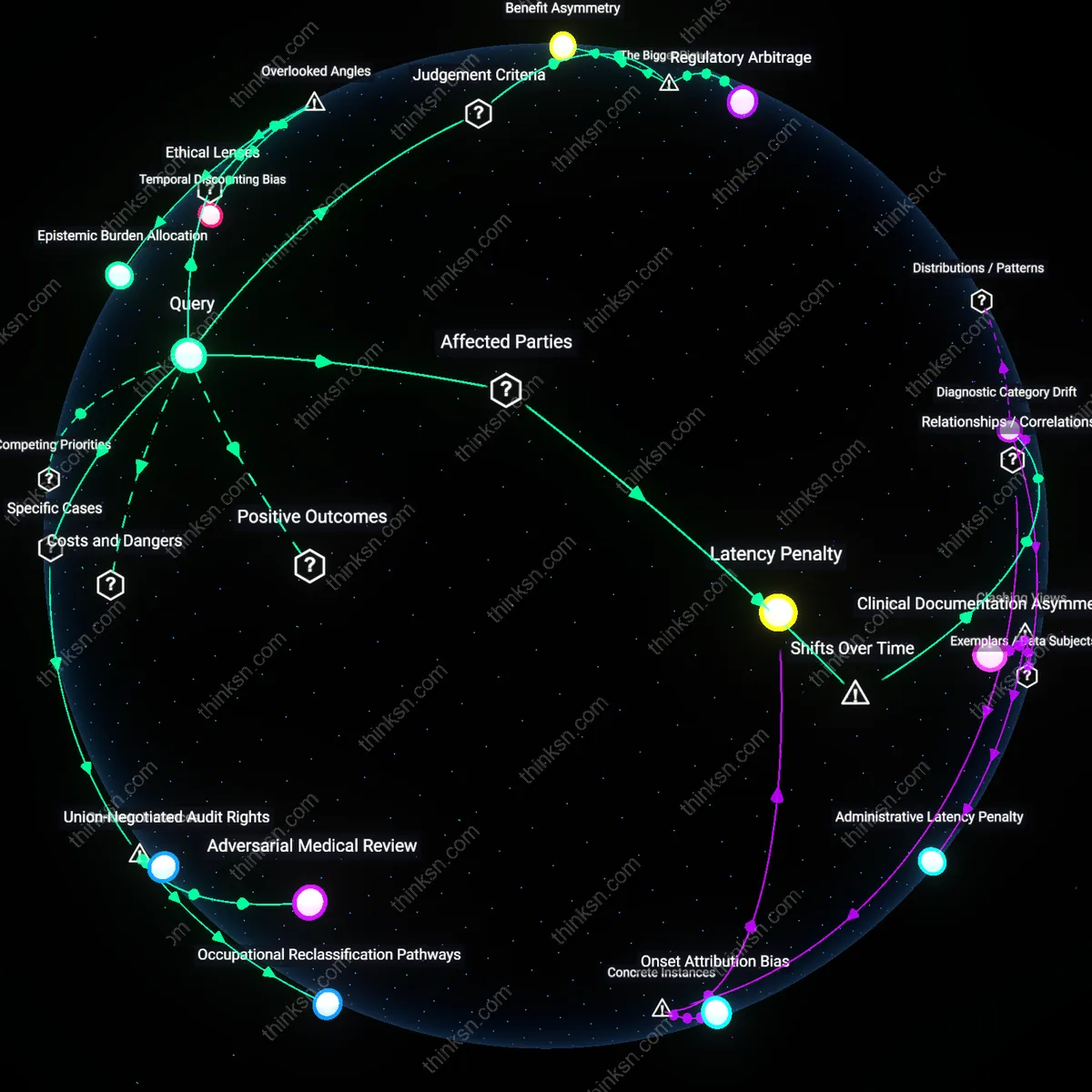
Analysis reveals 9 key thematic connections.
Key Findings
Diagnostic Category Drift
An employee can evaluate fairness by tracking how the definition of 'non-occupational' has shifted since the 1996 HIPAA amendments, when comorbidity exclusions were codified in small-group insurance markets, prompting insurers to reclassify once-covered chronic conditions as 'pre-existing' through retrospective diagnosis matching, a process enabled by pooled claims data and standardized coding systems like ICD-9-CM. The overlooked consequence is that diagnostic categories—originally clinical tools—have become temporal gatekeepers, where the same condition may be deemed eligible or not depending on when it was documented relative to employment onset, exposing a hidden timeline arbitrage that disadvantages those with early-onset or intermittently managed illnesses.
Regulatory Arbitrage
An employee can evaluate fairness by scrutinizing how insurers exploit gaps between state insurance mandates and federal ERISA preemption to impose restrictive definitions of disability, a mechanism enabled by the fragmented U.S. benefits regulatory system. Insurers, acting under ERISA’s deferential judicial review standards, classify non-occupational impairments narrowly because federal law weakens state-level consumer protections, allowing medical determinations to be influenced by cost-containment incentives rather than clinical norms. This imbalance reveals the non-obvious reality that 'fairness' is structurally compromised not by individual bias but by deliberate jurisdictional fragmentation that insulates employer-sponsored plans from local accountability. The enabling condition is ERISA’s preemptive authority, which severs alignment between medical expertise and benefit eligibility, privileging fiduciary parsimony over embodied patient experience.
Diagnostic Gatekeeping
Employees can assess fairness by analyzing how insurers outsource classification credibility to third-party medical reviewers who apply protocolized checklists that depersonalize chronic symptomatology, a process legitimized by the institutional weight given to objective biomarkers over subjective patient reports. This system functions through specialized vendor firms like Maximus or eviCore, which are contracted by insurers to audit claims using criteria emphasizing functional capacity over illness trajectory, thus redefining 'work ability' as a technical calculation divorced from lived endurance. The underappreciated dynamic is that clinical neutrality is weaponized to sustain an epistemic hierarchy—where episodic testing overrides longitudinal suffering—enabling denial of claims without direct engagement with the employee’s experiential testimony. The key enabling condition is the medical-industrial complex’s alignment with actuarial logic, turning diagnostic authority into a gatekeeping function.
Benefit Asymmetry
An employee can gauge fairness by mapping how the employer’s delegation of risk to insurers creates a misaligned incentive structure where cost avoidance supersedes worker rehabilitation, particularly when benefit designs incentivize early claim termination through lump-sum buyouts or abbreviated appeal windows. This dynamic is enforced through reinsurance markets—like those provided by Lloyds of London or Swiss Re—where risk pools are priced based on historical denial rates, pressuring primary insurers to maximize exclusions for conditions with variable functional impacts, such as fibromyalgia or long COVID. The non-obvious consequence is that fairness becomes actuarially calculated rather than ethically determined, embedded in hidden contractual flows between large employers and reinsurers who collectively shape what counts as a 'legitimate' chronic condition. The residual pressure arises from the unaccountable feedback loop between reinsurance economics and frontline claims adjudication.
Epistemic Burden Allocation
An employee can evaluate fairness by scrutinizing how the insurer delegates the burden of proving functional limitations to the claimant, a mechanism governed by liberal contractualism where obligations are fulfilled only when explicitly demonstrated. Disability classifications often require employees to produce medical evidence in forms and frequencies that exceed clinical norms, effectively shifting epistemic labor onto chronically ill individuals whose conditions fluctuate and resist documentation—this asymmetry is rarely challenged because legal frameworks assume procedural neutrality, yet in chronic illness, the demand for constant verification compounds cognitive and emotional exhaustion. What is overlooked is that the scheduling and format of evidence submission—such as requiring monthly physician letters for conditions with slow progression—functions as a covert exclusion mechanism, making the evaluation of fairness hinge not on outcome but on the distribution of epistemic effort, which disproportionately disadvantages those already impaired by systemic fatigue and medical gaslighting.
Temporal Discounting Bias
An employee should assess whether the insurer’s classification system discounts future functional capacity based on current performance, a practice rooted in actuarial utilitarianism that prioritizes cost-benefit efficiency over biographical continuity. Chronic conditions often involve remission-relapse cycles misinterpreted as non-credibility or malingering, leading insurers to collapse a person’s identity into episodic data points rather than recognizing longitudinal patterns validated by neurology or immunology. The overlooked dynamic is that insurers apply a presentist temporal logic—where temporary improvement invalidates long-term impairment—despite clinical consensus that diseases like ME/CFS or lupus are defined by unpredictability; this temporal mismatch systematically invalidates claims not through outright denial but through a hidden time-based skepticism that contradicts medical epistemology, rendering fairness evaluations incomplete unless they account for how time is weaponized against episodic disability.
Adversarial Medical Review
An employee can evaluate fairness by scrutinizing the use of third-party medical reviewers with financial ties to insurers, as seen in UnumProvident’s 2007 U.S. Senate investigation, where the company systematically used in-house physicians to override treating doctors’ disability assessments, revealing a structural bias embedded in the review process. This mechanism privileged actuarial risk management over clinical continuity, exposing how insurer-controlled medical adjudication undermines employee trust even when benefits are employer-sponsored. The significance lies in demonstrating that the imbalance of power is not merely procedural but medically instrumentalized—medical authority is co-opted to serve financial outcomes.
Occupational Reclassification Pathways
An employee can assess fairness by mapping how insurers reclassify job duties using proprietary job databases like DISCO (Dictionary of Occupational Titles successor), as demonstrated in the 2014 MetLife ERISA litigation, where plaintiffs showed that non-occupational disability determinations were based on algorithmically minimized physical demands that ignored actual workplace conditions. The mechanism here is the substitution of empirical job tasks with insurer-defined occupational categories, which allows denial of claims by redefining what the claimant ‘can do’ in abstract labor markets rather than their real work environment. This reveals how power asymmetry is automated through seemingly neutral vocational taxonomies.
Union-Negotiated Audit Rights
An employee can leverage collective bargaining provisions that mandate transparency in disability determinations, as exemplified by the 2016 SEIU Local 775 health care workers’ agreement with Group Health Cooperative in Washington State, which included enforceable access to insurer decision logs and external review panels. The mechanism operates through contractual obligations that shift information control from insurer to plan participants, enabling employees to contest non-occupational classifications using audited clinical and administrative records. This shows that power imbalance can be institutionally countered when disability evaluation is embedded in labor rights rather than left to individual appeal.