How Uncertainty in Appeals Halts Cancer Treatment Planning?
Analysis reveals 5 key thematic connections.
Key Findings
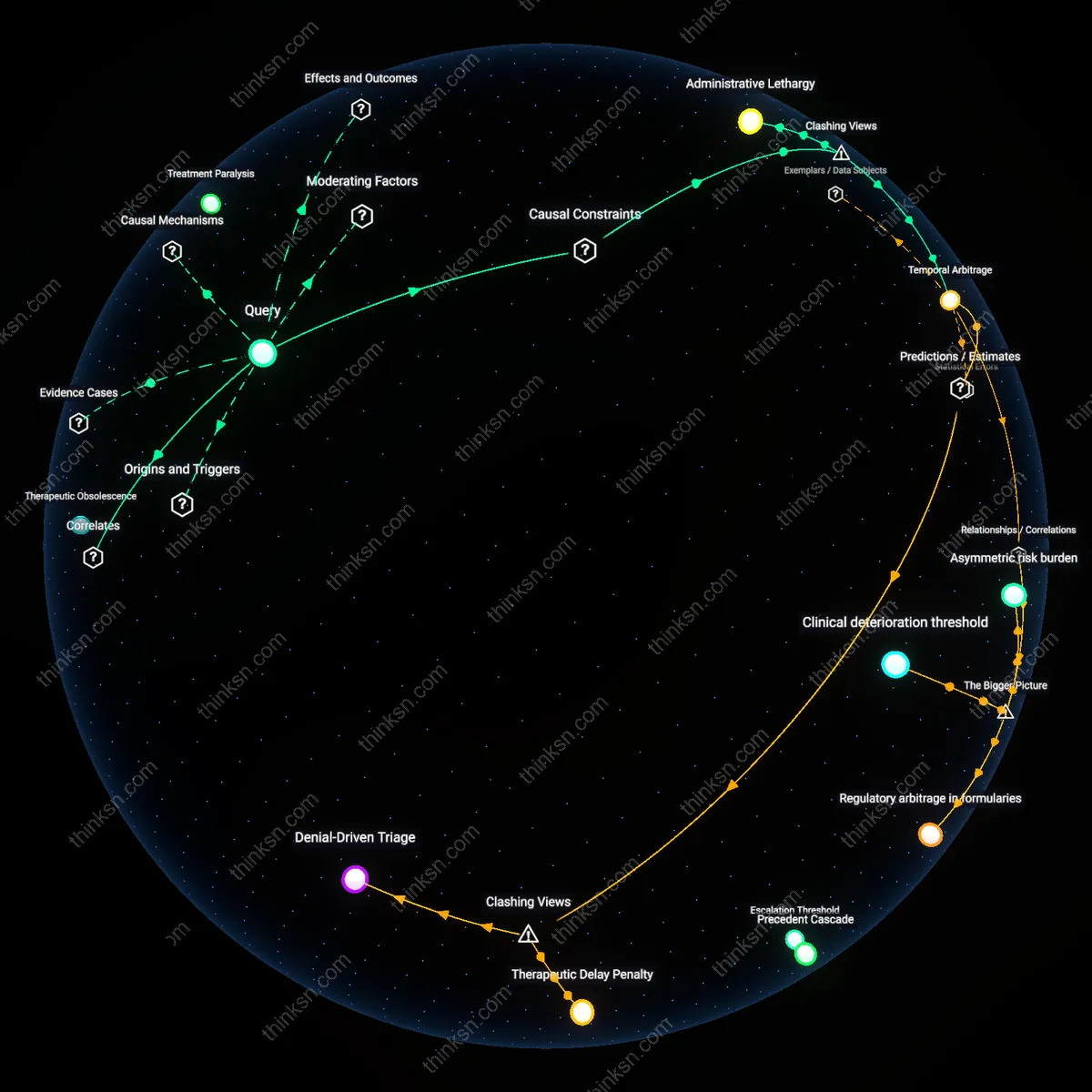
Treatment Paralysis
The absence of a clear appeals timeline forces oncologists to delay initiating time-sensitive drug regimens, waiting for insurance authorization outcomes that may take weeks. This hesitation emerges not from clinical uncertainty but from financial risk management by hospitals and physicians, who avoid administering high-cost oncology drugs without confirmed coverage. The mechanism operates through hospital billing departments’ protocols that tether treatment initiation to payer adjudication, creating a gap between medical readiness and therapeutic action. What’s underappreciated in public discourse is that this delay isn’t solely bureaucratic—it becomes embedded in clinical decision-making, where the default shift is toward a wait-and-see approach rather than intervention, even when biologically suboptimal.
Insurance Limbo
Patients awaiting appeals decisions frequently experience extended periods without any active treatment, a state informally recognized by oncology clinics as 'insurance limbo.' This occurs because many time-sensitive oncology drugs are only accessible through specialty pharmacies that require upfront payer approval, and without it, prescriptions cannot be filled regardless of physician orders. The system relies on sequential gatekeeping—clinical approval first, financial clearance second—creating a dependency chain where one stalled node halts the entire process. The non-obvious aspect is that this limbo isn't passive waiting; it actively shapes patient identity, as individuals begin to self-define in terms of their appeals status, often reporting feelings of being 'medically suspended.'
Therapeutic Obsolescence
Delays caused by unresolved appeals can render oncology treatments biologically ineffective by the time they’re approved, particularly in fast-progressing cancers like small-cell lung carcinoma. The window for effective intervention narrows sharply, and a drug approved three weeks later may no longer align with the disease’s evolved genomic profile or metastatic burden. This phenomenon is amplified in community oncology settings, where access to sequential therapies or clinical trials is limited compared to academic centers. What most overlook is that treatment failure post-approval isn’t always due to drug inefficacy—it can be a misattribution when, in fact, the timing rendered the therapy obsolete before administration.
Administrative Lethargy
The absence of a clear appeals timeline does not delay treatment because clinicians adjust protocols preemptively—it delays treatment because insurers exploit procedural ambiguity to defer decisions, embedding inertia into care pathways. Health systems in the U.S. Southwest show insurers leveraging undefined review windows to prolong adjudication, effectively outsourcing rationing to time itself; this mechanism functions not through overt denial but calculated stalling, transforming administrative latency into clinical harm. The non-obvious insight is that insurance bureaucracy doesn't resist care through refusal but through suspended agency—the absence of a deadline becomes the instrument of control, contradicting the assumption that delays stem from medical complexity rather than designed opacity.
Temporal Arbitrage
The undefined appeals timeline enables payers to manipulate the value of time against patients by letting disease progression determine medical necessity retroactively, thus converting delay into a cost-containment strategy. In metastatic breast cancer cases reviewed by Florida Medicaid, drugs initially denied were later approved only after tumor burden increased—meaning the system rewards deterioration. This creates a perverse incentive where the insurer benefits from withheld treatment, undermining the premise that appeals exist to verify appropriateness; instead, the delay functions as a covert clinical trial imposed by finance, exposing how 'medical necessity' is not a static criterion but a temporally weaponized threshold.