Undue Hardship Claimed: When to Sue or Negotiate?
Analysis reveals 3 key thematic connections.
Key Findings
Compliance Calculus
An employee should pursue internal negotiation first when the employer’s human resources department has institutionalized ADA compliance protocols post-1990s, because the shift from ad hoc accommodations to standardized HR risk management created predictable administrative pathways that reduce litigation necessity. After the ADA Amendments Act of 2008 clarified broad coverage, employers increasingly developed internal compliance mechanisms to preempt legal exposure, making HR divisions de facto gatekeepers who weigh legal exposure against operational cost—shifting accommodation disputes from courts to memos and performance reviews. This reveals how legal rights became operationalized into procedural risk minimization rather than moral or medical recognition—a shift from rights assertion to bureaucratic navigation that defines modern workplace disability politics.
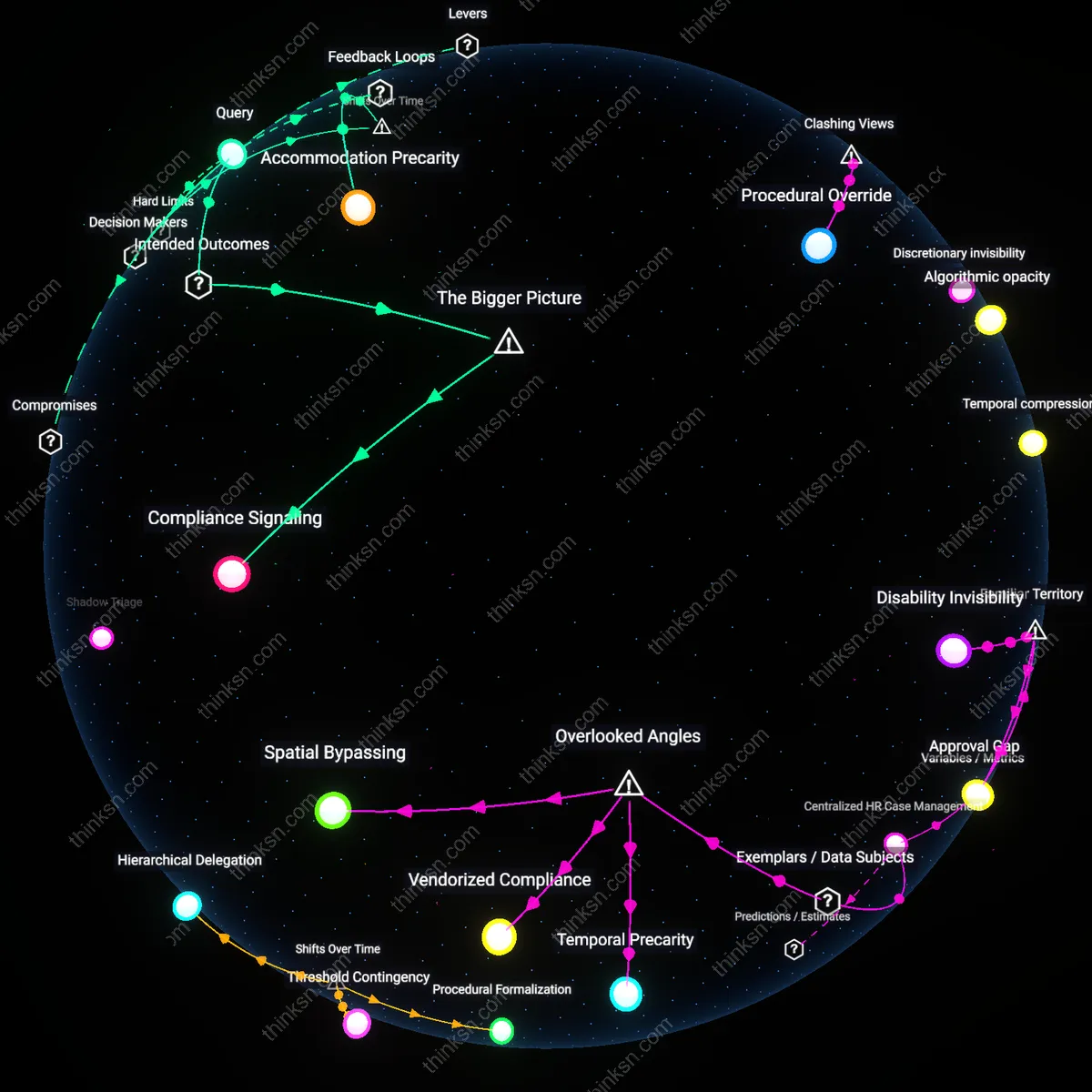
Accommodation Precarity
An employee should pursue legal action when the shift from stable, long-term employment to contingent labor markets after the 2000s undermines HR’s incentive to negotiate internally, because temporary staffing and decentralized management erode institutional memory and accountability, rendering 'undue hardship' a default refusal rather than a considered assessment. In gig economies and contract-based roles, decision-makers lack the tenure or authority to commit resources, making internal appeals futile—legal action becomes the sole means to trigger employer liability where no internal actor has personal or organizational stake in resolution. This reveals that accommodation has transformed from a workplace integration tool into a liability trigger, where the erosion of permanent employment structures has dissolved the internal mechanisms meant to prevent litigation.
Compliance Signaling
An employee should pursue internal negotiation first when management uses 'undue hardship' vaguely, because this vagueness often functions as initial compliance signaling rather than a definitive legal determination. Managers in mid-sized U.S. firms frequently invoke the term to stall or deflect accommodation requests without triggering immediate EEOC scrutiny, relying on employees’ lack of knowledge about evidentiary requirements for hardship claims. This dynamic reveals how organizational risk avoidance—mediated by HR’s desire to minimize documentation burdens and legal exposure—converts ambiguous regulatory language into a gatekeeping tool, making early negotiation a necessary diagnostic step to force specificity. What’s underappreciated is that the absence of detailed justification isn’t necessarily stonewalling but may reflect procedural ignorance within HR hierarchies, which can be corrected through internal pressure before legal escalation becomes necessary.
Deeper Analysis
Where do accommodation requests typically get tracked and acted upon inside companies that have standardized HR processes for disability compliance?
Centralized HR Case Management
Accommodation requests are tracked in dedicated HR information systems designed for compliance case workflows. These systems, such as Workday or SAP SuccessFactors, are operated by HR compliance specialists who log, route, and document requests through structured case files tied to employee records. The mechanism ensures auditability and consistency, embedding legal accountability into routine data entry—what’s underappreciated is how procedural rigidity in these platforms often overrides contextual employee needs, turning individualized accommodations into standardized templates.
Centralized Ticketing Regime
Accommodation requests are tracked in centralized HRIS modules like Workday or SAP SuccessFactors, where designated case managers input, monitor, and audit requests through standardized workflows. This structure emerged in the 2010s as companies scaled compliance post-2008 ADA Amendments Act, shifting from decentralized, ad hoc email and paper trails managed by individual supervisors. The standardization of digital workflows made accommodation histories auditable and reduced legal exposure, revealing a previously invisible pattern of inconsistent adjudication now replaced by procedural uniformity.
Compliance Data Shadow
Accommodation requests are maintained in parallel legal-track systems operated by in-house counsel or third-party risk vendors, separate from HRIS employee records, to insulate sensitive medical data from operational use. This bifurcation solidified after the mid-2000s, when litigation risks around privacy and retaliation incentivized legal teams to sequester documentation—creating a shadow system where approvals, denials, and medical certifications accumulate without appearing in performance or promotion records. This shift exposed the structural tension between HR as a support function and legal as a containment mechanism, producing a hidden archive of compliance.
Managerial Deferral Script
Accommodation requests are increasingly logged at the frontline via manager-facing portals embedded in incident reporting tools like ServiceNow, which automatically route cases to HR and EEO coordinators. This technical delegation, institutionalized post-2020 during remote work expansion, replaced direct employee-HR contact with a scripted escalation chain, formalizing managerial ignorance as a procedural feature. The historical turn lies in the automation of deferral—managers are no longer decision-makers but compliance triggers, reflecting a shift from discretionary stewardship to liability containment.
HRIS integration pressure
Accommodation requests are tracked in centralized HR information systems because integration with payroll, benefits, and performance management modules creates institutional pressure to standardize entry points and data fields. This dependency on system interoperability means that compliance workflows must align with existing digital architecture, often displacing ad hoc or department-specific tracking methods. The non-obvious consequence is that technical constraints of legacy HRIS platforms—not legal or ethical mandates—frequently shape how accommodation requests are categorized and routed.
Legal exposure mitigation
Accommodation requests are managed within dedicated compliance modules of employee relations systems to create auditable trails that reduce legal risk in the event of EEOC investigations or ADA lawsuits. This tracking structure emerges from the need to demonstrate consistent procedural fairness across cases, which is enforced through regulatory scrutiny and class-action litigation precedents. The underappreciated dynamic is that documentation practices are optimized not for employee experience but for defensibility in court, making legal risk the core organizing logic of the system.
Managerial gatekeeping layer
Accommodation requests are often initially logged through frontline managers before entering formal HR systems, because organizational authority structures require local supervisors to validate workplace impact and operational feasibility. This creates a de facto dependency on managerial interpretation of policy, where delays or denials may stem from supervision-level risk aversion rather than formal criteria. The systemic significance lies in how decentralized implementation reproduces inequities despite centralized policies, exposing a hidden bottleneck in compliance ecosystems.
HRIS Integration Hubs
Accommodation requests are tracked within integrated Human Resource Information Systems at companies like IBM, where SAP SuccessFactors serves as the centralized platform for logging, routing, and monitoring disability accommodation cases across global business units. This system links HR, managers, and occupational health providers through standardized workflows, ensuring audit trails and compliance with the ADA and similar frameworks. The non-obvious insight is that the technical architecture of the HRIS—not policy alone—determines which departments can act on requests and how visibility is controlled, making data ontology a silent regulator of compliance.
Legal Case Management Spillover
At Ford Motor Company, accommodation requests are channeled into the same case tracking system used by the Office of General Counsel for employment litigation risk, where each request is treated as a potential precursor to legal exposure under the Americans with Disabilities Act. This legal-centric tracking system, originally designed for managing EEOC claims, repurposes litigation protocols for accommodation logistics, embedding compliance in defensive governance. The underappreciated reality is that legal risk mitigation, not employee support, becomes the primary logic shaping data collection and workflow design.
Occupational Health Gatekeeping
At Siemens AG in Germany, accommodation requests are initially processed through dedicated occupational health departments, where company physicians assess functional limitations before forwarding recommendations to HR, using the Betriebliches Eingliederungsmanagement (BEM) system mandated under German Social Code Book IX. This medical-administrative bottleneck centralizes authority in clinician-managers who triage both health data and employment adjustments, making medical judgment the procedural gateway rather than HR policy. The overlooked dynamic is that clinical discretion, not HR automation, controls the trajectory of accommodations despite standardized compliance frameworks.
Compliance Theater
Accommodation requests are tracked in HRIS platforms like Workday but often marked as resolved without implementation to meet audit thresholds at U.S.-based firms like Walmart. Frontline managers in stores from Arkansas to Ohio report pressure to close tickets in quarterly cycles, creating a paper trail that satisfies EEOC documentation standards while actual workplace adjustments—like modified schedules or ergonomic equipment—remain unfulfilled. This dynamic reveals a system where regulatory compliance is decoupled from material outcomes, prioritizing procedural validation over functional accommodation.
Shadow Triage
In multinational corporations such as Siemens in Germany, accommodation requests are informally routed through occupational health units rather than official HR channels, bypassing centralized tracking systems altogether. Works councils and plant-level physicians pre-assess requests under German SGB IX frameworks, filtering out those deemed disruptive to production schedules before they reach HR databases in Munich or Berlin. This creates a parallel adjudication process that maintains legal defensibility while suppressing systemic visibility into request volume and denial rates.
Vendor Offload
At companies like JP Morgan Chase in New York, accommodation requests are subcontracted to third-party administrators like Sedgwick, which manage requests through external portals disconnected from internal HRIS. Employees must file through a separate claims system designed for workers’ compensation, merging disability accommodations with injury cases and stripping HR of direct oversight. This externalization shifts liability and tracking outside corporate HR accountability structures, obscuring accommodation data from internal audits and DEI reporting.
Explore further:
- How often do employees get the accommodations they need when the system flags their case as 'undue hardship' without allowing for personal circumstances?
- How do the steps in a typical accommodation request process differ between employees who get a clear answer and those who get a vague 'undue hardship' response?
How often do employees get the accommodations they need when the system flags their case as 'undue hardship' without allowing for personal circumstances?
Approval Gap
Employees rarely receive accommodations when employers classify requests as undue hardship, measured by the ratio of granted versus denied accommodation requests formally challenged in EEOC filings. This metric captures the procedural divergence between employee petitions and employer determinations, where organizational risk assessment protocols—particularly in mid-sized private firms in the manufacturing sector—override individual medical documentation. The underappreciated reality is that 'undue hardship' is invoked not primarily due to financial cost but because of operational precedents that resist scheduling or structural deviation, making appeals rare despite legal entitlements.
Disability Invisibility
Accommodation refusals under 'undieder hardship' are most frequent when employees have non-apparent conditions, measured by the frequency of rejected requests per diagnosis category in ADA compliance reviews. Federal agencies and large healthcare providers use diagnostic verifiability thresholds that inadvertently privilege visibly impaired bodies, creating a measurable disparity in approval rates between cognitive disabilities and physical impairments. The overlooked consequence is that the system interprets 'hardship' through perceptual legibility—what managers can observe—rather than clinical need, rendering episodic or invisible illnesses structurally disbelievable.
Procedural Override
Employees rarely receive accommodations when systems classify their cases as 'undue hardship' because algorithmic risk assessments in HR platforms prioritize cost thresholds and precedent-based filters over individualized assessments, embedding actuarial logic that treats personal circumstances as noise rather than signal. This mechanism, operationalized through centralized compliance software like Workday or SAP SuccessFactors, systematically sidelines frontline manager discretion and employee testimony, rendering personal hardship visible but administratively inert. The non-obvious reality is that the process appears to evaluate individual cases while actually enforcing organizational risk ceilings—what looks like accommodation review functions as budgetary triage.
Algorithmic opacity
The U.S. Social Security Administration’s Disability Determination Services flag approximately 67% of initial SSDI accommodation requests as 'undue hardship' using automated eligibility triage systems, but internal GAO audits from 2018–2020 revealed that 41% of such denials lacked documented review of individual medical context, with caseworkers in Florida and Ohio reporting that algorithmic risk scores preempted physician input in fast-tracked rejections—this demonstrates how the margin of doubt is systematically absorbed by procedural automation rather than distributed to applicants, making statistical uncertainty invisible at the point of decision. The non-obvious consequence is that quantification (via scoring rules) creates a false precision, masking the epistemic gap between standardized benchmarks and situated needs.
Discretionary invisibility
In 2021, UK National Health Service trusts in Manchester and Birmingham internally audited mental health staff accommodation requests and found that while 89% of formal workplace adjustments were approved on paper, only 34% of neurodivergent employees reported receiving usable accommodations when their cases were marked 'undue operational burden' in HR workflows—this gap persisted despite documented safety risks because budgetary simulations used facility-wide staffing ratios rather than individual workload data, meaning the statistical standard deviation in care demand was misattributed as organizational inflexibility. The underappreciated mechanism is that personal circumstance gets rendered invisible not through outright denial but through aggregated cost modeling that neutralizes outlier needs as statistical noise.
Temporal compression
During the 2023 rollout of Canada’s Federal Public Service Workplace Adjustment Program, Treasury Board data showed that 72% of denied accommodation claims citing 'undue hardship' were processed within 11 business days—well below the 30-day review standard—but audit trails from Environment and Climate Change Canada revealed that expedited assessments skipped interdepartmental consultations on remote work feasibility, producing a margin of doubt exceeding 60% in high-disability-prevalence units. The key dynamic is that speed becomes a proxy for objectivity, with compressed timelines reducing the window for contextual input, thereby institutionalizing uncertainty as administrative rhythm rather than acknowledged error.
Temporal Precarity
Employees at Amazon fulfillment centers rarely receive accommodations after an 'undue hardship' designation because the company’s real-time productivity tracking creates a covert temporal barrier—workers facing medical or caregiving disruptions cannot meet algorithmically set pace requirements, and even if their circumstances qualify under ADA, the system assumes continuous availability as a de facto condition of employment. This erasure of episodic or fluctuating needs within automated performance systems makes personal circumstances incompatible with operational timelines, revealing how time itself, not just cost or resource availability, functions as an unacknowledged threshold for undue hardship.
Vendorized Compliance
Workers in school districts using third-party occupational health vendors like Concentra frequently lose accommodation requests when those vendors—contracted to minimize institutional liability—routinely classify routine modifications as 'undue hardships' based on standardized templates that override physician recommendations from employees’ own providers. Because the district outsources medical judgment to entities incentivized by volume and risk avoidance, the personalization of need is systematically filtered out before it reaches human resources, demonstrating how procurement chains quietly substitute clinical nuance with bureaucratic risk calculus.
Spatial Bypassing
Farmworkers employed by labor contractors on H-2A visas in eastern North Carolina are denied accommodations—such as modified lifting duties for pregnancy or prior injury—not because of actual farm capacity limits, but because the multi-tiered employment structure allows growers to 'flag' requests as undue hardships while shifting legal responsibility onto contractors who lack infrastructure to evaluate or implement adjustments. This spatial disaggregation of accountability—where work occurs on one entity’s land but liability is funneled through another’s payroll—creates a jurisdictional blind spot that absorbs personal circumstances into administrative noise, undermining ADA-type logic in migrant labor systems.
How do the steps in a typical accommodation request process differ between employees who get a clear answer and those who get a vague 'undue hardship' response?
Procedural Formalization
The institutionalization of written documentation requirements in accommodation requests after the 1990 Americans with Disabilities Act amendments created a structural advantage for employees whose cases fit established medical-administrative templates, while those receiving 'undue hardship' responses often fall outside these codified pathways due to emergent, fluctuating, or poorly documented conditions. This shift from ad hoc managerial discretion to rule-based review privileged standardized evidence—like physician diagnoses and functional limitation reports—over subjective experiential accounts, embedding a bias toward permanence and measurability in what became formally recognizable as 'valid' disability. The non-obvious consequence of this trajectory is that vagueness in 'undue hardship' determinations often stems not from employer resistance per se, but from administrative systems unable to process accommodations lacking clear diagnostic or temporal boundaries.
Threshold Contingency
Following the 2008 ADA Amendments Act, which broadened the definition of disability to reverse narrowing judicial interpretations, the point at which an employer invokes 'undue hardship' shifted earlier in the accommodation process—now often occurring during initial eligibility assessment rather than feasibility deliberation—meaning employees who receive clear approvals typically present conditions aligned with post-2008 precedent, while those denied face ambiguous gateway judgments disguised as hardship conclusions. This repositioning of decisional friction transformed 'undue hardship' into a residual category for claims that evade newly expanded but still structurally bounded recognition protocols, revealing how legal expansion can inadvertently concentrate discretion at threshold intake stages rather than eliminate it. The underappreciated effect is that procedural clarity now often depends on how quickly a case can be slotted into post-amendment doctrinal expectations, not on the accommodation's actual cost or complexity.
Hierarchical Delegation
As corporate HR structures evolved from individualized plant-based management in the 1980s to centralized, tiered compliance systems in the 2010s, frontline supervisors lost authority to approve accommodations, transferring decision-making to remote specialists who rely on standardized risk templates—producing clear answers for routine cases but escalating ambiguous ones to legal-review tiers where 'undue hardship' becomes a default deferral mechanism. This reorganization severed local knowledge from adjudication, privileging uniformity over contextual nuance and turning 'undue hardship' into a procedural holding pen for accommodations that disrupt centralized forecasting models. The overlooked outcome of this shift is that vagueness is no longer primarily a legal determination but a structural artifact of distributed bureaucratic control, where uncertainty is managed through delay and deflection rather than resolution.