Is Skipping Long-Term Care Insurance at 60 a Risky Move?
Analysis reveals 6 key thematic connections.
Key Findings
Family Care Leveraging
A person in their early sixties should forego long-term care insurance when embedded in a kinship network with demonstrated caregiving continuity, as seen in the 2015 Pew Research Center analysis of Japanese Okinawan families, where multigenerational household structures routinely absorbed elder care burdens without institutional support; this reveals a culturally institutionalized mechanism in which geographic proximity, Confucian-derived familial duty norms, and low formal care utilization collectively suppress the necessity for private insurance, highlighting how deeply structured family systems can function as de facto long-term care insurers.
Public Infrastructure Arbitrage
An individual in their early sixties may responsibly forgo long-term care insurance if residing in a jurisdiction with robust public eldercare infrastructure, such as Germany’s 1996 Pflegeversicherung (long-term care insurance) system, which mandates statutory coverage and funds home-based and facility care through payroll contributions; this publicly guaranteed safety net enables older adults to rely on state-supported services rather than private plans, illustrating how citizens can optimize personal financial allocation by leveraging pre-existing collective risk-pooling mechanisms designed for demographic aging.
Wealth Threshold Effect
High-net-worth individuals in their early sixties, such as those managing liquid assets exceeding $2 million as defined in the 2020 Fidelity Retirement Research study of non-institutionalized elders in Massachusetts, can rationally forgo long-term care insurance because their self-insurance capacity via diversified portfolios and home equity neutralizes catastrophic care cost risks; this financial buffer enables direct payment for in-home aides or assisted living without policy reliance, exposing a threshold effect where personal wealth supersedes insurance utility by transforming individual liquidity into a more flexible and accessible care financing instrument.
Intergenerational care debt
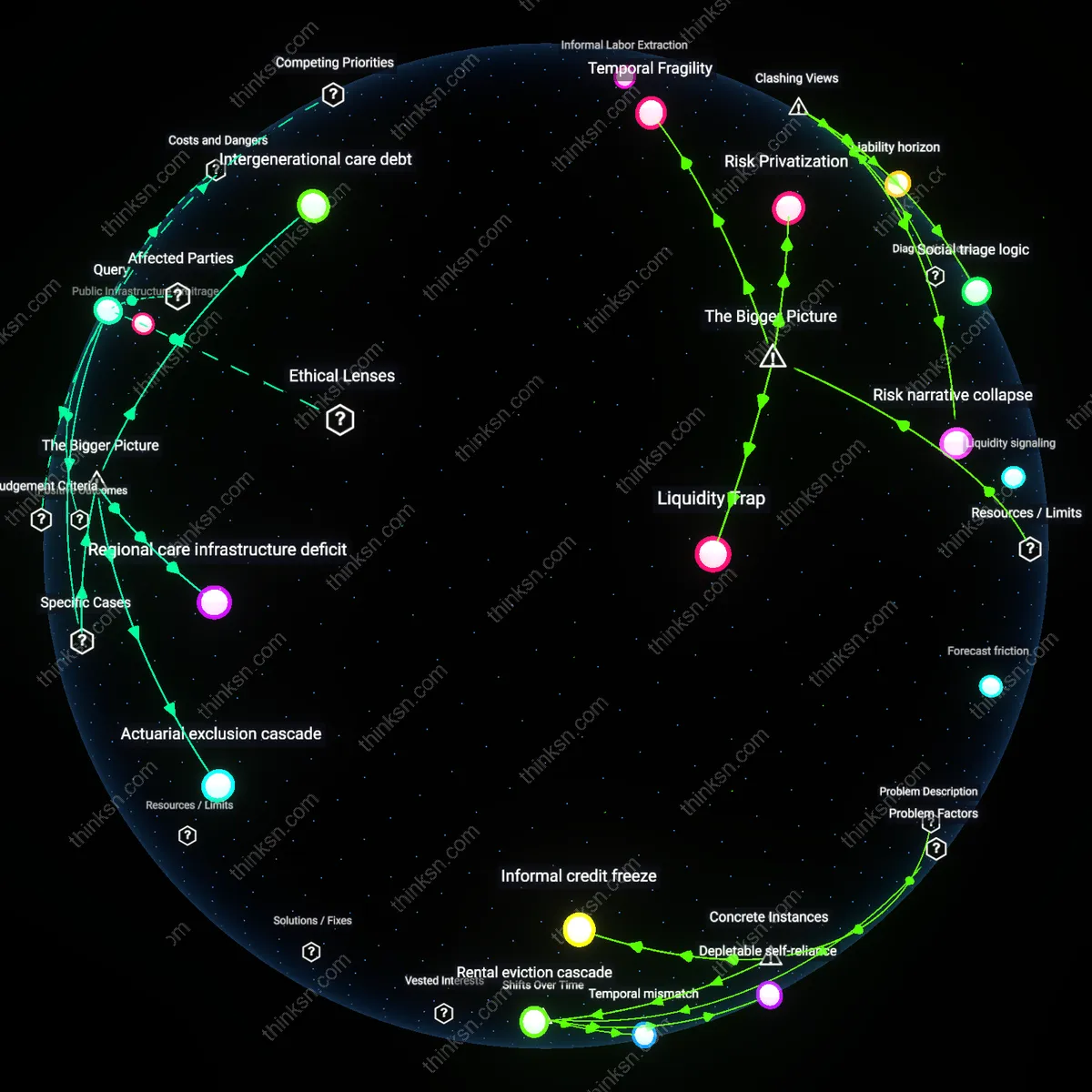
A person in their early sixties should forego long-term care insurance because reliance on family-provided care shifts financial and labor burdens onto younger kin, especially daughters and daughters-in-law, who disproportionately absorb unpaid caregiving. In the United States, where 53 million adults provide informal care—60% of whom are women—this dynamic reinforces a hidden system of intergenerational transfers that subsidizes the eldercare gap left by underdeveloped public infrastructure. The persistence of this pattern is enabled not by choice alone but by structural underfunding of social care and cultural expectations of familial duty, making family care a de facto public policy. The non-obvious insight is that foregoing insurance does not simply reflect personal risk calculation but activates an informal economic circuit where care becomes a deferred cost passed down generations.
Actuarial exclusion cascade
A person in their early sixties should not forego long-term care insurance because private insurers systematically price risk based on emergent health trajectories, and delaying purchase until symptoms appear locks individuals out of affordable coverage. In countries like the U.S., where private long-term care insurance dominates, carriers use medical underwriting to exclude or surcharge those with early signs of chronic conditions—such as prediabetes or mild cognitive impairment—rendering insurance inaccessible just as need becomes probable. This exclusion mechanism is amplified by rising premiums and insurer retreat from the market, as seen when Genworth Financial faced solvency pressures, leaving applicants with few options. The overlooked reality is that the decision to delay is not financially neutral but triggers an irreversible cascade where market actors, driven by risk pooling constraints, systematically disqualify late entrants, turning biological uncertainty into economic ineligibility.
Regional care infrastructure deficit
A person in their early sixties should forego long-term care insurance in regions where alternative care ecosystems—such as community-based cooperatives or publicly funded home care—function reliably, as seen in parts of Scandinavia and Germany, where state-supported models reduce dependence on both family and private markets. In Germany, the universal long-term care insurance system, introduced in 1995, covers home and institutional care, enabling older adults to access services without draining personal wealth or relying solely on kin, thereby diminishing the necessity of private supplemental plans. This structural alternative alters the calculus of individual insurance decisions by decoupling care access from familial availability or market participation. The underappreciated point is that the 'family-provided care' option is not a natural or cultural constant but emerges in inverse proportion to state-supported infrastructure, making insurance opt-outs viable only where public mechanisms preempt private failure.