Benefit Threshold Anticipation
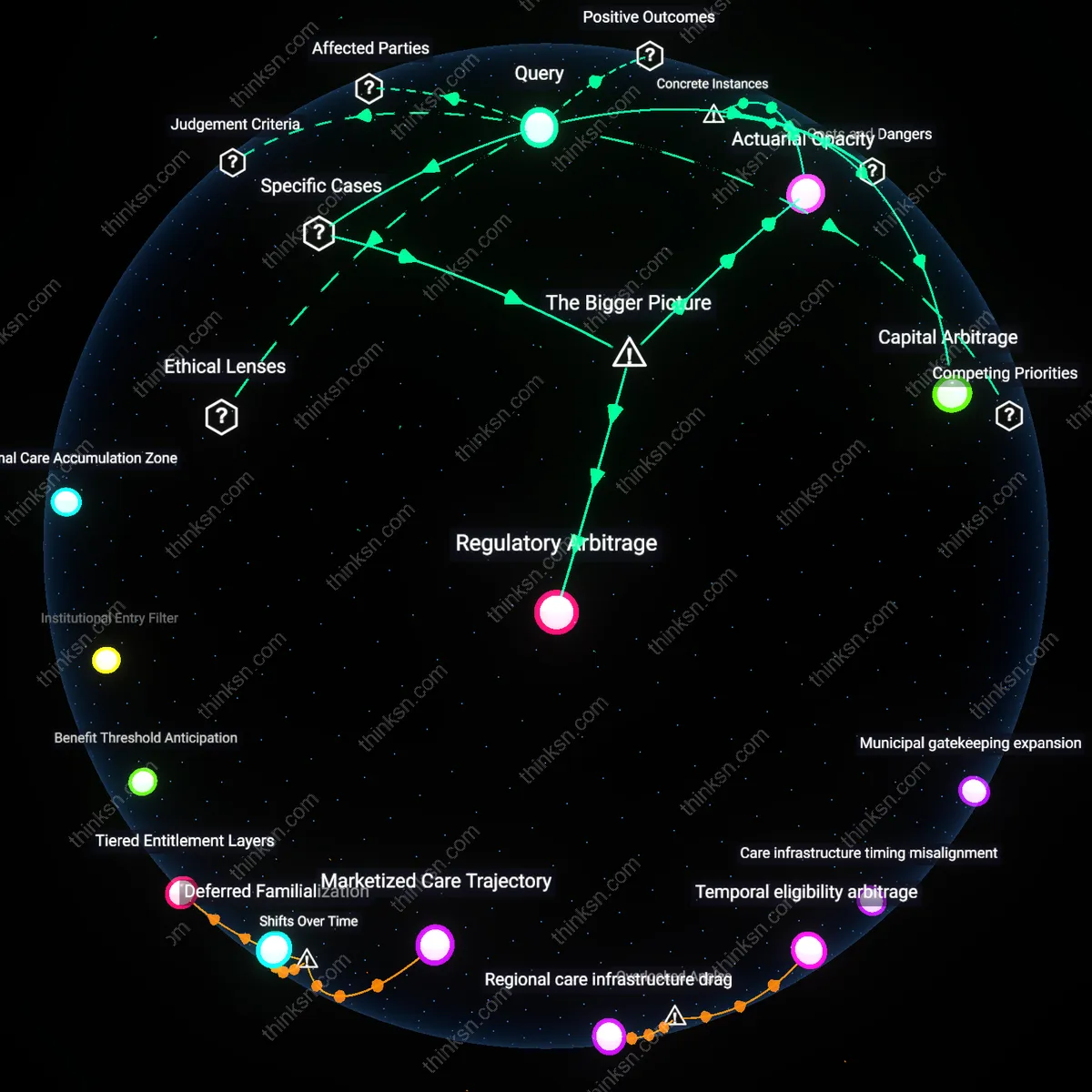
The gradual increase of care benefits in Germany causes family members to delay formal care applications until needs approach the next eligibility tier. Individuals and households actively monitor symptom progression not to seek help sooner, but to time bureaucratic entry when it yields tangible financial reimbursement. This behavior is driven by the tiered Pflegestufe system, where benefits jump significantly only at defined thresholds rather than scaling smoothly, making sub-threshold care economically invisible. The non-obvious effect is that caregiving effort becomes concentrated in informal networks precisely in the near-miss zones below threshold, where support is medically meaningful but financially unrewarded.
Institutional Entry Filter
The stepwise expansion of care benefits functions as a gatekeeping mechanism that reserves professional services for advanced stages of dependency. Because access to nursing homes or funded home-care hours depends on reaching higher care levels (Pflegegrad 3+), families initially absorb care tasks assuming they are temporary or manageable. This creates a de facto trial period where the state withholds support unless deterioration is sustained and documented. The underappreciated consequence is that institutional providers effectively inherit only those cases that have already exhausted familial capacity, shaping residential care as a last resort rather than a continuous option.
Informal Care Accumulation Zone
The incremental structure of German care benefits channels early- and mid-stage support into unpaid family labor, especially among middle-aged women related to the care recipient. Since lower Pflegegrade offer minimal compensation that doesn't cover full service costs, beneficiaries often use small cash payments to supplement rather than replace familial input. This turns modest benefit increases into indirect subsidies for private caregiving, reinforcing gendered and intergenerational care norms. What remains unseen is how the benefit schedule doesn't merely reflect care needs but actively constructs a zone of anticipated informality where state support is just visible enough to justify its own insufficiency.
Tiered Entitlement Layers
The phased expansion of German care benefits since reunification structured access according to legally defined dependency levels, creating a hierarchical system where formal state recognition of care needs determines both benefit magnitude and permissible types of support. This mechanism channels care recipients into specific service categories—ranging from in-home assistance to full residential care—based on bureaucratic assessments conducted by the Medical Service of the Health Funds (MDK), which means that who provides care (family members, private agencies, or institutional staff) is functionally determined by the stage at which entitlement is activated. The non-obvious result of this temporal development—particularly pronounced after the 2017 reform that redefined care levels (Pflegegrade)—is that the gradualism in benefit increases has less to do with actual care needs and more with administrative thresholds that sort people into fixed support regimes, thereby shaping provider roles ex ante rather than in response to evolving conditions.
Deferred Familialization
The incremental way German long-term care benefits have expanded since the 1994 introduction of the Pflegeversicherung progressively delayed the state's responsibility for direct care provision, relying instead on families—especially women—to absorb early- and mid-stage support work before benefits become sufficient to afford professional services. As benefit levels rose slowly over the 1995–2015 period, the state effectively subsidized informal care by making modest cash allowances (Pflegegeld) more accessible while keeping service entitlements below the cost of market-based alternatives, thus structuring a phase-dependent care ecology where families are compelled to act as primary providers during low-grade stages. This trajectory reveals that the gradualism was not merely fiscal caution but a deliberate deferral of state intervention, making family labor the systemic shock absorber across care transitions—an outcome visible only through the historical lens of incremental reform cycles rather than a single policy design moment.
Marketized Care Trajectory
The staged increase in German care benefits, particularly after the 2008–2010 liberalization of service providers, enabled the alignment of rising public entitlements with expanding private care-sector capacity, transforming care delivery from a household-responsibility model to a tiered market exchange where eligibility levels unlock access to a standardized service menu from officially certified providers. As statutory benefits gradually grew, they became calibrated not to facilitate autonomy but to sustain demand in a regulated quasi-market, where regional agencies (Pflegekassen) contract with private firms whose service designs shape what support is offered at each Pflegestufe. The underappreciated consequence of this shift—from dependency-based assistance to benefit-triggered purchasing power—is that care providers are no longer determined by familial or medical logic but by contractual availability within a state-subsidized market infrastructure that emerged distinctly in the post-2000 reform era.
Intergenerational bargain erosion
Gradual increases in German care benefits incentivize families to delay formal care system engagement, relying instead on informal care—especially from adult daughters—until needs exceed household capacity. This deferral is enabled by predictable, incremental benefit expansions that make early formal access financially suboptimal, reinforcing gendered caregiving roles within households while reducing short-term fiscal pressure on public programs. The non-obvious consequence is that policy design intended to sustain long-term care coverage unintentionally entrenches familial dependency as a structural subsidy, making systemic resilience dependent on private, unpaid labor that is increasingly scarce due to demographic and labor market shifts.
Municipal gatekeeping expansion
The stepwise expansion of care benefits in Germany empowers local social offices to act as de facto rationers of higher-tier support, requiring extensive documentation and assessments before beneficiaries access increased levels. Because eligibility is tied to gradated care levels (Pflegegrade), municipalities gain discretionary authority to interpret need, creating a bottleneck that shapes who receives what kind of support—and when. This dynamic reveals how national benefit design decentralizes triage decisions to frontline administrators, whose risk-averse practices amplify delays and filter access based on bureaucratic readiness rather than medical urgency, thereby embedding local administrative culture into the distribution of care.
Care infrastructure timing misalignment
Because care benefits in Germany rise incrementally in response to political and fiscal constraints rather than projected demographic demand, private and nonprofit care providers underinvest in scalable infrastructure, anticipating slow revenue growth. This creates a lag between rising care needs and available formal services, forcing reliance on patchwork solutions during transition periods between benefit stages. The underappreciated systemic effect is that the pace of benefit reform—not just its level—distorts market signals for care providers, making the availability of professional support contingent on policy rhythm rather than patient need, thereby privileging crisis-driven access over preventive, continuous care models.
Temporal eligibility arbitrage
The staggered rollout of care benefits in Germany enables middle-income households to strategically time family members’ entry into caregiving roles, aligning with benefit thresholds to maximize informal care input just before eligibility jumps; this creates a covert system of labor optimization where daughters or daughters-in-law delay formal employment or re-enter part-time work precisely at threshold points, leveraging the anticipation of increased state support to offset lost wages. This mechanism operates through the predictability of the Pflegestufe classification system, which announces future benefit levels years in advance, allowing families to coordinate around known inflection points—overlooked because standard analyses treat benefit increases as passive transfers rather than active triggers for intertemporal labor reshuffling. The significance lies in revealing how the calendar of benefit expansion, not just its level, distorts labor market behavior among secondary earners in ways invisible to income-based welfare models.
Regional care infrastructure drag
In western German states such as North Rhine-Westphalia, the incremental rise in care benefits has reinforced reliance on decentralized, familial support networks because local long-term care infrastructure has not scaled proportionally with benefit value, whereas in former East German states like Thuringia, where public caregiving institutions were preserved from GDR-era systems, the same benefit increases have been absorbed into professionalized services—creating a bifurcated care regime masked by nationally uniform benefit schedules. This divergence persists because federal benefit design assumes fungibility between informal and formal care, ignoring how legacy institutional endowments determine whether benefit increases translate into family labor release or institutional reinvestment; this is rarely acknowledged in comparative welfare state literature, which treats regional administrative variation as noise rather than a structuring force. The oversight matters because it misattributes reduced family burden to policy generosity when it may simply reflect pre-existing state capacity differences.