Should You Spend Your Estate on Parent Care Now or Later?
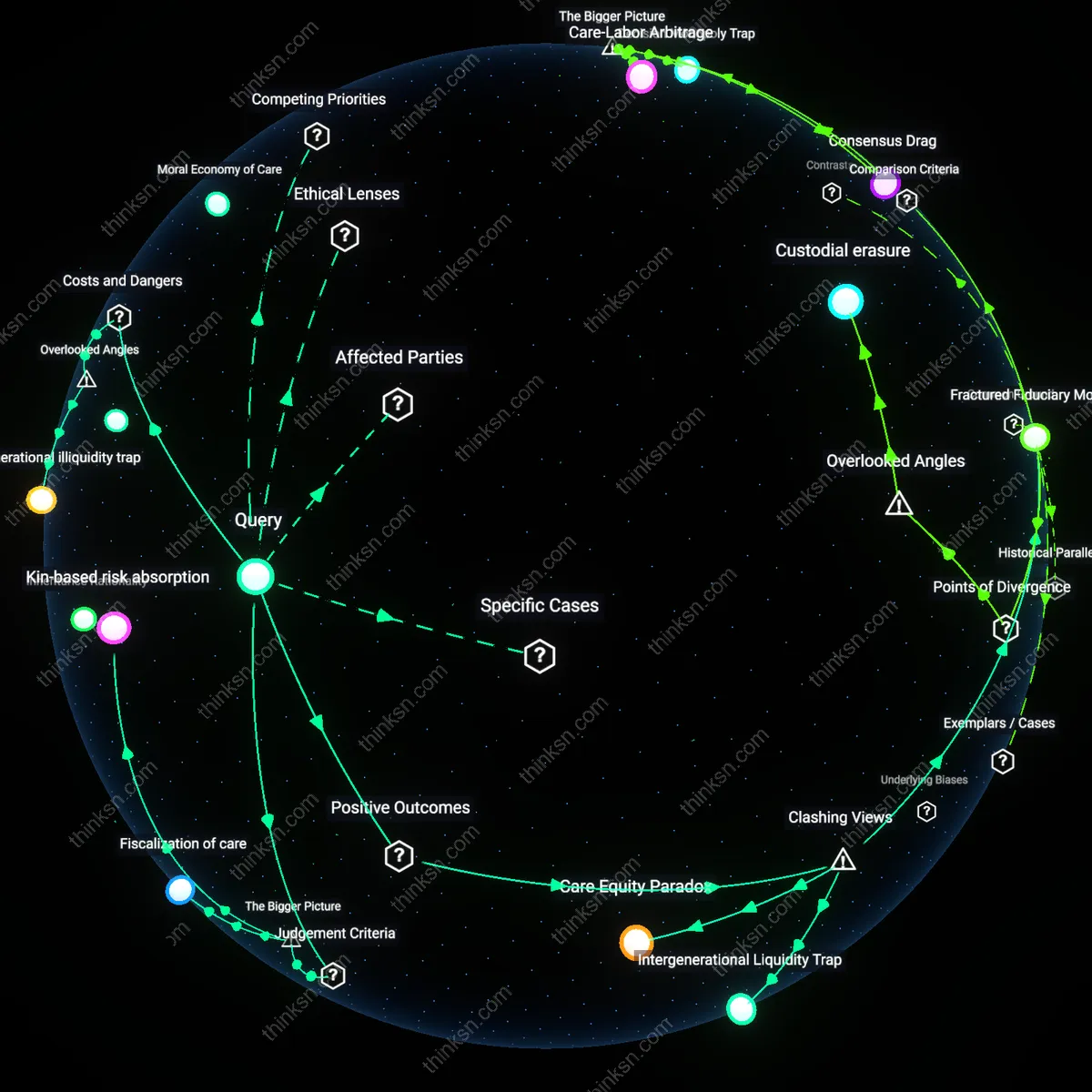
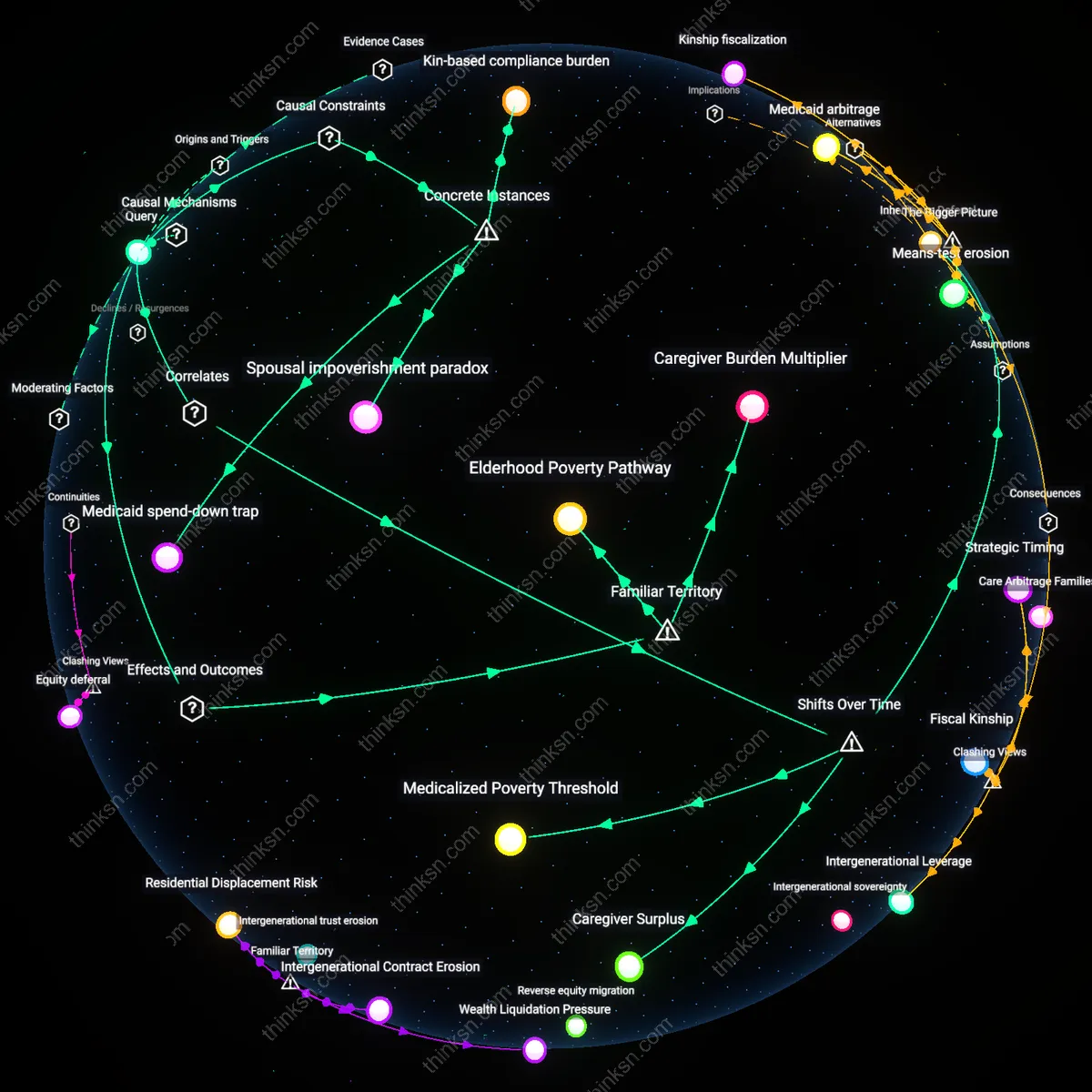
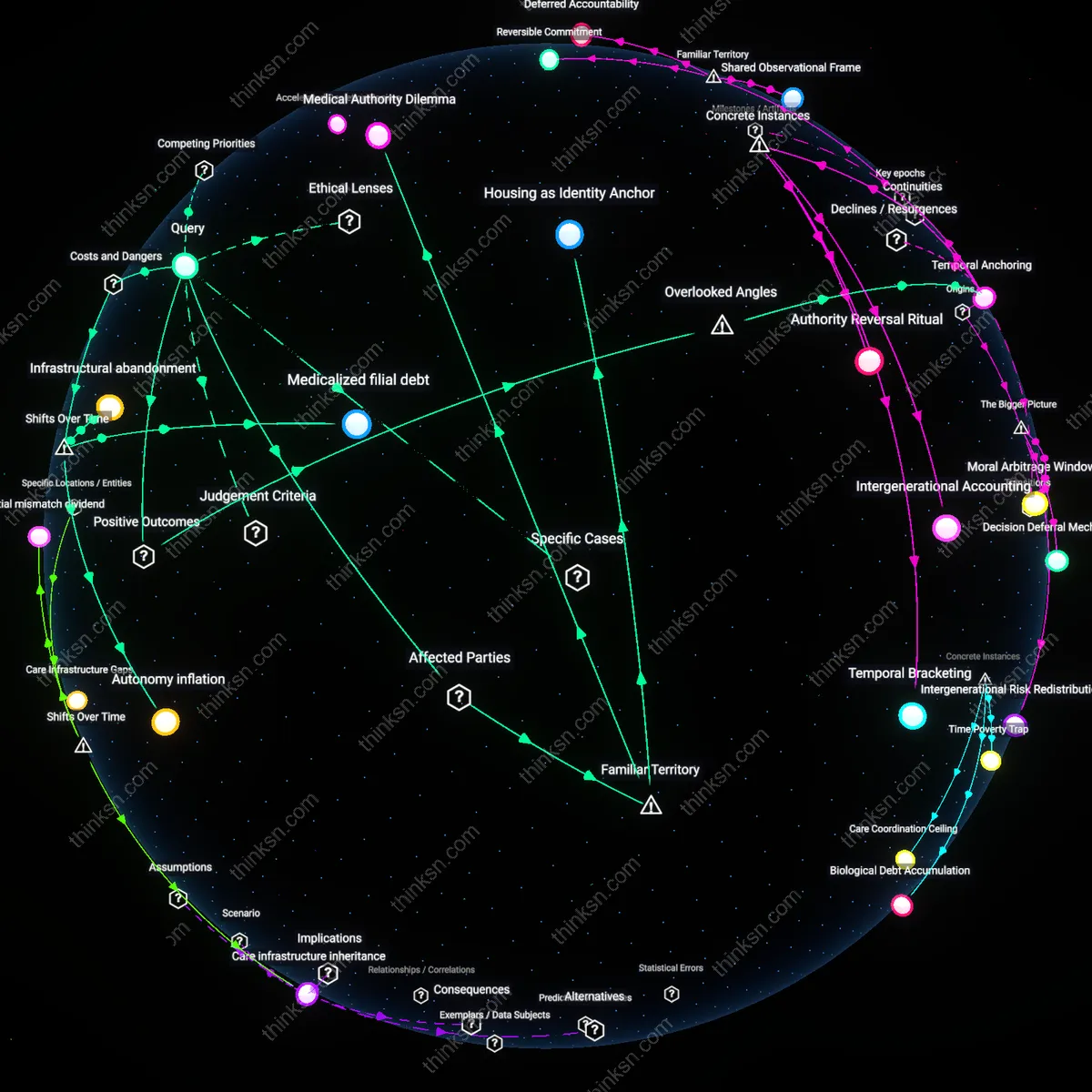
Analysis reveals 11 key thematic connections.
Key Findings
Temporal Equity
One should prioritize the parent's immediate healthcare over estate preservation because intergenerational justice requires balancing temporal asymmetries in need, not equal distribution. The elderly parent faces irreversible health deterioration, a non-deferrable claim on resources, whereas future generations can access capital through evolving labor markets, credit systems, or public infrastructure—conditions that dilute the moral weight of hoarded private wealth. This reframing treats time-specific vulnerability as the operative moral criterion, not familial duty or asset continuity, exposing how conventional estate planning often disguises presentist bias under claims of responsibility.
Fiduciary Distortion
Preserving the estate for future generations is ethically obligatory when the parent’s healthcare is partially covered by public systems, because premature private depletion subsidizes state disinvestment. In nations with universal healthcare—such as Canada or the UK—diverting modest estates to marginally extend care duration effectively privatizes a public good, rewarding policy underfunding and distorting the fiduciary role of family wealth from intergenerational security to crisis absorption. This reveals that familial financial sacrifice in such contexts becomes a concealed act of political acquiescence, normalizing the erosion of collective provision by redefining adequacy in narrowly private terms.
Vulnerability Arbitrage
The decision should be determined by which party holds greater structural exposure to systemic risk, which often favors the parent due to age-based precarity in housing, insurance, and income ceilings. Elderly individuals in the U.S. Southwest, for example, face compounding risks from underfunded Medicare, soaring senior housing costs, and climate-driven health events, making their vulnerability acutely site-specific and less insurable than younger heirs’ abstract future needs. This recalibrates the judgment from moral obligation to risk topology, showing that apparent ‘selfishness’ in spending may in fact be a rational hedge against collapsing social infrastructure—a move economics mislabels as consumption, but which functions as deferred social insurance.
Intergenerational Equity Mechanism
Prioritizing immediate healthcare funding for a parent through a modest estate strengthens long-term family stability by preventing medical debt accumulation, as seen in post-2008 Ohio working-class households where liquidating modest assets to cover elder dialysis costs forestalled public assistance reliance and preserved children's educational investment capacity; this mechanism functions through the alignment of immediate health expenditure with intergenerational cost avoidance, revealing that short-term asset depletion can generate long-term fiscal resilience for descendants.
Care Cascade Triggers
Directing a modest estate toward a parent’s urgent cancer treatment, as demonstrated by rural Kerala’s community-managed health trusts in the 2010s, enabled timely clinical intervention that reduced transmission risks of treatable comorbid infections across household members, operating through localized care networks that amplified individual medical spending into household-level health improvement, underscoring that immediate elder care can act as a prophylactic investment with distributed familial returns.
Estate Recalibration Model
In Amsterdam’s municipal elder-care partnership program (2015–2022), families who channeled modest inheritances into parent-supported assisted living—instead of preserving capital—generated unexpected liquidity through public co-financing triggers, where municipal matching funds converted personal expenditure into expanded service access, demonstrating that immediate estate use in healthcare can activate institutional leverage mechanisms otherwise unavailable to passive savings, a dynamic rarely captured in traditional inheritance planning.
Intergenerational Drain
Prioritizing a parent’s immediate healthcare with a modest estate accelerates the erosion of family wealth precisely when broader social safety nets have receded, shifting caregiving costs from state to kinship networks after the 1980s neoliberal policy turn. This privatization of elder care, exemplified in the U.S. by reduced Medicare coverage breadth and stagnant public assistance, compels families to liquidate intergenerational assets—a mechanism rarely needed during the mid-20th century’s expansive welfare state—to cover unpredictable medical spending, thus converting accumulated capital into emergency expenditures. The non-obvious consequence is that filial responsibility becomes a vector of downward mobility, not because of personal failure but due to structural disinvestment in public health infrastructure over the last fifty years.
Temporal Arbitrage
Distributing estate value toward immediate parental healthcare functions as a hidden form of temporal arbitrage, where older generations consume future capital to sustain present survival, a dynamic amplified by the post-1990s financialization of longevity. As medical technology extended the duration of chronic elder care, especially in OECD nations, families now face decades of managed decline rather than acute end-of-life events, transforming estates into recurring cash flows rather than terminal bequests. This shift—from seeing inheritances as post-mortem transfers to treating them as mid-stream infusions—reveals how delayed mortality has reconfigured kinship finance into an informal life-extending hedge fund, with children effectively short-selling their own future economic capacity.
Caregiver Solvency
Using a modest estate for a parent’s healthcare risks collapsing the financial solvency of the primary caregiver—typically a daughter or female sibling—who inherits not just debt but ongoing liability, a danger that crystallized after the 2008 recession when home equity and retirement savings sharply contracted. As employer-linked benefits weakened and wage stagnation spread across deindustrialized regions, families could no longer afford to ring-fence care costs from core assets, turning what were once buffer funds into frontline currency—exposing how the collapse of household surplus after 2010 erased the distinction between emergency and inheritance. The overlooked danger is that the person managing care often becomes the estate’s informal guarantor, absorbing losses that formal systems refuse to recognize as public risk.
Intergenerational Debt Scheduling
Prioritize parent healthcare spending when the family occupies a transitory socioeconomic tier where delayed medical intervention risks irreversible descent into public assistance dependency, as observed among lower-middle-class households in Rust Belt counties like Mahoning, Ohio, where home equity is the primary asset; the overlooked mechanism is the implicit 'debt scheduling' families perform across generations—deferring care today shifts costs onto children tomorrow through lost mobility and increased public burden, a dynamic masked by framing cost as immediate outlay rather than intertemporal obligation. This reframes estate preservation not as thrift but as potential intergenerational liability deferral, altering the normative weight given to fiscal restraint.
Kinship Liquidity Cascades
Spend the estate on parental healthcare when the care recipient is a matriarch or patriarch in a multigenerational household common in South Texas colonias, where informal caregiving labor provided by adult children is a binding constraint on household solvency; the overlooked dependency is that parental health sustains the entire kinship liquidity network—when an elder can no longer co-manage childcare or household logistics, the economic functioning of three generations destabilizes abruptly. Standard analyses treat estates as transferable assets but miss how health spending preserves the operational integrity of pre-market social infrastructure, turning medical expenditure into structural liquidity maintenance.