Probiotics: Where Science Ends and Marketing Begins?
Analysis reveals 9 key thematic connections.
Key Findings
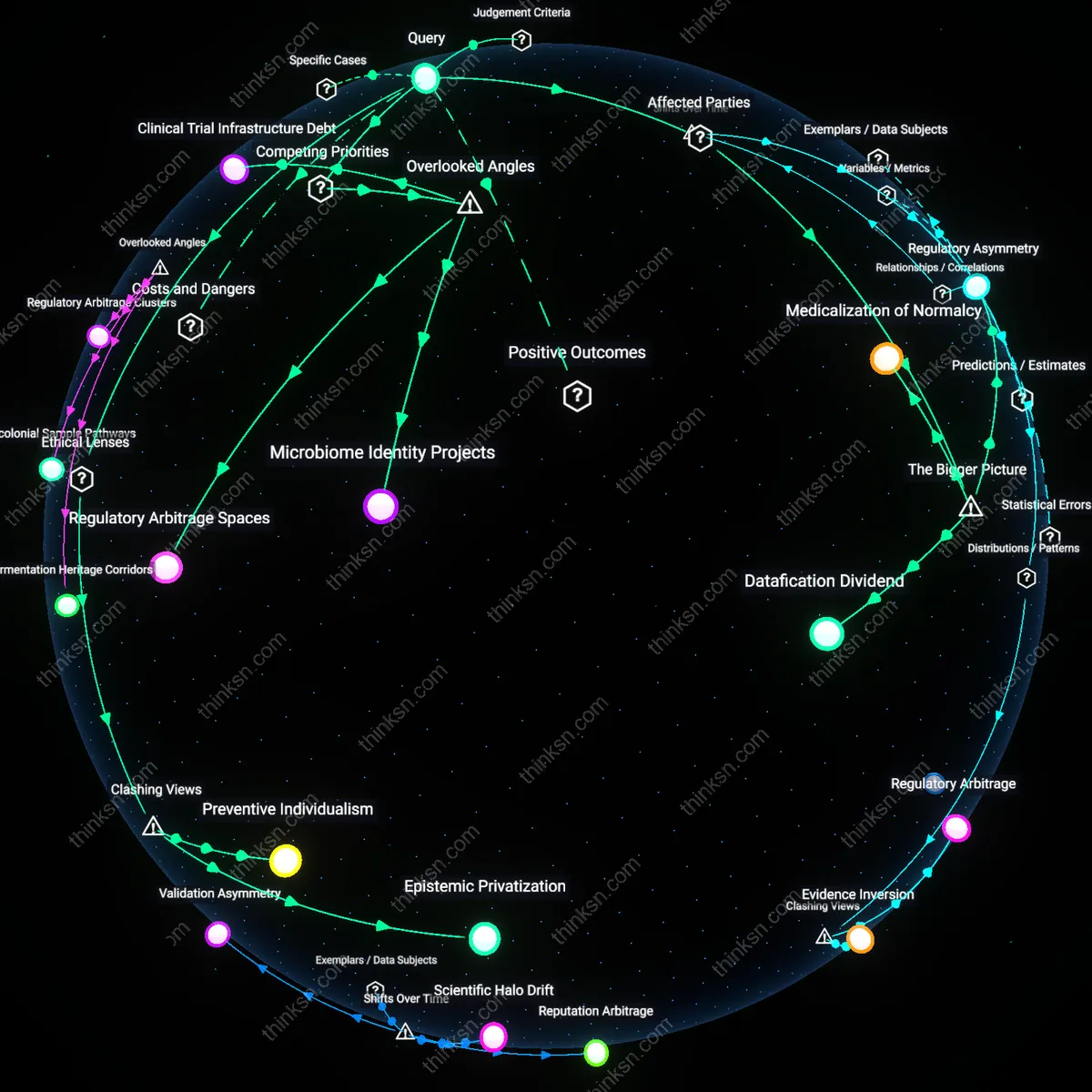
Regulatory Asymmetry
The promotion of daily probiotics shifts when health agencies classify microbiome supplements as foods rather than therapeutics, enabling indefinite consumer exposure without requiring clinical proof of preventive efficacy. This classification, lobbied for by supplement manufacturers and upheld by deregulatory trends in the U.S. Food and Drug Administration, allows claims to proliferate in marketing without undergoing the evidentiary scrutiny reserved for pharmaceuticals—rendering the boundary between science and suggestion porous. The non-obvious outcome is that regulatory categorization, not scientific uncertainty alone, structurally enables market-driven narratives to fill the evidentiary vacuum.
Medicalization of Normalcy
Daily probiotic use becomes market-influenced when primary care providers, under pressure from pharmaceutical detailing and patient expectations shaped by direct-to-consumer advertising, begin endorsing microbial supplementation as routine prevention for asymptomatic individuals. This medicalizes a normative bodily state—gut microbiota variation—into a treatable deficit, shifting clinical norms through subtle institutional adoption rather than breakthrough evidence. The underappreciated dynamic is that physician complicity, driven by time-constrained consultations and cultural authority, legitimizes commercial messaging more effectively than advertising alone ever could.
Datafication Dividend
The shift occurs when consumer genomics companies bundle microbiome testing with probiotic recommendations, monetizing personalized health narratives through continuous data feedback loops that reward repeat purchases. Here, the business model depends on producing actionable insights from inconclusive science, transforming probabilistic risk into algorithmic prescriptions that feel individually tailored. The systemic insight is that data infrastructure, not clinical guidelines, becomes the credibility engine—where the value lies not in proven outcomes but in the perception of scientific precision generated by proprietary analytics.
Normalization Cascade
Daily probiotic use became market-influenced behavior when pediatric and primary care practices began endorsing broad-spectrum supplements during the 2010s, not based on new clinical consensus but in response to perceived patient demand amplified by digital health trends. This medical legitimation, often issued in the form of passive recommendations—like 'it can’t hurt'—allowed commercial products to gain entry into clinical habit through the backdoor of low-risk tolerance, effectively institutionalizing consumption as precautionary ritual. The mechanism—medical acquiescence to consumerism under conditions of information overload—reflects a historical shift where preventive authority eroded from centralized guidelines to distributed, encounter-level negotiations. The non-obvious consequence is that the line between scientific prudence and market capture was crossed not through overt falsehoods but through clinical inaction in the face of commercial framing.
Regulatory Arbitrage Spaces
The shift from science-based prevention to market-influenced behavior begins when probiotic manufacturers exploit gaps in FDA and FTC oversight by classifying products as supplements rather than therapeutics, enabling health claims without clinical proof. This regulatory misalignment allows companies to anchor marketing in plausible biological mechanisms—like gut microbiome modulation—while bypassing the burden of demonstrating net health benefits, effectively laundering commercial messages through scientific ambiguity. The overlooked dynamic is how jurisdictional fragmentation between agencies creates strategic loopholes not due to incompetence but by design, where industry aligns product architecture with regulatory boundaries rather than health outcomes. This transforms scientific uncertainty into a structural enabler of market expansion.
Microbiome Identity Projects
Daily probiotic use shifts from prevention to market-driven behavior when consumers begin treating microbiome optimization as a proxy for personal identity management, especially in urban wellness subcultures where gut health becomes a visible signal of self-mastery. This shift hinges not on evidence but on the institutionalization of fecal biomarkers in direct-to-consumer testing services, which reframe probabilistic data into narratives of internal imbalance requiring proprietary solutions. The overlooked mechanism is the emergence of somatic surveillance—where individuals monitor bodily outputs as moral metrics—transforming probiotics from interventions into ritual objects that maintain perceived biological integrity, thus displacing public health norms with personalized biolegitimacy.
Clinical Trial Infrastructure Debt
The promotion of daily probiotics becomes market-influenced when dominant strains in commercial products are selected not for efficacy but for compatibility with existing biobanking and trial logistics, privileging well-characterized, patentable strains over potentially superior but less-studied candidates. This occurs because clinical research infrastructure—frozen around legacy models of strain viability and endpoint measurement—creates path dependency, making it systematically cheaper and faster to validate minor variants of existing strains than to explore novel taxa. The underappreciated factor is how the material constraints of laboratory workflows, such as cryopreservation protocols and genomic database coverage, silently shape the commercial microbiome pipeline, aligning scientific progress with industrial convenience rather than therapeutic need.
Epistemic Privatization
The shift happens when clinical uncertainty about microbiome efficacy is deliberately maintained by private actors who fund selectively publishable research, thereby converting scientific ambiguity into a commercial asset. Entities like multinational supplement firms and contract research organizations generate just enough positive trial data to sustain consumer belief while avoiding definitive consensus, operating through a fragmented evidentiary landscape where no single study is powerful enough to trigger regulatory reclassification. This contradicts the intuitive framing of probiotic promotion as a lag between science and market; instead, it shows how market interests actively forestall scientific closure to preserve commercial flexibility.
Preventive Individualism
The shift is complete when public health discourse reframes collective disease prevention as a personal microbiome stewardship duty, aligning with neoliberal health ideology that privileges self-managed risk over structural interventions. This is operationalized through wellness influencers, primary care nudges, and insurance-linked wellness programs that position daily probiotics as a responsible citizen’s ethical obligation, not a consumer choice. The non-obvious consequence is that scientifically weak interventions gain ethical weight not through evidence, but by fitting within politically compatible narratives of autonomy and preemption—revealing how ethics can legitimize commerce without verification.