Peer Review or Popularity: Evaluating Health Claims in Wellness Media?
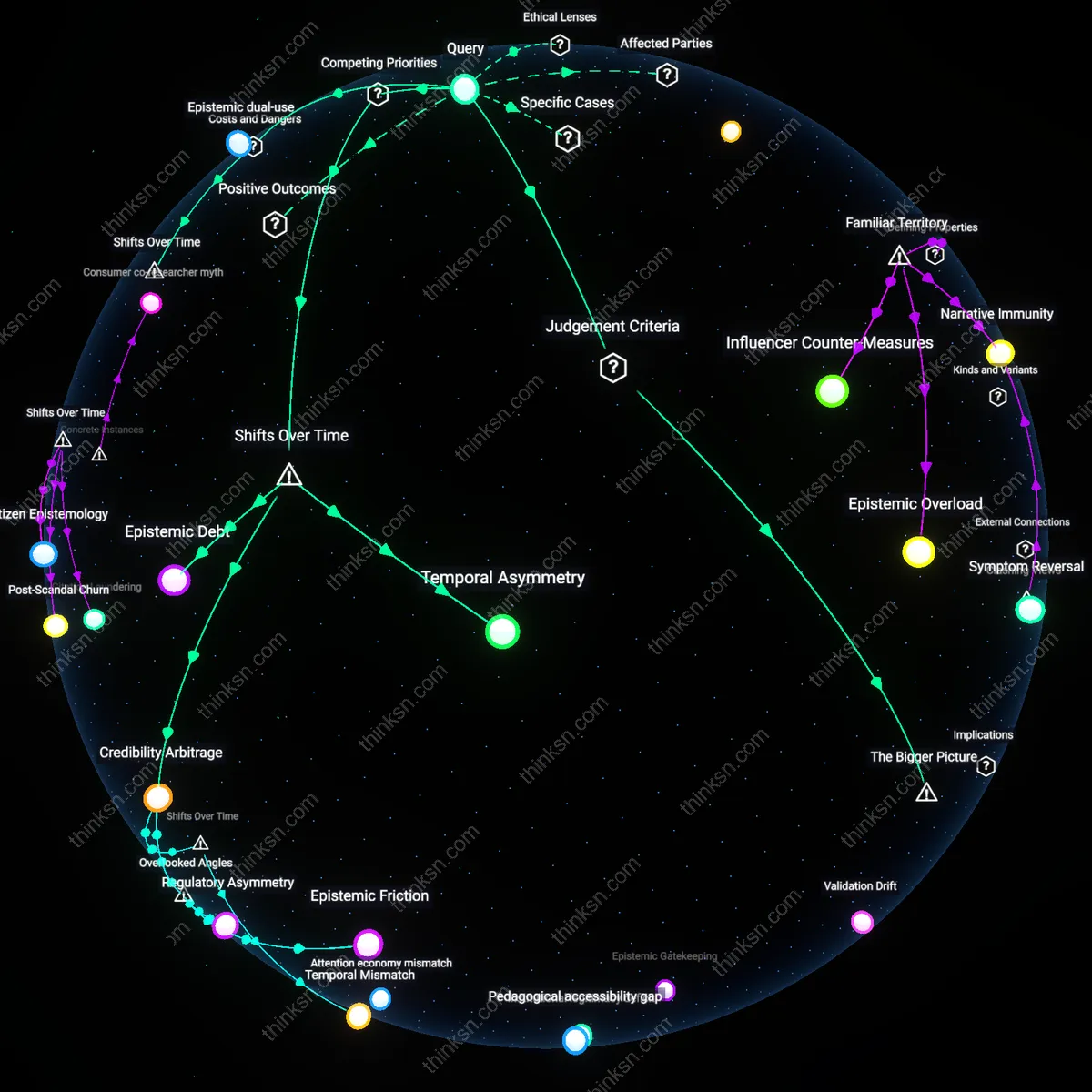
Analysis reveals 7 key thematic connections.
Key Findings
Audience Trust Transduction
A researcher should evaluate how a health claim leverages the transfer of trust from scientific institutions to influencer personas by analyzing the narrative strategies that conflate personal authenticity with empirical authority. Wellness influencers do not merely repeat journal findings—they reframe them through testimonial storytelling, embodied expertise, and community affiliation, which activate affective trust mechanisms distinct from academic skepticism; this transduction converts technical credibility into relational credibility, exploiting the public’s limited capacity to differentiate between peer review and peer resonance. The key dynamic is not misinformation per se, but trust rechanneling—where the influencer becomes a surrogate evaluator, displacing methodological critique with experiential validation within ecosystems like Instagram or podcast networks, making credibility assessment contingent on media literacy rather than statistical literacy alone.
Institutional Erosion Debt
A researcher must trace how the erosion of epistemic trust in medical institutions since the 1980s has created a deferred cost in credibility assessment, where peer review is no longer a sufficient safeguard because its authority has been systematically undermined by pharmaceutical-industrial scandals and regulatory capture. Beginning with the backlash against Big Pharma in the 1990s and accelerating during the 2000s with ghostwriting revelations and selective trial publication, the journal system lost its aura of impartiality, making space for wellness influencers to position themselves as truth-tellers despite lacking credentials. The mechanism here is not misinformation per se but the exploitation of institutional debt—where past failures to self-correct compound into present vulnerabilities to pseudoscientific claims promoted under the guise of 'natural' alternatives. The underappreciated shift is that credibility is now assessed not through verification but through alignment with post-institutional identities, leaving researchers to navigate a landscape where trust has been temporally displaced from process to persona.
Influencer-journal arbitrage
A researcher can detect credibility distortion by identifying cases where a wellness influencer promotes a health claim that selectively cites a peer-reviewed study while ignoring its limitations, as when Goop endorsed the 'toxic burden' detox concept based on a single small-sample environmental biomonitoring study from the Journal of Exposure Science & Environmental Epidemiology, which the company amplified without disclosing the study’s authors explicitly warned against therapeutic interpretation. This mechanism exploits the credibility transfer between scientific publication and mass endorsement, where the journal’s peer-review status grants legitimacy that the influencer monetizes, bypassing scientific consensus-building processes and regulatory scrutiny, revealing a systemic loophole in post-publication accountability that prioritizes visibility over validation.
Epistemic dual-use
A researcher assessing the claim that collagen supplements improve skin elasticity—supported by a Nestlé-funded study in the Journal of Medicinal Food and promoted by influencers like Kayla Itsines—must confront how the same study satisfies peer-review standards while simultaneously functioning as marketing infrastructure, as the trial’s design allowed direct commercial branding of results before publication. This dynamic reveals an underappreciated duality in nutrition science where research acts as both knowledge production and commercial instrument, with journal publication enabling regulatory defensibility and consumer trust simultaneously, thus institutionalizing a form of epistemic dual-use where science serves both public health and private profit without structural conflict mitigation.
Credibility Arbitrage
A researcher can assess the credibility of a health claim by identifying where peer-review authority is selectively invoked to legitimize assertions that align with influencer commercial objectives, a practice intensified after 2010 as digital platforms enabled wellness figures to cite journal citations as proof while bypassing scientific consensus norms. This mechanism operates through the strategic fragmentation of scientific discourse—where isolated studies are extracted from broader epistemic contexts and amplified by influencers who gain legitimacy without accountability—leveraging the historical shift from institutional gatekeeping to decentralized knowledge dissemination. The non-obvious insight is that the credibility is not being evaluated but rather exploited as a transferable attribute, decoupled from methodological rigor and repurposed within a market logic that prioritizes reach over reproducibility.
Temporal Asymmetry
A researcher must account for how the same health claim circulates differently across scientific and influencer timelines, a divergence that solidified after the mid-2000s when journal publication cycles remained slow while social media accelerated validation through engagement metrics. The delay in peer-review correction mechanisms creates a window where influencers establish public belief using preliminary findings, exploiting the historical transition from cumulative, iterative science to real-time public interpretation. This dynamic reveals that credibility assessment now requires not just evaluating evidence quality but reconstructing the sequence in which knowledge is stabilized—scientifically versus publicly—a conflict invisible in earlier eras when mass dissemination lagged behind consensus formation.
Epistemic Debt
A researcher can detect credibility erosion by tracing how repeated endorsement of borderline claims from journals by influencers since the 2010s has created a deferred cost in public trust, analogous to financial borrowing against future scientific clarity. This occurs as the wellness industry leverages the residual authority of peer review while undermining its long-term reliability through overextension into weak or preliminary findings, transforming journals from arbiters of truth into citation reservoirs. The shift from science as a self-correcting process to one operating under promotional pressure reveals that each unchallenged misapplication of a study accumulates epistemic debt—compromising both scientific integrity and public discernment in favor of immediate influencer authenticity.