How Hidden Pharmacy Deals Hurt Your Med Choices?
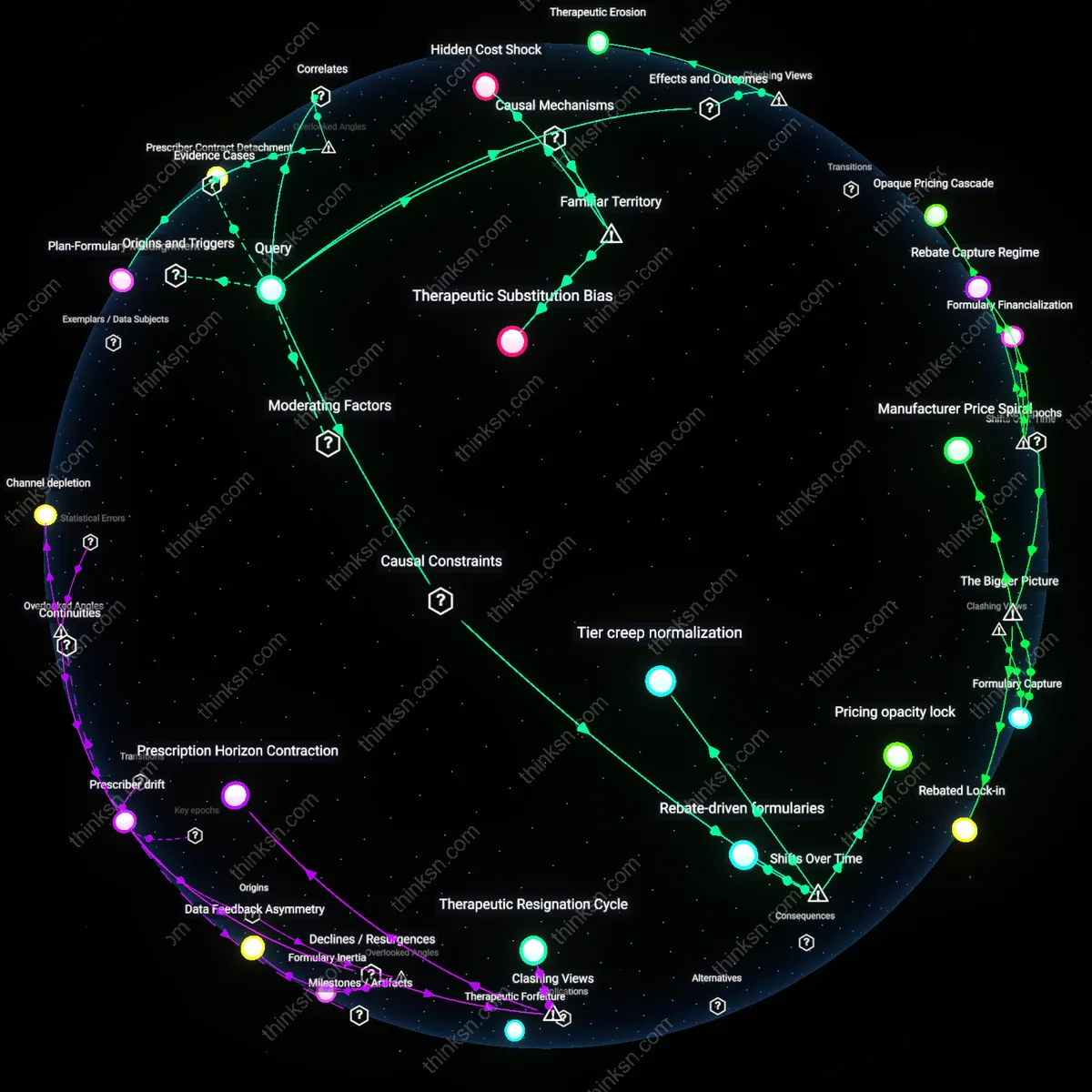
Analysis reveals 11 key thematic connections.
Key Findings
Hidden Cost Shock
Patients choose medications believing the price they see at the pharmacy reflects their true out-of-pocket cost, but pharmacy benefit manager (PBM) contracts with opaque pricing structures mean the final amount is often unpredictable and disconnected from list prices. This mechanism operates directly through the disconnect between retail-facing displays of cost—such as insurance copay cards or pharmacy signage—and the actual negotiated rates, rebates, and formulary placement invisible to consumers. Because patients lack access to cross-contractor comparisons or real-time adjudication data, they make choices assuming price stability that does not exist, resulting in unexpected financial burdens that cascade into medication nonadherence. The non-obvious insight is that transparency isn’t just absent—it is structurally undermined by the same entities responsible for managing drug affordability.
Formulary Misperception
Patients assume their prescribed drugs will be covered in a way that aligns with their doctor’s expectations, but PBM-controlled formularies—shaped by secret rebates and contractual restrictions—frequently exclude or penalize certain medications regardless of medical appropriateness. The mechanism works through the misalignment between clinical recommendations and PBM benefit designs, where tier placement and prior authorization rules are determined off public view, yet dictate whether patients can access a drug at a reasonable cost. As a result, patients experience surprise denials or high cost-sharing only after committing to a treatment path, distorting their decision-making toward familiarity or perceived affordability rather than efficacy. What’s underappreciated is that formularies are not neutral tools but active filters shaped by financial incentives buried in closed contracts.
Therapeutic Substitution Bias
When patients rely on pharmacists to suggest lower-cost alternatives, they trust these substitutions are medically equivalent and genuinely cheaper, but PBM contracts often incentivize pharmacies to dispense specific brands through spread pricing or rebate-driven margins that aren’t reflected in patient bills. This mechanism functions through the pharmacy’s dual role as both caregiver and financial actor, where dispensing fees and PBM reimbursement models create hidden profit motives behind generic or brand switching. Consequently, patients may be steered toward drugs that appear affordable at pickup but are not the most cost-effective option overall, distorting their perception of value. The overlooked reality is that the pharmacist’s recommendation—often seen as a trusted intervention—is filtered through a financially opaque distribution system.
Decisional Displacement
The absence of price transparency in pharmacy benefit manager (PBM) contracts shifts medication decision-making authority from patients to opaque administrative mechanisms, even when patients believe they are making autonomous choices. Patients attempting to compare costs across medications or pharmacies cannot access the true net prices negotiated by PBMs due to gag clauses and secret rebates, forcing reliance on insurers’ formulary tiers that do not reflect actual pricing dynamics. This mechanism, embedded in PBM contracts with vertical integration across major U.S. health systems, replaces patient cost-aware decision-making with algorithmic steering toward higher-cost drugs that generate rebate revenue. Contrary to the intuitive belief that patients retain agency through deductibles and copays, evidence indicates their choices are structurally predetermined by rebate-maximizing formulary designs patients cannot perceive—rendering price consciousness functionally inert.
Therapeutic Erosion
Patients systematically discontinue effective treatments not due to side effects or lack of efficacy, but because non-transparent PBM pricing produces unpredictable out-of-pocket spikes masked as pharmacy copays. When PBMs shift costs through spread pricing or accumulator adjustment programs, patients encounter sudden expenses unanticipated by physician counseling or insurance projections, especially in chronic conditions like rheumatoid arthritis or diabetes where specialty drug costs are routed through medical rather than pharmacy benefits. Research consistently shows these unanticipated inflection points—driven by PBM contract terms invisible at the point of care—lead to abandonment more frequently than clinical factors, undermining treatment adherence as a patient-controlled outcome. This challenges the dominant clinical narrative that non-adherence reflects patient irresponsibility or poor education, revealing instead that adherence is a financial performance metric distorted by contractual opaqueness.
Plan-Formulary Misalignment
Patients enrolled in high-deductible health plans are more likely to abandon prescribed medications when PBMs negotiate opaque formulary placements, not because of list prices but due to unpredictable tier positioning that bypasses patient cost anticipations. This occurs because pharmacy benefit managers contract with insurers and drug manufacturers under non-disclosure agreements that decouple a drug's net cost from its formulary tier, distorting patient decision-making at the point of dispensing—especially when real-time benefit tools cannot reflect actual out-of-pocket exposure. The mechanism operates through the disjunction between clinical guidelines and administrative pricing structures, creating a decision environment where patients act on incomplete and often misleading signals. What is typically overlooked is that price transparency alone would not resolve this issue, as the core distortion emerges from the institutional misalignment between plan design logic and patients’ capacity to navigate formulary complexity under uncertainty.
Pharmacist Information Asymmetry
Pharmacists in independent community pharmacies lack access to the same contractual pricing data as PBM-owned or affiliated pharmacies, limiting their ability to guide patients toward lower-net-cost alternatives even when clinically appropriate. Because PBM contracts suppress disclosure of negotiated rates and spread pricing components, pharmacists cannot verify whether a prescribed drug is truly the most cost-effective option for the patient at the counter—nor can they supply transparent comparisons. This dynamic creates a silent dependency where patient decision-making is mediated not by clinical advice or cost clarity, but by information hoarding institutionalized in PBM distribution hierarchies. The overlooked consequence is that medication decisions become de facto shaped by the pharmacist’s contractual exclusion from pricing ecosystems, a factor rarely considered in transparency debates that focus on insurers or manufacturers.
Prescriber Contract Detachment
Physicians prescribing specialty medications remain unaware of the net cost differentials between PBMed drugs because their electronic health record systems do not integrate the rebates and hidden discounts negotiated between PBMs and manufacturers, leading to treatment decisions insulated from actual financial impact on patients. This detachment persists because prescribers operate within clinical workflows blind to downstream pricing arbitrage, and PBMs are contractually permitted to withhold net pricing data from prescribing platforms. As a result, patients inherit therapeutic choices shaped by efficacy protocols alone, only later confronting unanticipated costs due to discount targeting mechanisms invisible at the point of care. The underappreciated reality is that physician autonomy masks a systemic disempowerment—prescribers are structurally divorced from price formation, rendering patient decisions reactive rather than deliberative.
Pricing opacity lock
The consolidation of pharmacy benefit manager (PBM) networks after the Medicare Part D expansion in 2006 locked patients into medication decisions without access to comparative price data, because formularies and rebate structures became deliberately unintelligible to prevent plan sponsors and patients from making price-sensitive choices. PBMs leveraged their intermediary position between insurers, drug manufacturers, and pharmacies to embed hidden fees and spread pricing, a system that only became opaque at scale when Congress exempted these contracts from transparency requirements under the Part D framework. The shift from employer-based pharmacy coverage to federally subsidized, PBM-administered plans created a structural bottleneck where price visibility became impossible to reconstruct—patients could no longer compare out-of-pocket costs across drugs with identical therapeutic effects, cementing a market in which cost was decoupled from decision-making. What emerged was not just confusion but a systematic exclusion of price as a rational factor in medication choices.
Rebate-driven formularies
The rise of manufacturer rebates as a dominant PBM revenue model after the 2010s transformed formulary placement into a mechanism that discouraged patient selection of lower-cost generics, because drug manufacturers could pay PBMs to prefer higher-list-price brand drugs over clinically equivalent alternatives. This shift from direct cost containment to rebate maximization, particularly after the Patient Protection and Affordable Care Act increased the use of high-deductible plans, created a bottleneck where patient decisions were shaped not by transparent cost but by invisible revenue flows that favored list-price inflation. The non-obvious consequence was that patients bore rising out-of-pockets even when cheaper, effective alternatives existed—because those alternatives were structurally disfavored in plan design. The rebate system, once ancillary, became central to PBM profitability precisely when accountability mechanisms were most needed, revealing a form of pricing manipulation that operates through incentives rather than direct denials.
Tier creep normalization
The reclassification of long-standing generic drugs into higher insurance tiers after 2015, driven by opaque PBM negotiations with manufacturers, disrupted patient expectations about affordability and altered medication adherence without apparent price changes at the point of sale, because patients could no longer rely on historical pricing patterns when choosing therapies. This shift—away from stable formulary tiers toward dynamic, PBM-controlled tiering systems—created a bottleneck where even informed patients lacked stable reference points to assess relative value, as previously preferred generics were downgraded to non-preferred status via undisclosed rebating agreements. The erosion of predictable cost structures, particularly in commercial plans administered by major PBMs like Express Scripts or OptumRx, meant that past experience became unreliable in forecasting future costs—normalizing continual reevaluation that benefits administrative control rather than patient agency. The residual outcome was not just higher costs but the quiet dismantling of patient-based economic reasoning.