Why Lack of Medical Price Data Hurts Informed Care Choices?
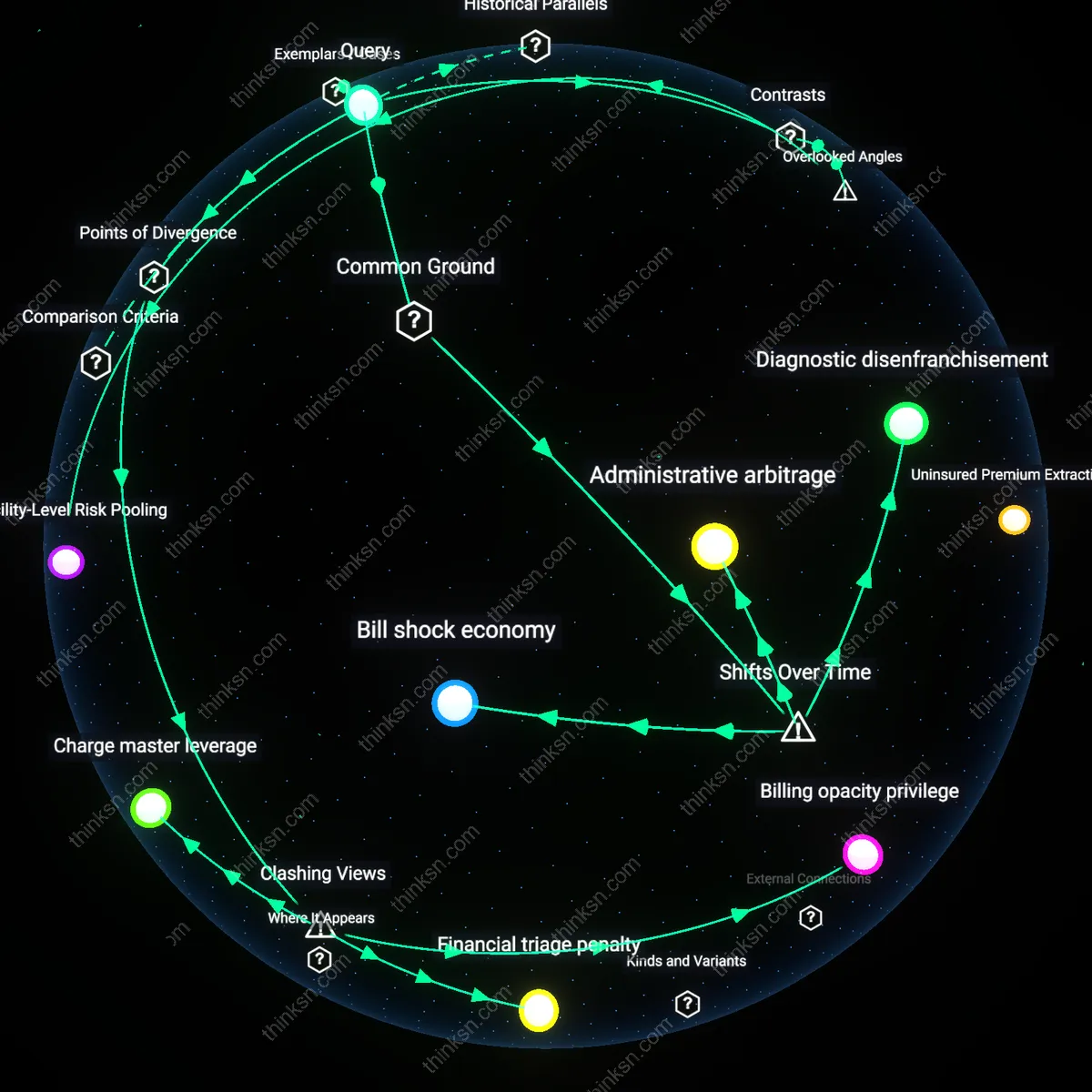
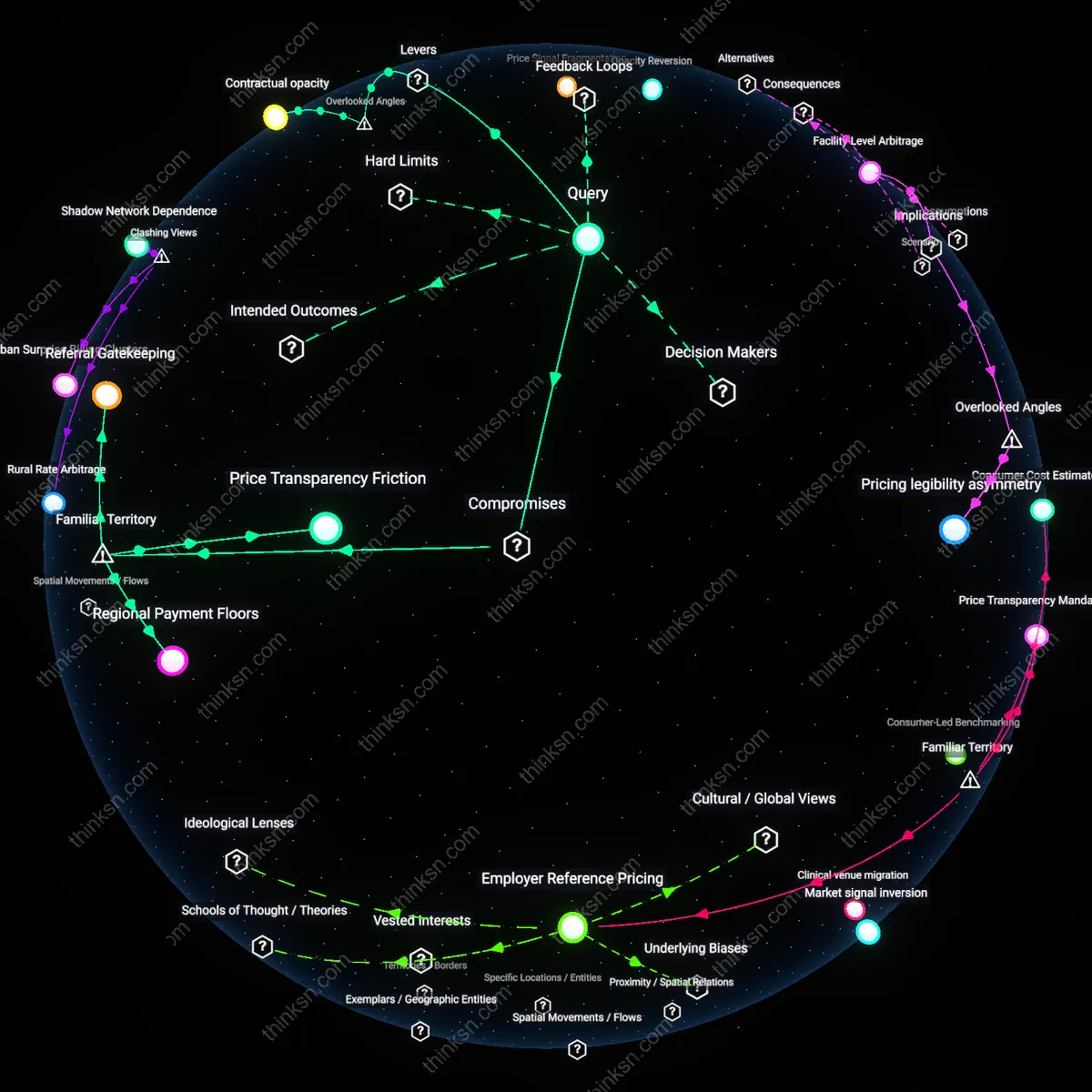
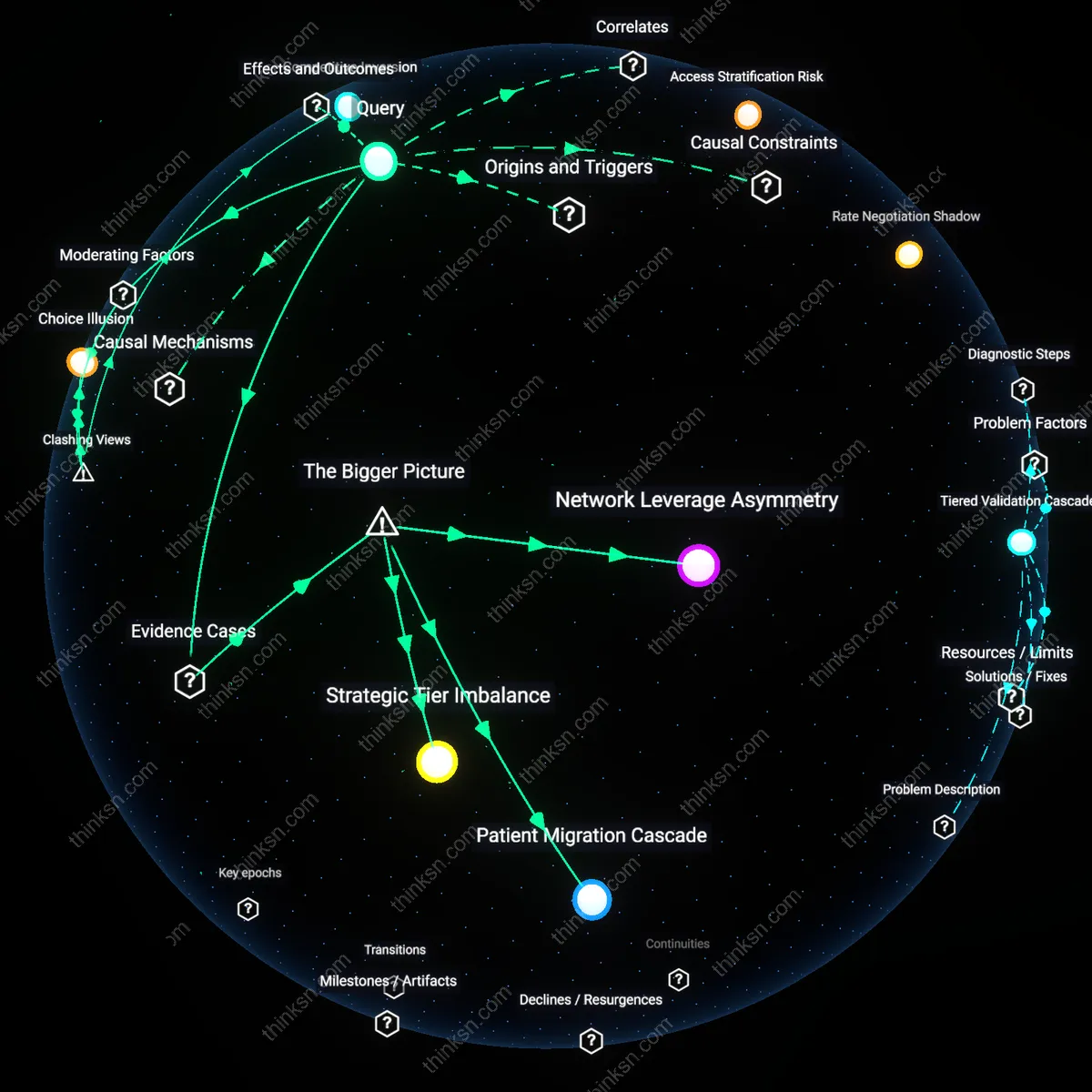
Analysis reveals 12 key thematic connections.
Key Findings
Pricing opacity
The absence of a unified national medical pricing database prevents patients from comparing procedure costs across providers, leaving them unable to identify cost-effective care options. Insurers and hospitals operate with proprietary fee schedules and negotiate secret contracts, which fragment price information and shield patients from transparent benchmarks. This opacity thrives because providers benefit from information asymmetry, reducing competitive pressure to lower prices—a dynamic entrenched in a decentralized payment architecture dominated by private payers. The non-obvious consequence is that even financially literate patients cannot exercise market rationality because no common pricing denominator exists across geographic or institutional boundaries.
Administrative arbitrage
Without standardized medical pricing data, healthcare systems exploit regional and contractual inconsistencies to inflate charges selectively, particularly targeting uninsured or out-of-network patients. Hospitals in areas with limited competition use lack of price transparency to justify elevated charges, knowing patients cannot access or interpret comparable rates. This behavior is enabled by a regulatory environment that permits variable billing under the guise of negotiated rates, while federal efforts like price transparency rules lack enforcement and interoperability standards. The underappreciated mechanism is that fragmented pricing isn’t merely a failure of information sharing—it’s actively weaponized as a revenue preservation strategy by powerful provider systems.
Decisional drift
Patients default to convenience-based healthcare choices—such as proximity or physician referrals—because inconsistent pricing data makes cost-benefit analysis impractical, even when insurance covers only partial expenses. This pattern persists because health systems and insurers design cost disclosure tools (e.g., cost estimators) with incompatible formats and incomplete CPT code mappings, so patients receive non-actionable or misleading projections. The systemic issue is that consumer-directed healthcare models falsely assume patients can function as price-sensitive agents without institutional infrastructure to support informed choice. The overlooked reality is that without a centralized pricing ontology, individual decision-making collapses into inertia or heuristic reliance, undermining the foundational logic of market-based healthcare reforms.
Pricing opacity as market design
The absence of a unified national medical pricing database persists because key stakeholders—especially private insurers and hospital systems—actively resist price transparency to preserve strategic opacity in reimbursement negotiations. This lack of standardization is not a technical failure but a deliberate feature of a fragmented payment architecture where variable pricing enables cross-subsidization, risk pooling, and competitive advantage. The non-obvious reality is that pricing chaos serves institutional stability, making transparency a systemic threat rather than a consumer benefit.
Patient agency as liability
Patients are structurally impeded from leveraging cost-effective care not because they lack data, but because the expectation that they should act as rational price-sensitive consumers undermines clinical trust and exacerbates decision paralysis. In high-stakes health decisions, cost-awareness can be interpreted as a moral burden—choosing cheaper care may feel like neglect—particularly when outcomes are uncertain and providers do not endorse price comparisons. This reveals that promoting patient choice based on price may contradict the therapeutic relationship, turning informed agency into a source of anxiety and ethical strain.
Infrastructure capture by incumbents
The failure to establish a national medical pricing database stems not from technical infeasibility but from regulatory capture by incumbent actors who control data flows, such as billing intermediaries and electronic health record vendors whose business models depend on opaque, transactional complexity. These firms profit from interoperability gaps and fragmented reporting standards, creating a de facto barrier to centralized pricing transparency. The overlooked insight is that the system’s inefficiency is a revenue stream, not a flaw, and thus the absence of a public database reflects successful rent preservation, not policy inertia.
Price opacity cascade
The lack of a unified national medical pricing database enables hospitals like John Muir Health in California to bill privately insured patients up to ten times more than Medicare rates for the same CT scan, revealing a mechanism in which fragmented pricing data prevents patients from identifying outliers—this occurs because insurers negotiate secret contracts with providers, and without public benchmarking, patients cannot distinguish therapeutic value from financial exploitation, making cost-effective choices functionally impossible even when care quality is comparable. The non-obvious insight is that opacity isn't incidental but structurally sustained by competitive market logic, where pricing asymmetry becomes a profit lever disguised as customization.
Informed consent distortion
When patients at Methodist Hospital in Indiana underwent elective arthroscopic knee surgeries without access to a national pricing reference, many later discovered they had paid over $12,000 for procedures available at nearby ambulatory centers for under $4,000, demonstrating how the absence of standardized price transparency distorts the medical decision-making process by conflating clinical urgency with financial risk—patients treat price discovery as retrospective regret rather than prospective choice because billing systems are decoupled from clinical consultations. The underappreciated reality is that without pre-service cost signaling integrated into clinical workflows, informed consent becomes medically accurate but economically blind.
Reference point failure
In 2019, Colorado’s all-payer claims database revealed that insulin administration in emergency departments cost an average of $1,800 per visit, yet patients in Denver hospitals had no means to compare this against community clinic alternatives at $300, exposing a system failure where decentralized pricing prevents the formation of a cognitive reference point for value—patients default to provider-recommended care paths not due to ignorance but because no external anchor exists for rational evaluation. The critical insight is that cost-effective decision-making requires not just data, but a standardized frame of comparison, and its absence renders individual price shopping an irrational burden, not a market solution.
Price Opacity Trap
Patients cannot compare prices for routine procedures like MRIs or colonoscopies because hospitals and imaging centers set wildly different rates without public disclosure. This lack of transparency forces consumers to rely on insurer-negotiated rates they don’t know upfront, causing them to inadvertently choose high-cost providers due to absent reference points. The non-obvious reality is that most assume insurance removes price sensitivity, but in high-deductible plans, patients pay full list prices—often inflated precisely because no market pressure exists to lower them.
Navigation Burden
Without a centralized database, patients must manually call multiple facilities, wait for billing departments to respond, and interpret inconsistent cost estimates—all while managing acute health concerns. This time-intensive process, requiring hours of coordination during already stressful medical episodes, disproportionately affects low-income or elderly populations with limited digital access or health literacy. The underappreciated issue is that people assume shopping for care is like shopping online, but the logistical friction makes cost-effective choices practically impossible even when motivation is high.
Reference Price Blindness
Employers and insurers sometimes use reference pricing to incentivize lower-cost care, but without a national benchmark, these benchmarks are arbitrary or outdated and fail to reflect actual local price variation. Patients denied coverage for exceeding the reference price have no way to verify if a provider’s higher charge reflects quality or mere rent-seeking, undermining trust in the entire cost-control system. What’s rarely acknowledged is that familiar notions of 'fair pricing' depend on visible market norms, which cannot form when price data is fragmented across 50 states and thousands of health systems.