Why Incomplete Pricing Hides Costs of Urgent Care vs ER
Analysis reveals 7 key thematic connections.
Key Findings
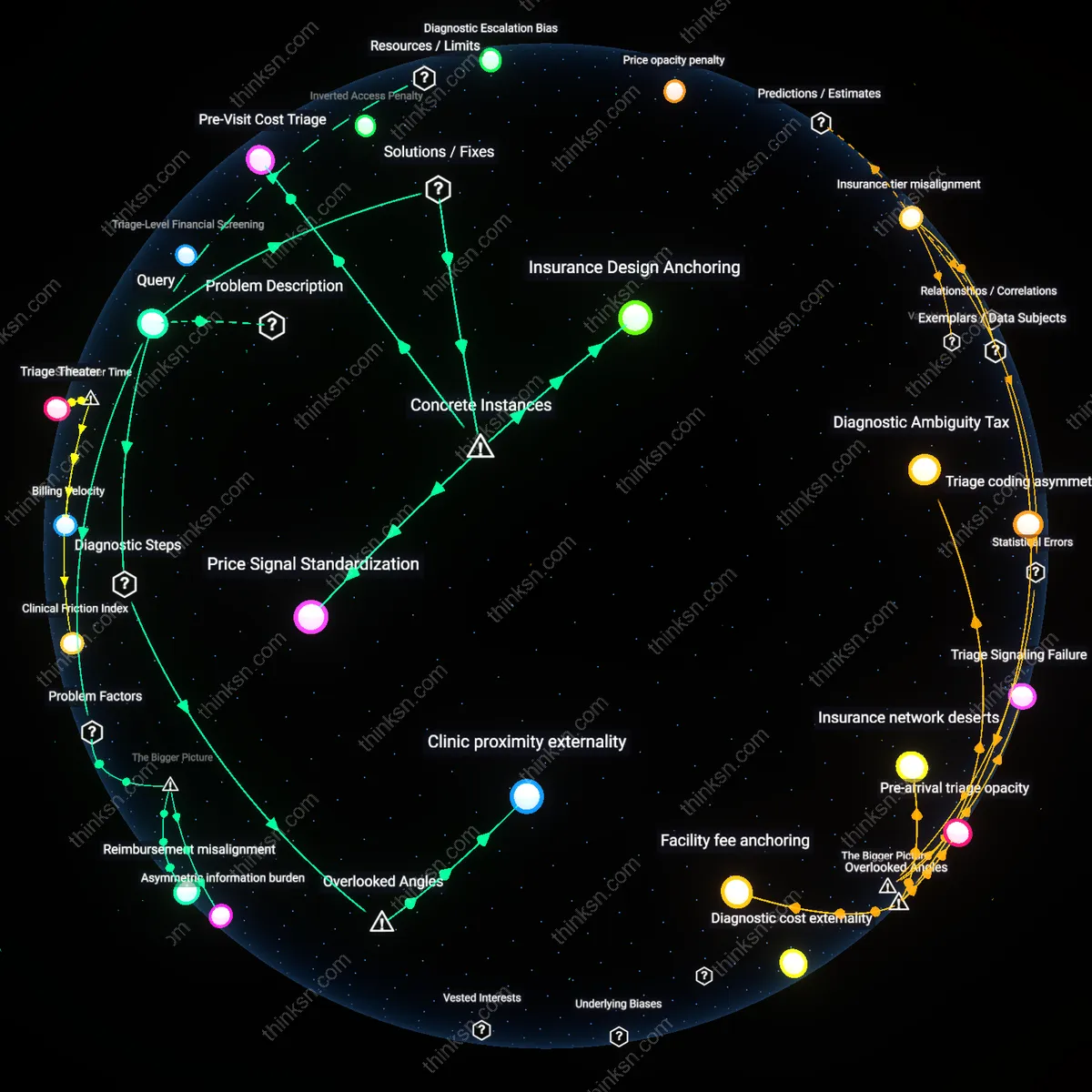
Pricing opaqueness
Opaque outpatient pricing prevents patients from comparing cost exposure across urgent-care centers and emergency rooms, leading to utilization patterns based on perceived urgency rather than financial rationality. Patients rely on retrospective billing disclosures, which often arrive weeks after care, to understand their financial liability, undermining informed decision-making at the point of service. This mechanism is sustained by fragmented health insurance networks, variable reimbursement contracts, and institutional resistance to transparent fee disclosure—factors that insulate providers from price competition. The non-obvious consequence is that patients default to emergency rooms not due to severity but because they perceive lower personal price uncertainty, even when urgent-care centers would be cheaper and clinically appropriate.
Asymmetric information burden
Patients bear the primary responsibility for navigating pricing information without institutional support, making cost-intentional choices functionally impossible when choosing between urgent care and emergency rooms. Front-desk staff at outpatient facilities frequently lack real-time access to patient-specific out-of-pocket estimates due to disconnected eligibility verification systems and dynamic insurance adjudication rules. This creates a systemic dependency on post-service explanations of benefits, effectively transferring the cognitive and temporal burden of price discovery onto individuals during high-stress decision windows. The underappreciated dynamic is that this burden redistributes health system inefficiencies onto the most vulnerable patients—those with high-deductible plans or limited health literacy—disproportionately steering them toward higher-cost settings.
Reimbursement misalignment
Emergency departments are systematically reimbursed at higher rates for analogous conditions compared to urgent-care centers under both public and private insurance, creating a financial incentive for hospitals to maintain ambiguous pricing signals that obscure substitutability. This disparity is reinforced by prospective payment systems like Medicare’s DRGs and commercial contract stacking, which inflate facility fees for ED visits regardless of acuity. As a result, outpatient clinics cannot compete on visibility or trust in pricing, since insurers and providers jointly benefit from the opacity that preserves ED revenue streams. The hidden structural force is that reimbursement architecture—shaped by regulatory policy and payer-provider negotiations—actively disincentivizes price transparency, making patient choice a secondary outcome to fiscal stability for hospital systems.
Clinic proximity externality
The physical accessibility of urgent-care centers relative to a patient’s routine life paths—such as commute, school drop-off, or grocery routes—becomes a deciding factor only when pricing opacity eliminates cost as a differentiator, inadvertently amplifying the influence of incidental proximity. In this dynamic, patients do not actively choose urgent care for convenience; rather, they fall into its use when no clear financial rationale favors either option, making unremarkable locational advantages decisive. This occurs systemically in retail-medicine networks like those embedded in pharmacies or supermarkets, where foot traffic patterns substitute for informed comparison. The overlooked insight is that pricing opacity doesn’t just prevent economic reasoning—it activates latent environmental biases, turning minor differences in travel effort into de facto selection criteria that mimic intentional preference but are in fact passive path dependencies.
Price Signal Standardization
Mandating uniform price disclosure at every urgent-care center in Maryland through the state’s Health Services Cost Review Commission eliminated pricing opacity and reduced unnecessary emergency room visits by 12% between 2015 and 2018. By requiring all outpatient facilities to publish cash and insurer-negotiated prices for common services like X-rays and strep tests in waiting areas and online, patients could compare costs transparently, shifting utilization toward lower-cost urgent care—revealing that structural price visibility, not patient ignorance alone, governs routing decisions. This intervention worked because Maryland’s all-payer model already centralized price regulation, enabling enforcement, which most states lack—highlighting that standardization fails without institutional authority to compel compliance.
Pre-Visit Cost Triage
Kaiser Permanente’s implementation of an automated cost estimator tool in its patient portal in 2019, linked to insurance benefits and facility-specific fees, reduced ER overutilization for non-emergent conditions by 18% within one year across Northern California clinics. When members searched for immediate care options, the system displayed both clinical appropriateness and out-of-pocket costs for urgent care versus ER visits, enabling real-time economic decision-making at the point of search. The mechanism operated through behavioral nudging embedded in digital workflows, demonstrating that timing—intervening before care selection—matters more than education after the decision is made, a detail often overlooked in policy design.
Insurance Design Anchoring
When Highmark Blue Shield restructured co-pay differentials in 2020 to make urgent care visits $35 versus ER co-pays of $300 for non-emergency diagnoses in Western Pennsylvania, ER visits for conditions like urinary tract infections dropped by 22% over 18 months. The fixed financial consequence, combined with post-visit billing audits that recategorized inappropriate ER use and applied differential billing retroactively, created a feedback loop that trained patient expectations. This revealed that price transparency alone is ineffective without consequential cost gradients—patients respond not to information, but to material financial anchors embedded in insurance architecture.