Why US Drug Prices Far Exceed Canadas: Market Power or Regulation?
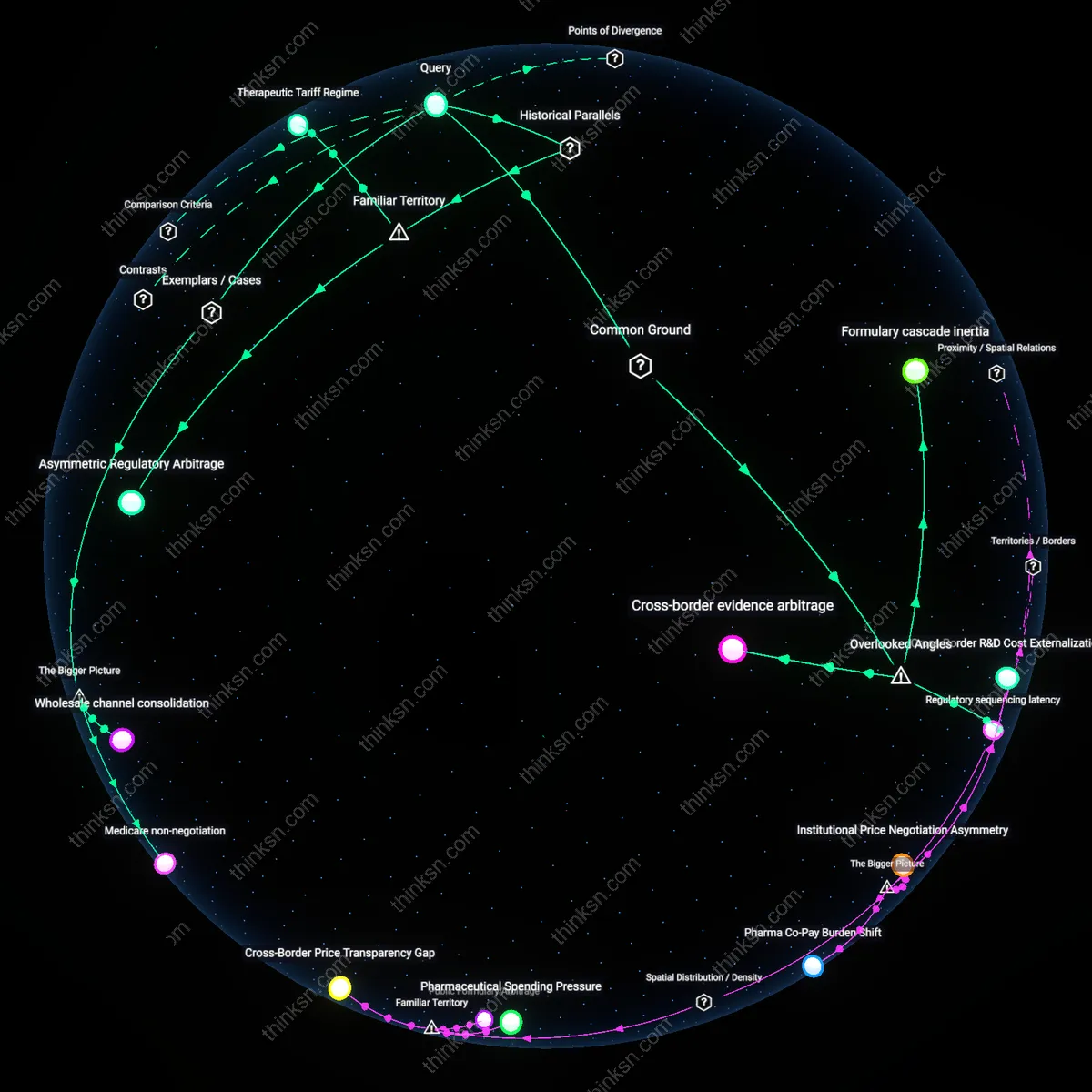
Analysis reveals 8 key thematic connections.
Key Findings
Pharmaceutical Rent Extraction
U.S. drug prices exceed Canadian prices because American regulators lack legal authority to directly negotiate bulk pricing with manufacturers, enabling firms to extract monopoly rents unimpeded by cost-effectiveness benchmarks. Unlike Canada’s Patented Medicine Prices Review Board and centralized provincial formularies that delink price from innovation cost and tether it to therapeutic value and international reference rates, the U.S. Medicare system is barred from negotiating drug prices directly, outsourcing purchasing through fragmented private intermediaries that lack coercive leverage. This reveals how the absence of countervailing state power transforms clinical necessity into revenue opportunity—what the public recognizes as ‘Big Pharma greed’ is not mere corporate ethos but a structurally codified outcome of asymmetric bargaining rights embedded in policy design. The non-obvious insight is that the price gap is not a market failure but a market fulfillment under rules deliberately insulated from democratic correction.
Asymmetric Regulatory Arbitrage
The U.S.-Canada drug price disparity reflects a system where transnational pharmaceutical firms exploit jurisdictional divides, maintaining high prices in unregulated markets while accepting lower returns in regulated ones without reducing global innovation output. Companies like Pfizer or Novo Nordisk set prices in Canada relative to OECD medians and strict affordability thresholds, but in the U.S., they maximize revenue by leveraging patent exclusivity and payer fragmentation, knowing public programs like Medicare cannot impose delisting or mandatory licensing. This mirrors historical patterns like tax haven utilization by multinationals—where legal entities profit from regulatory asymmetry without relocating production—except here, the arbitrage is in pricing sovereignty, not jurisdictional domicile. The familiar outrage over ‘foreign freeloaders’ obscures how Canada functions not as a free rider but as a pricing disciplinarian, forcing firms to internalize social cost in ways the U.S. politically resists.
Therapeutic Tariff Regime
The Canadian drug pricing system operates as a de facto therapeutic tariff, systematically lowering prices for essential medicines through state-backed reference pricing and delinking reimbursement from list price, while the U.S. functions as a premium-clearing market where insurers, pharmacy benefit managers, and hospitals absorb but ultimately pass through markups. This parallels 19th-century customs regimes where Britain’s abolition of the Corn Laws enabled cheap imported grain, feeding urban populations at low cost, while protectionist regimes in continental Europe preserved landed elite profits at public expense—the pharmacological counterpart sees Canada importing price discipline from global benchmarks, while the U.S. protects domestic revenue flows to biopharma under the rhetoric of innovation supremacy. What appears to the public as natural market variation is actually the result of discrete policy tariffs on therapeutic value, where access is taxed not at the border but at the prescription counter.
Regulatory sequencing latency
The staggered timing of drug approval processes between the U.S. FDA and Canada’s Health Canada creates a window where pharmaceutical firms extract maximum prices in the U.S. before facing price constraints in Canada, giving the appearance of pure market failure when it is partly a function of procedural chronology. Health technology assessment bodies like CADTH review drugs only after U.S. approval, allowing U.S. payers to bear the full cost of early adoption while Canadian negotiators leverage clinical data generated abroad to justify lower prices—this delay is rarely accounted for in cross-country price comparisons. The overlooked dynamic is not just regulatory stringency but the temporal asymmetry in evidence utilization, which shifts risk and cost onto American patients and insurers. This reveals that affordability differences are not solely about pricing policy but about who absorbs the initial cost of market entry and evidence accumulation.
Formulary cascade inertia
U.S. private insurers maintain legacy formularies that favor high-cost branded drugs due to rebate-driven contracting with pharmacy benefit managers (PBMs), whereas Canada’s public formularies function as centralized adoption funnels that resist rapid inclusion of new, expensive drugs without demonstrated cost-effectiveness. Because Canadian provinces coordinate drug evaluation through the pan-Canadian Pharmaceutical Alliance, there is a systemic delay in listing new agents, which dampens manufacturer pricing power by compressing the global revenue curve over time. The underappreciated factor is that slower formulary uptake in Canada indirectly lowers U.S. prices downstream by reducing the manufacturer’s ability to frame their drug as essential, yet this feedback loop is ignored in most unilateral pricing analyses. This inertia acts as a stealth price anchor, reshaping global launch strategies.
Cross-border evidence arbitrage
Canadian drug pricing decisions rely heavily on clinical and economic data produced within U.S.-funded trials and real-world use, enabling Canadian agencies to negotiate lower prices without bearing the research and development risk shouldered by American patients and insurers. This transfer of evidentiary value—generated under U.S. market conditions—allows Canadian bodies like pCPA to demand discounts based on outcomes observed in a more permissive regulatory environment, creating a hidden subsidy from U.S. patients to Canadian affordability. Most comparisons treat price disparities as policy outcomes, but they obscure how American experiential risk becomes Canadian negotiating capital. This asymmetry in evidence production and utilization reveals a silent dependency where U.S. market freedom underwrites Canadian cost control.
Medicare non-negotiation
The U.S. federal government's prohibition on Medicare directly negotiating drug prices enables pharmaceutical manufacturers to set higher list prices, as seen in the case of insulin manufacturers like Eli Lilly and Novo Nordisk, which charge two to four times more in the U.S. than in Canada. This mechanism persists because U.S. law—specifically the Medicare Modernization Act of 2003—explicitly bans the largest single-payer actor in the U.S. from leveraging its purchasing power, allowing manufacturers to extract premium pricing without systemic pushback. The non-obvious significance is that it’s not market competition but a deliberate policy absence that sustains high prices, revealing how regulatory forbearance functions as a covert subsidy to drug makers.
Wholesale channel consolidation
In the U.S., vertically integrated pharmacy benefit managers (PBNMs) like CVS Caremark and Express Scripts exploit their dual role as intermediaries and dispensers to retain rebates from drugmakers—such as those from Janssen for Darzalex—without fully passing savings to patients, thereby sustaining high list prices even when net prices are lower. This dynamic is structurally enabled by opaque contract terms and spread pricing, where PBMs profit from the difference between negotiated rebates and prices charged to insurers or consumers. The overlooked consequence is that market power in the U.S. is not just held by manufacturers but redistributed to intermediaries whose incentives align with price inflation, making regulatory negotiation less effective than in Canada, where public transparency and tighter channel control prevent such arbitrage.