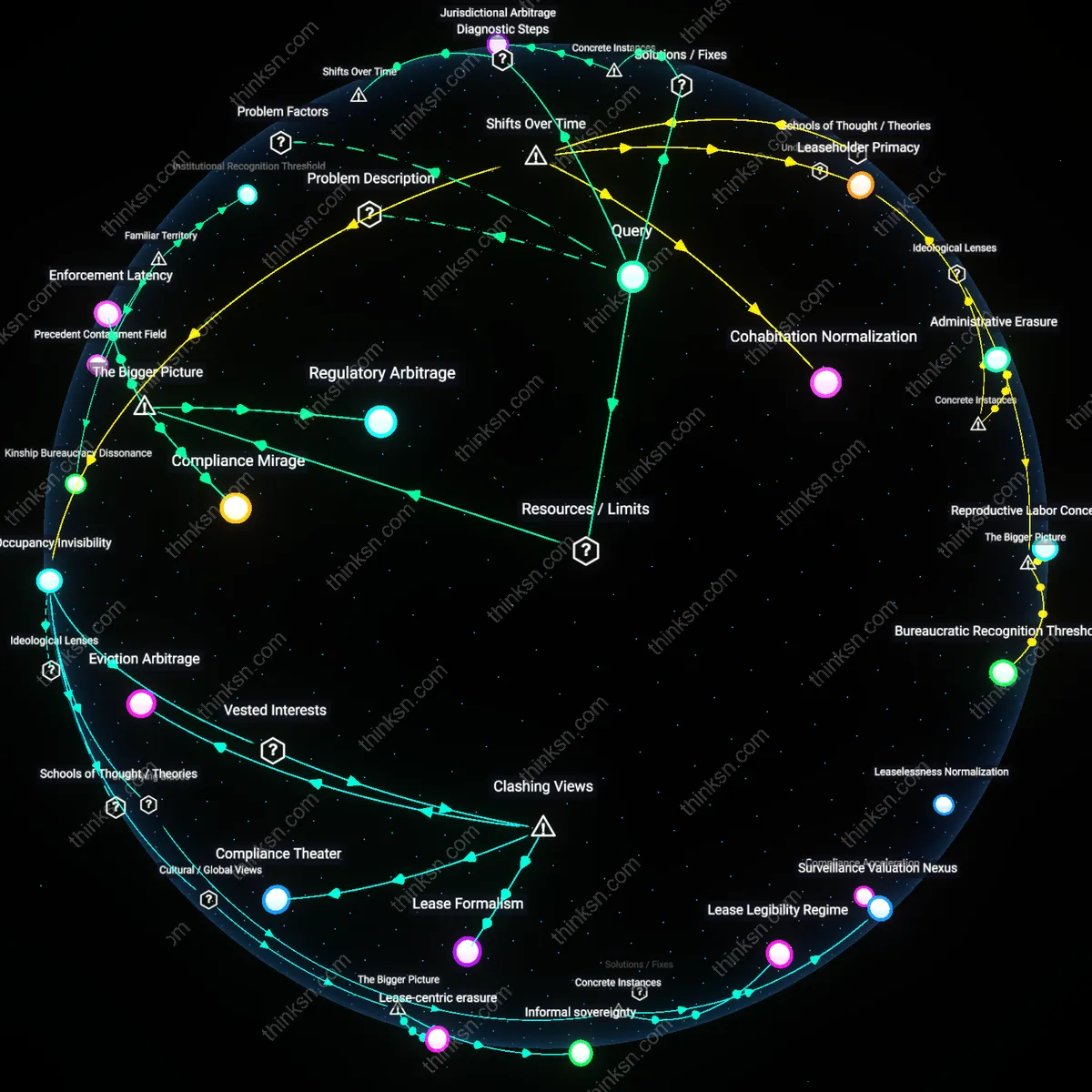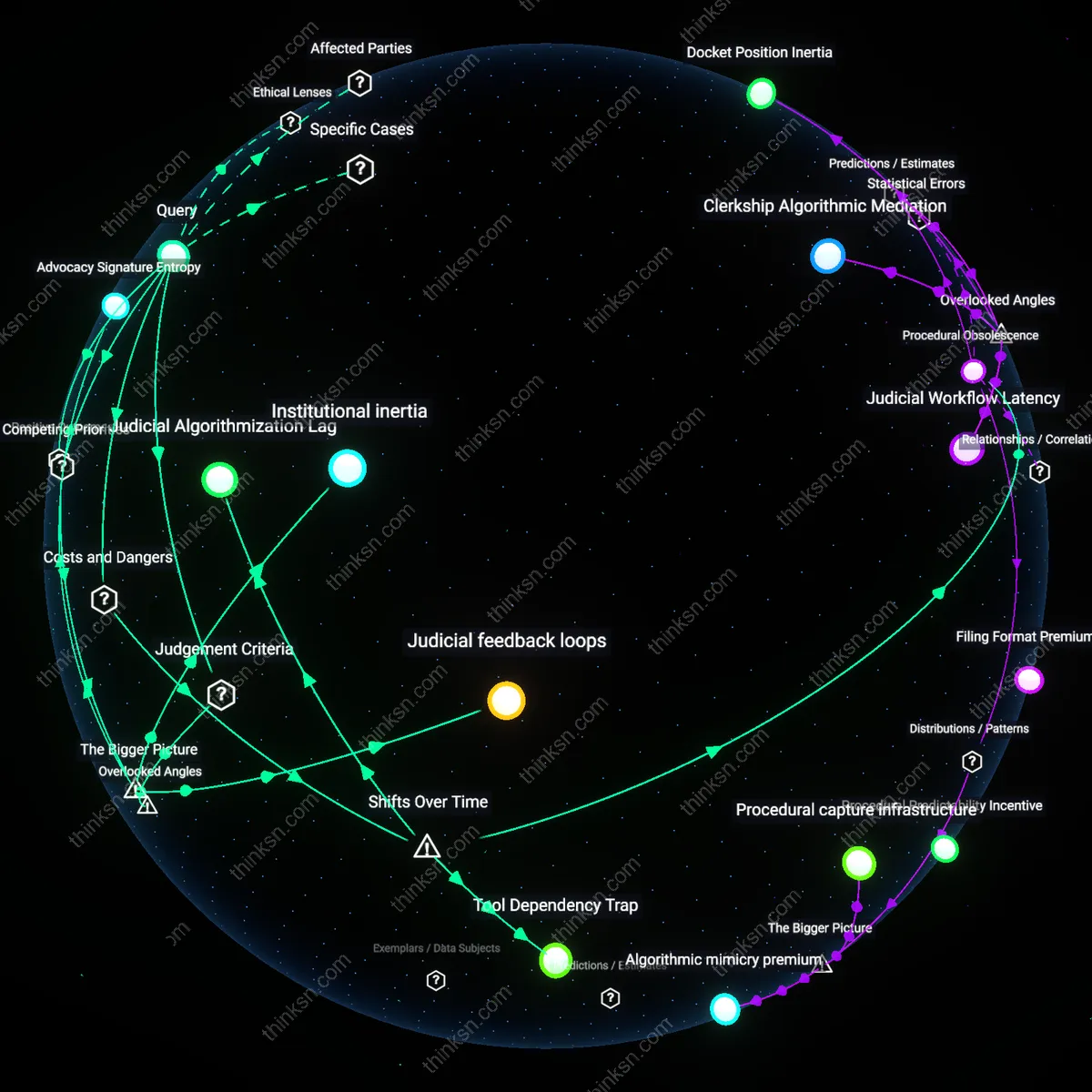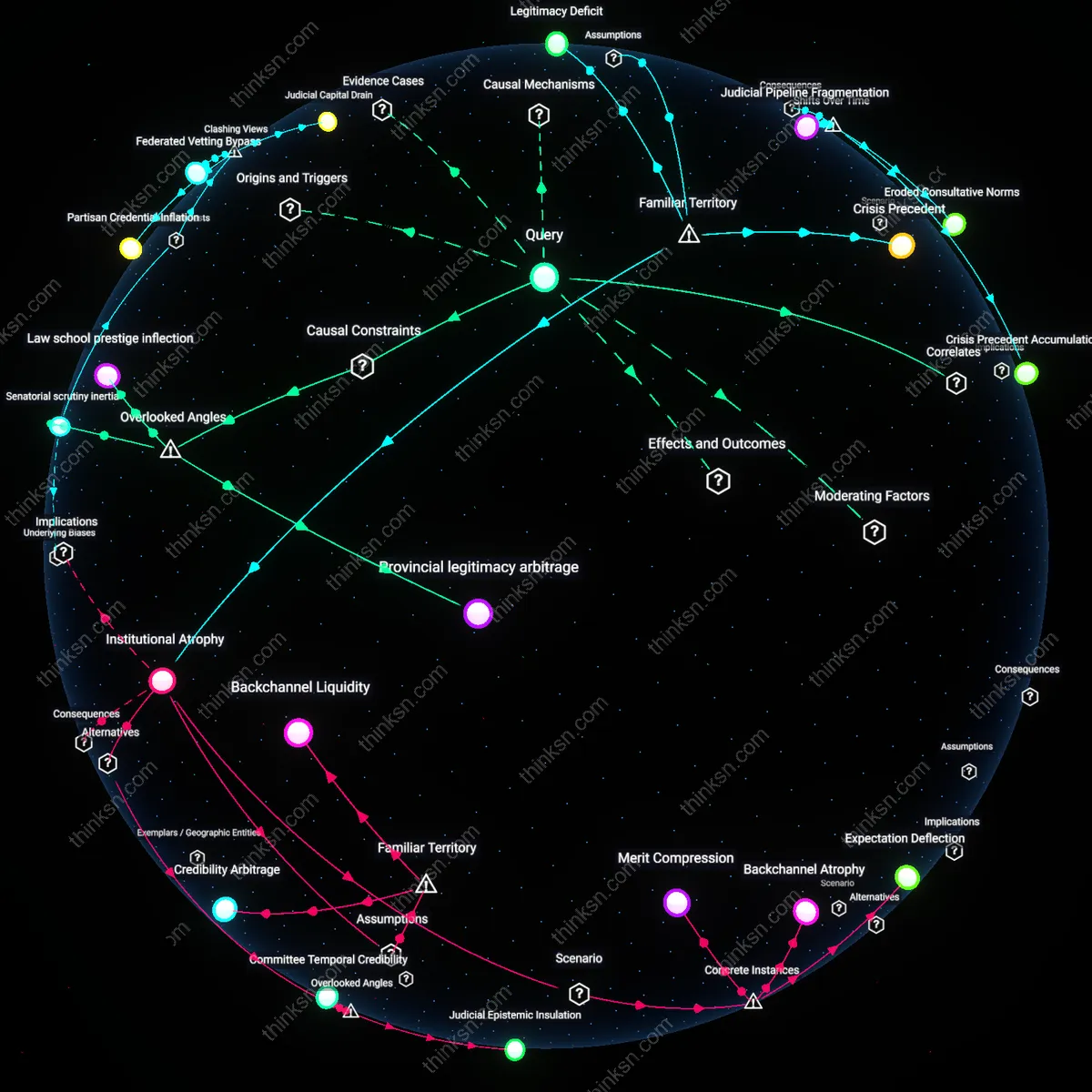
How Elite Capture Shapes Judicial Integrity in U.S. and Canada?
Analysis reveals 5 key thematic connections.
Key Findings
Appointment formalization
The shift from informal senatorial patronage in U.S. judicial appointments to structured White House screening after the 1950s enabled the appearance of meritocratic legitimacy while consolidating elite access through professional credentials. This transition, driven by the expansion of the Department of Justice’s Office of Legal Policy and ABA rating formalization, replaced overt political brokers with credentialized gatekeepers who systematically favored graduates from top-tier law schools and prior government insiders. The historical displacement of one elite (regional party bosses) by another (institutional technocrats) reveals how procedural reform can mask continuity in elite capture, rendering enforcement integrity dependent on class-congruent professionalism rather than accountability. What is underappreciated is that integrity metrics improved post-reform not because capture diminished but because the new system better disguised it through bureaucratic ritual.
Integrity deferral
The Canadian adoption of independent judicial advisory committees in 1985 deflected direct political appointments by requiring non-partisan evaluation of candidates’ professional and community qualifications, marking a departure from prior Prime Ministerial discretion. This shift, institutionalized under Mulroney and expanded under subsequent administrations, embedded a norm of depoliticized selection that relied on professional consensus and regional representation to legitimize appointments. Over time, this process generated a perception of enforcement integrity by distancing judiciary selection from overt political favoritism, even as cabinet retained veto power and strategic committee appointments allowed indirect elite influence. The non-obvious outcome is that integrity became a deferred promise — sustained not by elimination of elite access but by its procedural displacement into seemingly neutral evaluation criteria.
Senatorial scrutiny inertia
The U.S. Senate’s constitutional role in judicial confirmations creates a bottleneck where elite capture emerges not through overt corruption but through delay and procedural attrition, favoring nominees with extensive elite sponsorship to withstand prolonged vetting. This inertia selectively filters out candidates lacking institutional patrons, particularly those from lower-prestige legal backgrounds or advocacy-oriented careers, while reinforcing a judiciary drawn from narrow professional networks centered on federal clerkships and elite law firms. Unlike Canada’s executive-driven appointments with minimal legislative oversight, the U.S. process institutionalizes a hidden threshold of endurance that entrenches status hierarchies under procedural neutrality—what is overlooked is not the act of appointment but the time-based selection it normalizes.
Provincial legitimacy arbitrage
Canadian provincial governments exert indirect control over Supreme Court appointments through the convention of regional representation, enabling local elites to influence federal selections by leveraging regional legitimacy as a defensible criterion. This creates a bottleneck where national enforcement integrity depends not on formal qualifications but on maintaining symbolic balance across provinces, allowing subnational power brokers to insert jurists aligned with regional elite interests under the guise of geographic equity. Compared to the U.S., where ideology is openly contested, Canada’s understated negotiation of jurisdictional legitimacy obscures how decentralized identity claims function as vectors for elite capture—what is missed is that federalism, not partisanship, becomes the channel for legal capture.
Law school prestige inflection
Judicial appointments in both countries are filtered through the prestige hierarchy of legal education, but the U.S. bottleneck intensifies this by requiring nominees to clear Senate Judiciary Committee scrutiny that implicitly validates graduates of top-tier law schools as presumptively qualified, while Canadian appointments, though also elite-skewed, lack a formalized feedback loop that rewards specific institutional pedigrees. The American process, therefore, institutionalizes a prestige inflection point where elite law schools become de facto credentialing bodies for federal office, embedding capture within academe rather than party or bar association networks. This dynamic is overlooked because most analyses focus on political affiliation, not how the academy functions as a gatekeeping institution for enforcement legitimacy.
Deeper Analysis
How do the career paths of U.S. federal judges reveal where power really sits in the appointment process?
Circuit Cluster Weighting
The concentration of judicial appointments in elite appellate courts—particularly the D.C. Circuit and Second Circuit—reveals that power in the nomination process hinges on controlling access to a few geographically and institutionally bounded docket clusters that feed the Supreme Court. A disproportionate share of lifetime federal judges elevated to the Supreme Court previously served on just two appellate circuits, not because of legal excellence alone but because those circuits handle cases involving federal agencies and national policy, making them visible to executive and Senate gatekeepers. This structural bottleneck is overlooked in favor of partisan or ideological analyses, yet it exposes how jurisdictional caseloads and circuit prestige subtly steer career trajectories long before nomination, privileging nominees from circuits that generate high-salience federal questions over others. The true locus of power thus resides not only in the Senate Judiciary Committee or White House counsel’s office but in the prior allocation of judicial labor that shapes which judges become visible.
Staff Attorney Ascendancy
Power in the federal judicial appointment process is partially captured by career staff attorneys—non-article III lawyers who serve for decades as confidential advisors to sitting judges—because their behind-the-scenes influence shapes both nominee pipelines and judicial performance evaluations that inform future appointments. These attorneys, though officially invisible in confirmation records, develop deep networks with prosecutors, clerks, and bar leaders, effectively curating a shadow meritocracy that prioritizes loyalty to institutional norms over public-facing ideology. Standard analyses focus on senators and interest groups, but few recognize how staffing hierarchies within the judiciary itself filter who becomes a viable candidate, especially for appellate posts where reputation is built through confidential influence rather than public rulings. This hidden career substrate reveals that power leaks into unelected intermediaries who sustain judicial culture across presidencies.
Confirmation Timing Arbitrage
The real power in judicial appointments shifts late in a presidential term when blue-slip customs and Senate collegiality collapse, allowing home-state senators to exploit procedural lags by strategically delaying ratings from their state’s judicial selection panels—panels often dominated by local bar associations or former judges with personal agendas. Because nomination timing is critical and vacancies are tracked nationally, even minor delays at the state-panel level force the White House to prioritize speed over scrutiny, effectively ceding control to sub-federal actors who decide which resumes even reach D.C. This dynamic is rarely dissected because confirmation studies focus on Senate floor votes, not the lagged micro-timing of referral packets from states like Utah or Louisiana, where a single panel member’s inaction can derail a year-long nomination. Thus, power decentralizes to overlooked clearinghouses that gatekeep the pre-nomination funnel.
Senate Judiciary Leverage
The failed 2009 appointment of Caitlin Halligan to the D.C. Circuit Court reveals that Senate Judiciary Committee members can block even consensus judicial candidates through procedural inaction, not just overt opposition. Though Halligan had support across judicial ideologies and was renominated by President Obama after initial Republican resistance, Senators Chuck Grassley and Jeff Sessions signaled opposition over her stance on gun rights, prompting Majority Leader Harry Reid to eventually withdraw her name to avoid a symbolic floor vote loss. This instance demonstrates that the Committee’s power to control nomination flow—not just up-or-down Senate votes—effectively allows individual senators to veto nominees through inertia, exposing a hidden chokepoint in judicial appointments. The non-obvious reality is that power resides less in the full Senate’s confirmation vote than in the gatekeeping discretion of committee members who can silently kill nominations without public accountability.
Executive Screening Primacy
The 2006 appointment of Brett Kavanaugh to the D.C. Circuit Court illustrates that the White House Counsel’s Office, not the Senate or Department of Justice, dominates the selection of federal judges by controlling the initial candidate pool. Kavanaugh was personally selected by Harriet Miers and later re-backed by Fred Fielding within the Bush White House, bypassing traditional DOJ vetting channels and reflecting longstanding Republican strategy of ideological consistency over judicial seniority. His prior work on independent counsel investigations and the Bush v. Gore legal team signaled pre-vetted loyalty, demonstrating how the Executive’s internal screening mechanisms prioritize political alignment long before nominations reach Capitol Hill. The underappreciated insight is that the real contest for judicial power begins in the President’s office, where gatekeepers anoint ideologically reliable figures whose confirmations become largely performative.
Home State Senator Veto
The 2013 blocking of President Obama’s nominee Victoria Nourse to the U.S. Court of Appeals for the Fourth Circuit by Maryland Senator Ben Cardin illustrates that home-state senators—even from the President’s party—can effectively kill judicial appointments through blue slip non-cooperation. Though Cardin did not publicly oppose Nourse, he refused to return his blue slip to the Senate Judiciary Committee, invoking procedural norms that allow senators to stall judicial nominees from their state. This act, despite Democratic control of the Senate, prevented her nomination from advancing, revealing that individual senators wield unilateral veto power over circuit court picks from their states. The overlooked mechanism is that informal norms like the blue slip, rooted in senatorial courtesy, decentralize appointment power away from both the President and majority party leaders to individual senators who can act as local gatekeepers.
What would happen to the credibility of judicial appointments in Canada if the government started bypassing the advisory committees during times of political crisis?
Legitimacy Deficit
Judicial appointments lose public trust when the government bypasses advisory committees during crises because the perceived impartiality of the selection process is undermined. The Advisory Board for Federal Judicial Affairs exists to depoliticize appointments, and sidestepping it signals that merit is subordinated to executive urgency or loyalty, particularly visible in high-profile appointments to the Supreme Court of Canada. While the public expects some political discretion, the erasure of independent review activates skepticism about whether appointees serve law or power—revealing that the ritual of consultation, even if symbolic, is essential to maintaining the judiciary’s non-partisan image.
Crisis Precedent
Once the government bypasses advisory committees during a political crisis, it creates a replicable template for future executive overreach under similar justifications. The invocation of 'national emergency' or 'constitutional urgency' becomes a functional loophole, as seen in temporary security measures that become permanent, and actors like the Prime Minister’s Office gain leverage to normalize ad hoc appointments. This underappreciated dynamic is not about immediate scandal but the incremental redefinition of norms—where exceptionalism calcifies into practice, and the distinction between emergency and routine erodes in judicial selection.
Institutional Atrophy
Advisory committees lose influence and functionality when consistently bypassed, even after crises end, because erosion of participation diminishes their expertise and morale. These committees, composed of judges, lawyers, and academics from bodies like the Canadian Bar Association, rely on consistent engagement to maintain credibility and operational readiness. The non-obvious consequence is not just damaged appointments in the moment but the long-term weakening of a self-sustaining meritocratic infrastructure—where the system’s capacity to function independently atrophies due to disuse and delegitimization from the centre.
Eroded Consultative Norms
Bypassing advisory committees during political crises would erode the consultative norms that solidified after the 2008 Supreme Court Act amendments, which institutionalized non-binding but expected consultations with legal experts and provincial representatives. This shift marks a departure from the post-1990 trend of depoliticizing judicial appointments through procedural formalization, revealing how emergency rationales can normalize executive discretion. The underappreciated consequence is not immediate scandal but the incremental weakening of soft constraints that depend on sustained governmental restraint, particularly when oversight bodies lack statutory authority. What emerged was not overt corruption but a slow recalibration of expectations, where exceptions become precedent.
Crisis Precedent Accumulation
Repeated bypassing of advisory committees in declared crises would initiate a pattern of crisis precedent accumulation, paralleling the post-9/11 normalization of emergency powers in security governance, where temporary measures became embedded in routine practice. Each invocation expands the executive’s interpretive space for what constitutes a 'crisis,' weakening the historical boundary between exceptional and ordinary governance established during the Charter era. The non-obvious mechanism is not abuse per se but the cumulative legitimization of deviation through repetition, which reshapes institutional memory and lowers resistance to future unilateralism in appointments. This trajectory transforms contingency into tradition.
Judicial Pipeline Fragmentation
The marginalization of advisory committees would fragment the national judicial pipeline, reversing the coherence formed during the 1970s–1990s when federal standardization of advisory panels began harmonizing regional appointments across provinces. As political crisis overrides standardized vetting, regional elites and patronage networks reassert control, diverging selection criteria and undermining the perception of a unified, merit-based legal elite. The shift reveals a latent tension between federal integration and localized legal cultures, previously mediated by advisory structures. What crystallizes is not chaos but parallel appointment ecologies—one formal, one shadow—diminishing the legitimacy of judges drawn from opaque routes.
How do candidates who lack elite connections experience the wait for judicial appointments in the U.S. compared to those in Canada?
Judicial Capital Drain
Candidates without elite connections in the U.S. experience prolonged judicial appointment waits because private legal corporations strategically delay support to maintain influence over bench composition, leveraging their control of post-clerkship funding and prestigious practice opportunities as leverage; unlike in Canada, where federal judicial advisory committees standardize merit-based assessments and depoliticize professional pedigree, American firms treat judicial candidacies as assets to be cultivated only when they reflect existing power networks, making exclusion not accidental but economically rational for gatekeeping firms. This reveals that delay functions as a mechanism of market segmentation within the legal profession, where access to the judiciary is priced through years of forgone earnings and relational investment—time becomes a currency that only connected candidates can afford to spend.
Partisan Credential Inflation
The extended wait for unconnected candidates in the U.S. is actively exacerbated by partisan activist networks that inflate ideological litmus tests to justify excluding jurists lacking patronage endorsements, whereas in Canada, non-partisan judicial cultures resist such credentializing rituals, allowing less-connected candidates to compete on professional competence; American conservative and progressive legal NGOs have turned Supreme Court-aligned lower-court appointments into proxy battles, demanding not just rulings but genealogies of affiliation—FedSoc membership, specific clerkships, particular law review roles—none of which are formal requirements but all of which conspire to make appointment time a filter for political lineage rather than ability. This turns non-connection into disqualification, not due to merit deficits but because belonging is now embedded in performance criteria that only incumbents can transmit.
Federated Vetting Bypass
U.S. candidates without elite ties endure longer waits because the federal government bypasses formal merit pools in favor of state-level political payoffs, where governors and senators use judicial vacancies as patronage currency, while in Canada, even provincial appointments are filtered through national standards enforced by the Department of Justice and independent advisory bodies that limit local spoils systems; the American model enables senators like those from Utah or Louisiana to indefinitely stall nominees who lack donor-backed resumes, not due to incompetence but because their patronage networks rely on distributing appointments to donors’ protégés, law firm partners, or political allies. This exposes the wait not as bureaucratic inertia but as active political rationing, where federalism functions less as a structural feature and more as a concealment mechanism for localized elite reproduction.
How do career staff attorneys in the U.S. and Canadian judicial systems differ in their influence on who eventually becomes a judge?
Judicial Nominating Capital
Career staff attorneys in the U.S. federal courts exert influence over judicial appointments by controlling access to elite judicial nomination networks, particularly through their roles in prestigious federal clerkships and Senate Judiciary Committee staff positions; because these attorneys evaluate and mentor potential candidates, their assessments shape which names rise in consideration under the hyper-partisan, politically risk-averse confirmation environment; this concentrates informal gatekeeping power within a semi-permanent legal technocracy that operates independently of elected officials but is critical to Senate approval—making the accumulation of 'judicial nominating capital' among staff attorneys a decisive, yet largely invisible, precondition for entry into the federal bench.
Institutional Pedigree Signaling
In Canada, career staff attorneys within provincial and federal justice departments influence judicial appointments by certifying professional legitimacy through institutional pedigree, leveraging centralized appointment advisory boards that prioritize internal coherence, non-partisan reputation, and career-long service within the state legal apparatus; because the federal Judicial Advisory Committees formally assess candidates based on sustained performance in public-sector roles—such as Crown prosecutors or Department of Justice counsel—staff attorneys effectively serve as validators of appointment-worthiness, embedding a system where ascent to the bench is less about political patronage and more about demonstrated alignment with bureaucratic legal norms—thus institutional pedigree becomes a signaling mechanism that filters candidates before political actors intervene.
Appellate Gateway Effect
U.S. career staff attorneys in federal courts of appeals shape judicial selection indirectly by determining which lower-court rulings gain visibility and persuasive authority, thereby elevating judges who write opinions that resonate with appellate court norms and legal elite preferences; because federal appellate chambers rely heavily on staff attorneys to draft bench memos, screen petitions, and frame legal questions, these attorneys influence not only case outcomes but also which trial judges develop reputations for doctrinal clarity and intellectual rigor—creating a feedback loop where appellate recognition boosts a judge’s likelihood of elevation to higher courts, especially the Supreme Court, making the 'appellate gateway effect' a structurally embedded but unacknowledged path to judicial career advancement.
Judicial Credentialism
Career staff attorneys in the U.S. federal system exert disproportionate influence on judicial appointments by curating elite clerkship lineages that prioritize pedigree over ideological diversity, thereby reinforcing a self-perpetuating legal aristocracy. These attorneys—often ex-clerks themselves—operate within circuits where clerks from top-tier law schools are funneled into future judgeships through invisible sponsorship networks, effectively turning staff roles into gatekeeping positions that liberal meritocracy claims obscure. This mechanism is non-obvious because it frames influence not as political lobbying but as cultural gatekeeping, where access to judicial identity is controlled through informal credential validation rather than formal nomination power.
Institutional Modesty
Canadian career staff attorneys wield minimal influence on judicial selection because the dominant conservative legal culture emphasizes judicial restraint and institutional hierarchy, which delegitimizes behind-the-scenes legal advocacy as a route to judicial authority. Unlike in the U.S., where staff attorneys can build reputations as independent legal entrepreneurs, in Canada their work is structurally anonymized and absorbed into the collective output of judicial chambers, preventing the accumulation of personal capital that could translate into appointment leverage. This challenges the intuitive assumption that legal expertise naturally converts into power, revealing instead how ideological norms of modesty and deference actively suppress individual ambition within the judiciary's support structure.
Meritocratic Theater
Marxist analysis reveals that U.S. career staff attorneys function as class brokers who convert liberal ideals of merit into mechanisms of bourgeois reproduction by ensuring judicial candidates reflect not intellectual rigor but alignment with ruling-class legal norms. Their behind-the-scenes role in drafting opinions and screening applicants allows them to privilege candidates who uphold property-centric jurisprudence and professional conformity, masking class continuity as neutral competence. This exposes the ‘meritocratic theater’ of judicial appointments—where procedural fairness disguises the exclusion of radical or economically subversive candidates—making the staff attorney not an impartial assistant but a class gatekeeper in plain sight.
Explore further:
- What would happen if Senate staff attorneys were barred from recommending former clerks they mentored for judicial nominations?
- If U.S. staff attorneys shape judicial appointments to favor candidates who uphold established economic interests, how do Canadian legal insiders influence the selection process differently?
How often do judicial nominees with broad support fail because of quiet committee-level delays rather than public votes?
Committee Gatekeeping
The Senate Judiciary Committee’s increasing use of inaction to block consensus nominees after the 1990s transformed confirmation from a vote-centered process to a bottleneck of procedural invisibility. Starting in the mid-1990s, bipartisan nominees like Richard Paez and Nancy Abudu faced no outright opposition, but their momentum stalled for years without hearings—enabled by committee chairs who could control dockets without explanation. This drift from public adjudication to backroom filtering revealed how delays became a deniable tool of ideological pruning even amid broad support, shifting power from floor dynamics to committee discretion. The non-obvious outcome was not just obstruction but the erasure of traceable responsibility for failure.
Normative Erosion
Judicial nominees with wide cross-institutional backing began failing silently after 2013 due to the breakdown of unanimous consent norms in the Senate, especially following the nuclear option for executive nominees. Previously, even contested picks moved through hearings by courtesy, but after 2013, holds placed by individual senators—such as those on D. Michael Fisher in 2001 (later resubmitted) or later on consensus candidates during the Obama-Trump transition—could be sustained indefinitely without public attribution. This historical rupture decoupled committee function from deliberative obligation, making delay a structural weapon rather than a temporary tactic. The result was not just slower confirmations but the normalization of latent sabotage under conditions of formal agreement.
Partisan Substitution
After 2016, broadly supported judicial nominees failed at higher rates due to the strategic replacement of moderate candidates with ideologically rigid ones during committee sorting, as seen in states like Arizona and Colorado where home-state senators allowed non-controversial nominees to languish while pushing newly aligned aspirants. The pivotal shift occurred post-Merrick Garland, when the Judiciary Committee under new leadership began treating every vacancy as a potential ideological upgrade rather than a neutral succession, transforming quiet delay into a facilitator of candidate displacement. This mechanism hid not mere obstruction but active replacement—a subtle evolution where delay serves selection, not stalling, revealing how consensus became a vulnerability to be exploited.
What would happen to the quality of judicial appointments if advisory committees were temporarily shielded from political interference for a full appointment cycle?
Merit Compression
Shielding Canada’s Judicial Advisory Committees from political interference during Stephen Harper’s tenure would have reduced the appointment of ideologically aligned but less-experienced candidates, as occurred when several Alberta nominees with thin records but strong conservative credentials were elevated; the mechanism lies in how advisory committees filter candidates by professional competence rather than partisanship, and this reveals the underappreciated reality that political interference does not merely skew outcomes—it actively degrades the density of qualified candidates considered, a phenomenon most visible when shields are removed rather than applied.
Backchannel Atrophy
In post-2004 Kenya, when judicial appointments briefly escaped executive dominance via the new Judicial Service Commission framework, the quality of High Court appointments rose sharply as practitioners with independent reputations replaced administrators with government ties; this improvement stemmed not from new laws alone but from the disruption of entrenched patronage networks that relied on informal negotiations between ministers and nominees, exposing how temporary insulation corrodes the infrastructure of political brokerage more fundamentally than formal rules might suggest.
Expectation Deflection
When Chile’s Supreme Court appointments were insulated from presidential influence during the 2005 judicial reform, newly empowered screening panels prioritized technical rigor over institutional loyalty, leading to the unexpected resignation of several senior judges who anticipated continued influence over successor selection; this shift illustrates how shielding advisory bodies alters not only input quality but also recalibrates internal power expectations within the judiciary itself, revealing that quality gains emerge partly through the disorientation of entrenched judicial elites who depend on politicized pipelines to reproduce their authority.
Credibility Arbitrage
Judicial appointment quality would rise because insulation from political actors allows advisory committees to prioritize professional reputation over electoral compliance. Law deans, bar association leaders, and retired judges on these panels rely on peer recognition within legal communities; shielded from Senate or executive bargaining, they nominate candidates whose records emphasize doctrinal rigor and procedural integrity rather than ideological signaling. This shift rewards nominees who have built credibility through appellate rulings or academic scholarship—assets with low political salience but high institutional durability. What’s underappreciated is that credibility functions as a fungible currency in judicial networks, one that committees can leverage more freely when not subjected to immediate partisan conversion rates.
Backchannel Liquidity
The quality of appointments would decline because insulation disrupts established informal feedback loops between advisory committees and elected officials that prevent overtly unconfirmable nominees from advancing. Behind closed doors, White House counsels and Senate Judiciary liaisons routinely signal red lines—on criminal justice stances, past rulings, or personal conduct—that committees use to filter candidates pre-emptively. Without access to this intelligence, even well-intention aggressive merit-based slates risk including nominees who trigger immediate partisan resistance, increasing withdrawal rates and recess appointments. The non-obvious insight is that political interference often functions less as coercion than as a conduit for system-avoiding information, preserving appointment throughput.
Judicial Epistemic Insulation
Shielding advisory committees from political interference would improve the technical competence of appointees by allowing sustained engagement with specialized legal knowledge communities. When insulated, committee members rely more heavily on peer-reviewed judicial performance metrics and deep-dive assessments from bar associations and appellate courts, rather than heuristic proxies like ideology or pedigree; this shifts evaluation toward actual courtroom reasoning patterns and case management efficacy. The non-obvious mechanism is the reactivation of dormant epistemic networks—circles of legal specialists who track judicial behavior in granular detail but are typically excluded from high-visibility appointments. This undermines the assumption that depoliticization primarily affects ideology, revealing instead how political exposure truncates expertise absorption.
Committee Temporal Credibility
A time-bound shield from interference would erode committee members’ long-term reputational accountability, leading to risk-averse or idiosyncratic recommendations because their decisions will be attributed to a 'transitionary' process rather than enduring institutional judgment. Members anticipate that future scrutiny—by legislatures, bar groups, or historians—will discount their choices as experimental or non-representative, weakening the incentive to build consensus or defend controversial but meritorious candidates. The hidden dependency is on sustained institutional memory and reputational continuity, which temporary measures disrupt; this reveals that appointment quality depends not just on autonomy, but on perceived permanence of judgment.