Why Do Companies Disagree on Remote Engineers Long-Term Prospects?
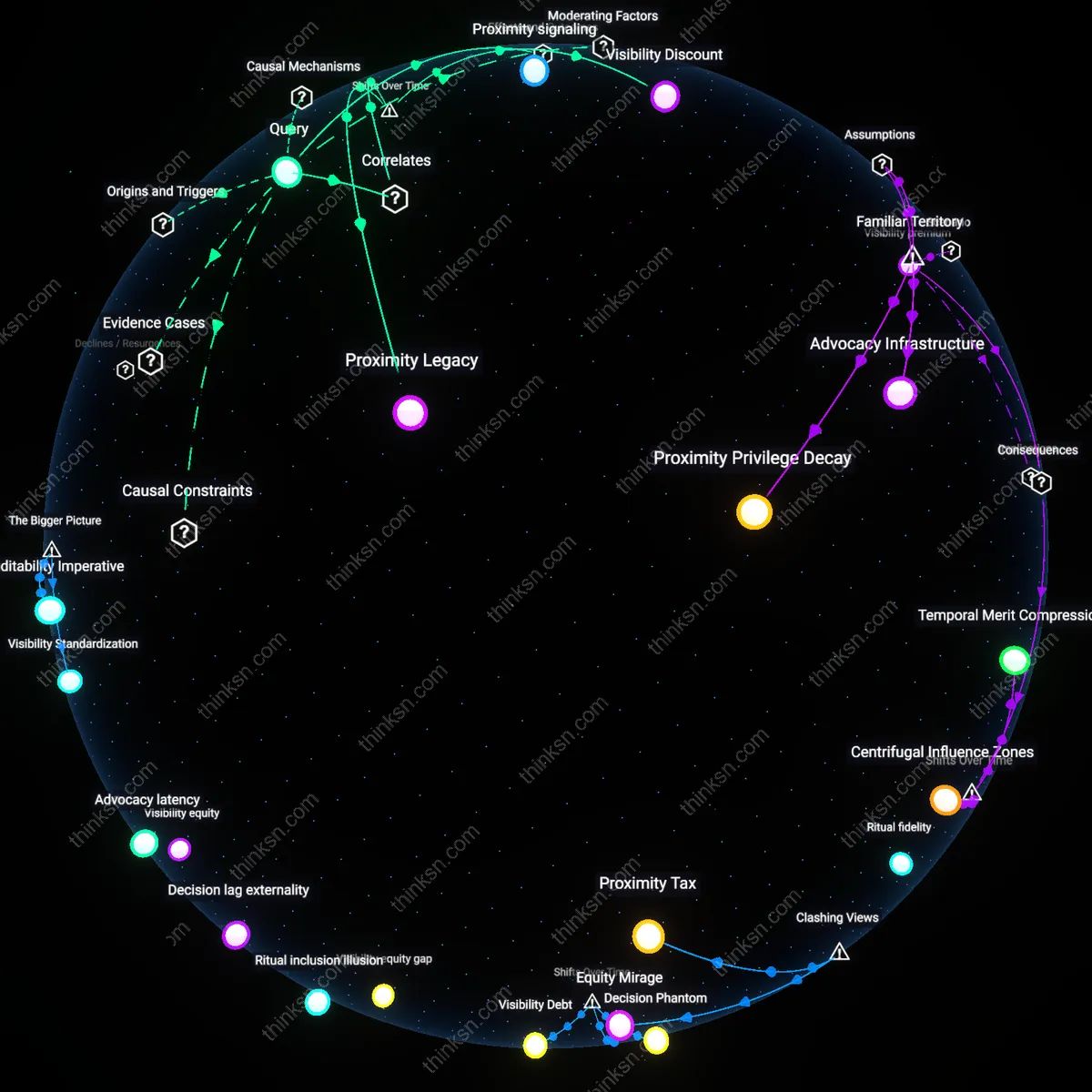
Analysis reveals 6 key thematic connections.
Key Findings
Visibility premium
Remote engineers receive fewer promotions than office-based peers because proximity to leadership increases informal influence and recognition, a dynamic entrenched in firms where advancement depends on subjective performance assessments. In tech companies like Google and Microsoft, managers disproportionately promote individuals they interact with frequently, a bias reinforced by office-centric cultures that equate presence with commitment. This creates a visibility premium where physical co-location becomes an implicit career accelerator, even when output metrics are comparable. The non-obvious consequence is that remote work, despite formal policy neutrality, systematically disadvantages distributed employees in mobility, reproducing office-based hierarchies through unmeasured social capital.
Proximity signaling
Company interpretations of remote promotion data vary because firms use promotion rates as proxies for cultural alignment, not just performance, leading to divergent conclusions about remote work’s viability. In high-growth startups such as those in Silicon Valley, leaders interpret lower remote promotion rates as evidence of weaker team integration, assuming that physical presence fosters spontaneity and loyalty critical to scaling. This reading treats promotion data as a feedback signal about engagement, not competence, reinforcing incentives for proximity signaling—deliberate presence to demonstrate commitment. The underappreciated outcome is that companies conflate developmental opportunity with cultural assimilation, normalizing promotion disparities as cultural maintenance rather than inequity.
Distributed evaluation lag
Long-term promotion parity emerges in fully remote-first organizations like GitLab and Automattic because structured evaluation systems replace ad hoc visibility with documented contribution tracking, decoupling advancement from location. These firms mandate transparent performance reviews, version-controlled project logs, and asynchronous goal-setting, which compress evaluation cycles and reduce managerial discretion. The systemic shift occurs when standardized metrics disrupt entrenched promotion routines that favor observable effort over measurable outcomes. The overlooked mechanism is that evaluation lag—the delay between action and recognition in remote settings—forces institutionalization of fairness mechanisms, inadvertently making promotion systems more meritocratic over time.
Visibility Discount
Remote engineers receive fewer promotions than office-based peers because leadership associates visibility with contribution, a bias amplified after 2020 when in-person presence reemerged as an implicit performance metric. This mechanism operates through routine access—managers promote those they see daily in meetings, hallways, or ad-hoc discussions—despite performance data showing no productivity gap. The non-obvious insight is that this isn’t nostalgia for offices but a recalibration of ‘proven reliability’ post-pandemic, where physical presence became a retroactive proxy for commitment after years of forced remote work eroded traditional observation channels.
Proximity Legacy
Promotion disparities emerged not during the remote work surge of 2020–2022 but in the 2023–2024 reversion phase, when companies reintroduced office mandates under hybrid policies that preserved remote titles but restored proximity-based advancement tracks. This reversal activated legacy systems—promotion committees trained on pre-2020 norms now interpret occasional office visits as engagement signals, while fully remote engineers, even if equally productive, fall outside habitual recognition loops. The underappreciated shift is that the damage isn’t in remote work itself but in the institutional memory that treats co-located work as the default trajectory, making remote paths seem like deviations rather than alternatives.
Trust Atrophy
Before 2019, remote engineering roles were rare and reserved for senior, proven talent, creating an implicit link between autonomy and trust; after 2022, mass remote hiring eroded that selectivity, leading management to equate broad remote access with lower accountability, thus slowing promotion velocity regardless of output. This dynamic runs through cohort perception—managers now associate early-career remote hires with surveillance gaps rather than scalability wins, altering promotion calculus even when metrics are met. The critical but overlooked transition is that trust shifted from being earned individually to being structurally withheld based on work location, turning remote status into a de facto probationary condition.