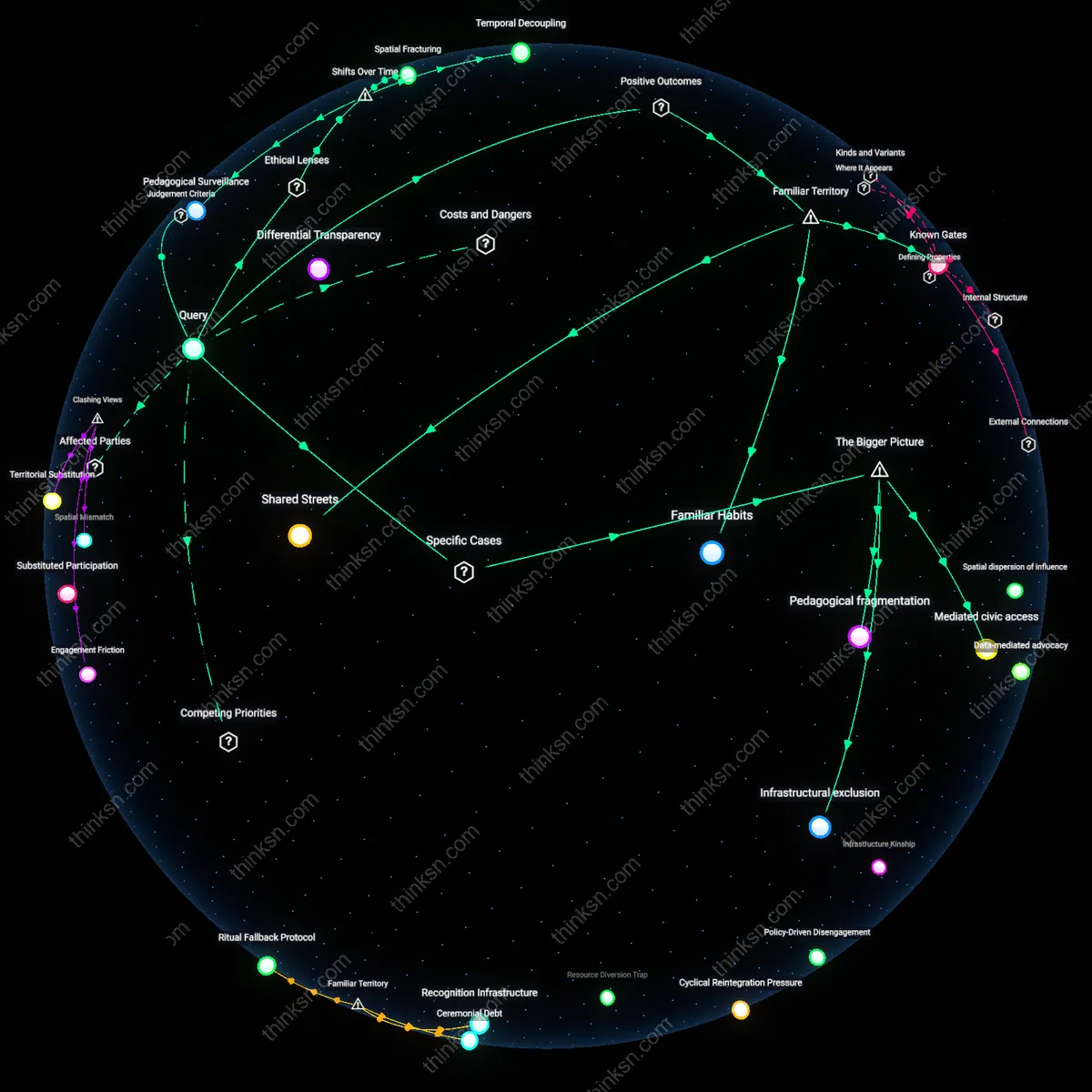
Blended Learning Hubs: Trade-offs for Community and Parental Oversight?
Analysis reveals 12 key thematic connections.
Key Findings
Differential Transparency
Blended-learning hubs in Arizona’s Yuma County ScholarShift program reduced parental oversight not through exclusion but by fragmenting the chain of accountability across remote platforms and in-person facilitators, making it harder for parents to monitor instructional quality despite increased access—this reveals that technological decentralization can erode oversight not by design but by operational opacity, a non-obvious consequence given the model’s promise of greater flexibility.
Civic Drift
When traditional public schools in Rochester, NY, faced declining enrollment due to charter and blended alternatives, the erosion of shared events like PTA meetings and sports diminished intergenerational community continuity, illustrating how traditional schools act as anchors of civic ritual—this underscores that community cohesion is not merely spatial but temporal, relying on repeated collective experiences that distributed learning models fail to replicate.
Substituted Participation
In the Houston Independent School District’s Apollo 20 initiative, the integration of blended learning in underperforming schools led to parent groups organizing not around curriculum but around internet access and device distribution, shifting engagement from pedagogical input to logistical support—this reveals that oversight can be displaced rather than enhanced, as parental roles are redefined by infrastructure rather than instruction.
Familiar Habits
Blended-learning hubs strengthen parental oversight by aligning with working families’ daily routines in places like after-school programs and community centers. Parents who already rely on these familiar local institutions find it easier to engage consistently when academics are embedded within them, creating continuity between supervision and learning. This integration reduces the perceived burden of involvement, making oversight feel less like an obligation and more like an extension of routine caregiving. The non-obvious insight is that parental oversight improves not because blended hubs are inherently superior, but because they piggyback on pre-existing patterns of trust and time-use that traditional schools often disrupt.
Shared Streets
Traditional public schools enhance community cohesion by serving as geographically anchored gathering points where neighbors interact during drop-offs, games, and performances. These repeated, informal encounters among parents and residents build social ties that span socioeconomic lines, reinforcing a shared sense of place and identity. What often goes unnoticed is that the school’s location—fixed, visible, and central—acts as a social condenser, transforming passive proximity into active community, a role that decentralized or virtual learning environments struggle to replicate despite technological connectivity.
Known Gates
Traditional public schools amplify parental oversight through established chains of authority and scheduled touchpoints like parent-teacher conferences and PTA meetings that parents recognize and expect. These rituals provide structured access and institutional legitimacy to parental involvement, making oversight feel formalized and reciprocal. The overlooked reality is that while blended hubs offer flexibility, they often lack these standardized entry points, leaving parents uncertain about when and how to engage, which ironically can reduce vigilance despite greater access to digital data.
Pedagogical Surveillance
Blended-learning hubs prioritize data-driven instruction over communal presence, a shift from the postwar American public school ideal of the school as a civic hearth; this transition, cemented by No Child Left Behind's accountability regime in the early 2000s, institutionalized algorithmic oversight that displaces parental influence into technical domains controlled by administrators and ed-tech vendors, thereby redefining parental oversight as compliance with dashboard metrics rather than participation in shared norm-setting. This reconfiguration reveals how the ethical framework of utilitarian efficiency—prioritizing quantifiable outcomes—has eroded the Rawlsian notion of schools as sites of equitable civic formation, making visible a quiet substitution of democratic accountability with operational transparency.
Spatial Fracturing
The rise of blended-learning hubs since the 2010s fragments student attendance across physical and digital spaces, breaking from the mid-20th-century model of the neighborhood school as a fixed locus of community identity; unlike traditional schools embedded in municipal districts governed by elected school boards, these hubs operate as networked nodes often managed by charter operators or regional education service centers, weakening geographically based parental coalitions and diluting the Lockean social contract between local taxpayers and educational authority. This decentralization, enabled by broadband expansion and austerity-driven school closures, exposes how neoliberal governance treats education as a portable service rather than a place-based public good, undermining the Habermasian public sphere that once flourished in PTA meetings and schoolyard exchanges.
Temporal Decoupling
Blended-learning models, especially after the 2020 remote instruction mandate during the pandemic, have severed the synchronicity that once bound students, parents, and teachers to a shared daily rhythm, dissolving the implicit schedule-based solidarity of traditional schools rooted in industrial-era time discipline dating to the 1890s; when learning occurs asynchronously across home and hub settings, parental oversight shifts from routine involvement—like walking to school or attending evening events—to episodic intervention, weakening the Durkheimian mechanical solidarity once produced by collective rituals. This rupture, now codified in hybrid learning policies adopted in states like Arizona and Florida, reveals how the ethic of liberal autonomy, emphasizing individual choice and flexibility, has supplanted the republican ideal of civic interdependence in shaping school-community bonds.
Mediated civic access
Blended-learning hubs in rural Arizona county networks reduce face-to-face coordination between parents and educators, weakening informal social ties that sustain community cohesion in traditional schools. In districts like Santa Cruz County, where public schools function as one of few multigenerational gathering spaces, the shift to hybrid instruction through online platforms operated by third-party providers disrupts routine interactions among families, teachers, and local leaders. This erosion occurs not merely from physical absence but from the institutional displacement of school-based decision-making into contracted educational management organizations, which operate under performance metrics rather than communal accountability. The non-obvious effect is that parental oversight becomes procedural—limited to data dashboards and scheduled virtual check-ins—rather than embedded in ongoing, observable school life, revealing how governance outsourcing reshapes civic participation.
Infrastructural exclusion
In post-Katrina New Orleans, the proliferation of charter-based blended-learning campuses has reconfigured parental influence into a stratified system where oversight correlates with digital access and administrative fluency, unlike the more geographically tethered and inclusive town-hall traditions of neighborhood public schools. As traditional schools were replaced by a decentralized portfolio model, many blended hubs adopted centralized enrollment and remote monitoring systems managed by charter management organizations like KIPP New Orleans, requiring parents to navigate complex digital portals to track student progress or voice concerns. This creates a hidden technical barrier that undermines equitable community cohesion, as low-income and non-English-speaking families face compounded friction in exercising oversight. The systemic driver is not choice per se, but the misalignment between digitized school management infrastructures and the lived communication ecologies of marginalized communities.
Pedagogical fragmentation
In the Harlem Children’s Zone’s Promise Academy blended classrooms, the integration of adaptive learning software from providers like DreamBox and Pearson fragments instructional authority, dispersing it across algorithms, remote content developers, and on-site teachers, thereby diluting consistent parental understanding of curriculum and undermining oversight grounded in shared educational norms. Unlike traditional public schools, where curricular consistency across classrooms enables collective parental expectations and communal benchmarking, the customization and opacity of digital learning paths make it difficult for parents to compare experiences or advocate cohesively. This fragmentation weakens the epistemic foundation of community cohesion—common knowledge about what children are learning—because parents cannot easily interpret or challenge algorithmically tailored content. The overlooked consequence is that oversight becomes individualized and technocratic, substituting data reports for dialogue and eroding the collective dimension of educational citizenship.