Expose Manager Harassment: Personal Cost vs Organizational Change?
Analysis reveals 6 key thematic connections.
Key Findings
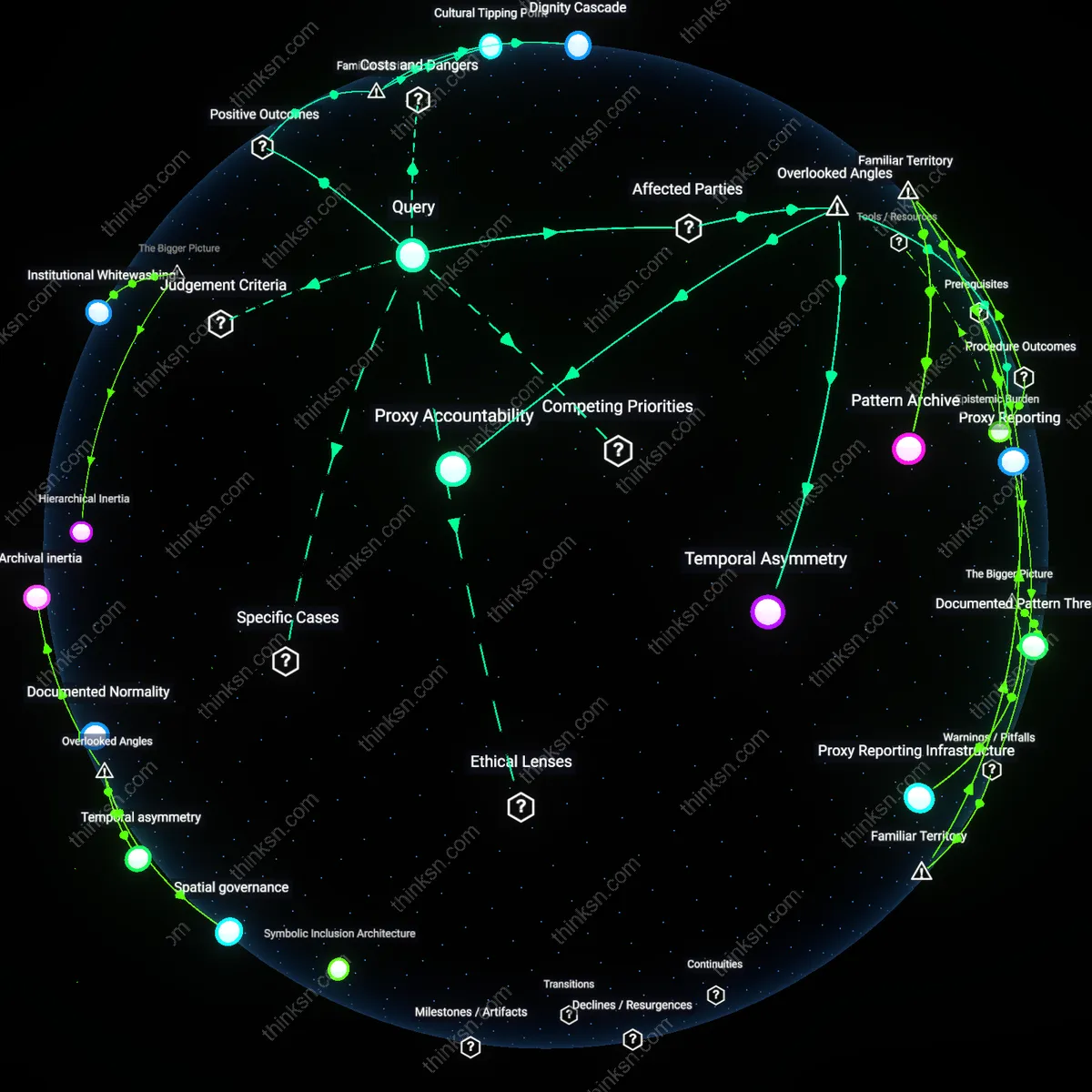
Temporal Asymmetry
One should delay public exposure of managerial harassment until after organizational exit to maximize personal safety while preserving reform potential. Remaining in the organization after reporting often traps targets in escalating retaliation cycles disguised as procedural review, whereas post-departure disclosures—especially by former employees with insider credibility—can trigger regulatory scrutiny or public pressure without risking job-based reprisal; this delay exploits the mismatch between individual vulnerability during employment and institutional accountability windows after departure, a dynamic rarely acknowledged in 'speak up' ethics campaigns that assume timely reporting is optimal for both justice and reform.
Proxy Accountability
Targets should channel harassment evidence through third-party audit firms contracted by the organization’s insurers rather than internal HR, because insurers’ financial exposure to repeat claims creates a vested interest in verifying misconduct without direct employer dependence. Unlike compliance officers bound by corporate hierarchy, external auditors retained by liability insurers operate under contractual mandates to assess risk patterns—enabling them to validate harassment data without triggering the same loyalty conflicts that neutralize internal investigations, revealing a hidden enforcement node where economic incentives align more closely with truth recovery than with image management.
Epistemic Burden
Exposing managerial harassment should be coupled with structured documentation that shifts from narrative testimony to quantifiable behavioral patterns, because organizational systems respond more reliably to aggregated process deviations than to individual suffering, which can be dismissed as subjective. When targets log incidents using standardized metrics—frequency, duration, witnesses, policy violations—this data integrates into existing compliance dashboards used by audit committees and regulators, transforming personal risk into systemic evidence that bypasses emotional framing often used to discredit whistleblowers; this procedural formalization is rarely emphasized, yet it alters power dynamics by speaking the language of institutional risk rather than moral appeal.
Moral Witness Effect
One should expose managerial harassment when doing so activates institutional accountability mechanisms, because observed integrity pressures organizations to align behavior with stated values. In environments like corporate offices or public agencies where ethics codes and HR policies exist but are inconsistently enforced, a single credible disclosure triggers review processes that cannot be ignored without reputational cost. The non-obvious power here lies not in personal sacrifice but in the role of the whistleblower as a catalyst—transforming private misconduct into public organizational risk, which management is structurally motivated to resolve. This leverages the gap between image and practice, turning individual risk into systemic correction through the organization’s desire to maintain legitimacy.
Cultural Tipping Point
One should balance personal risk by withholding immediate exposure until patterns of harassment are documented across multiple cases, because collective evidence shifts perception from isolated grievance to systemic failure. In workplaces where rumors of abusive managers circulate but remain unverified—like hospital departments or retail chains—individual stories are dismissed as subjective, but aggregated accounts create undeniable momentum for reform. The underappreciated dynamic is that people do not respond to morality alone, but to social proof; when enough employees validate harm, bystanders become allies and leaders can no longer justify inaction. This transforms personal danger into strategic timing, where patience enables impact.
Dignity Cascade
One should expose managerial harassment in a way that centers the human cost of abuse, because narratives focused on emotional and psychological harm resonate more deeply than policy violations alone. In settings like universities or non-profits—where communal values of care and equity are publicly championed—personally told stories disrupt complacency more effectively than formal complaints. The unspoken leverage is that people protect institutional identity; when abuse contradicts core mission statements, members experience cognitive dissonance that motivates change to restore moral coherence. This makes the exposé not an accusation, but an invitation to reclaim shared values.