Expose Company Wrongdoing: Brand Impact vs. Personal Costs?
Analysis reveals 8 key thematic connections.
Key Findings
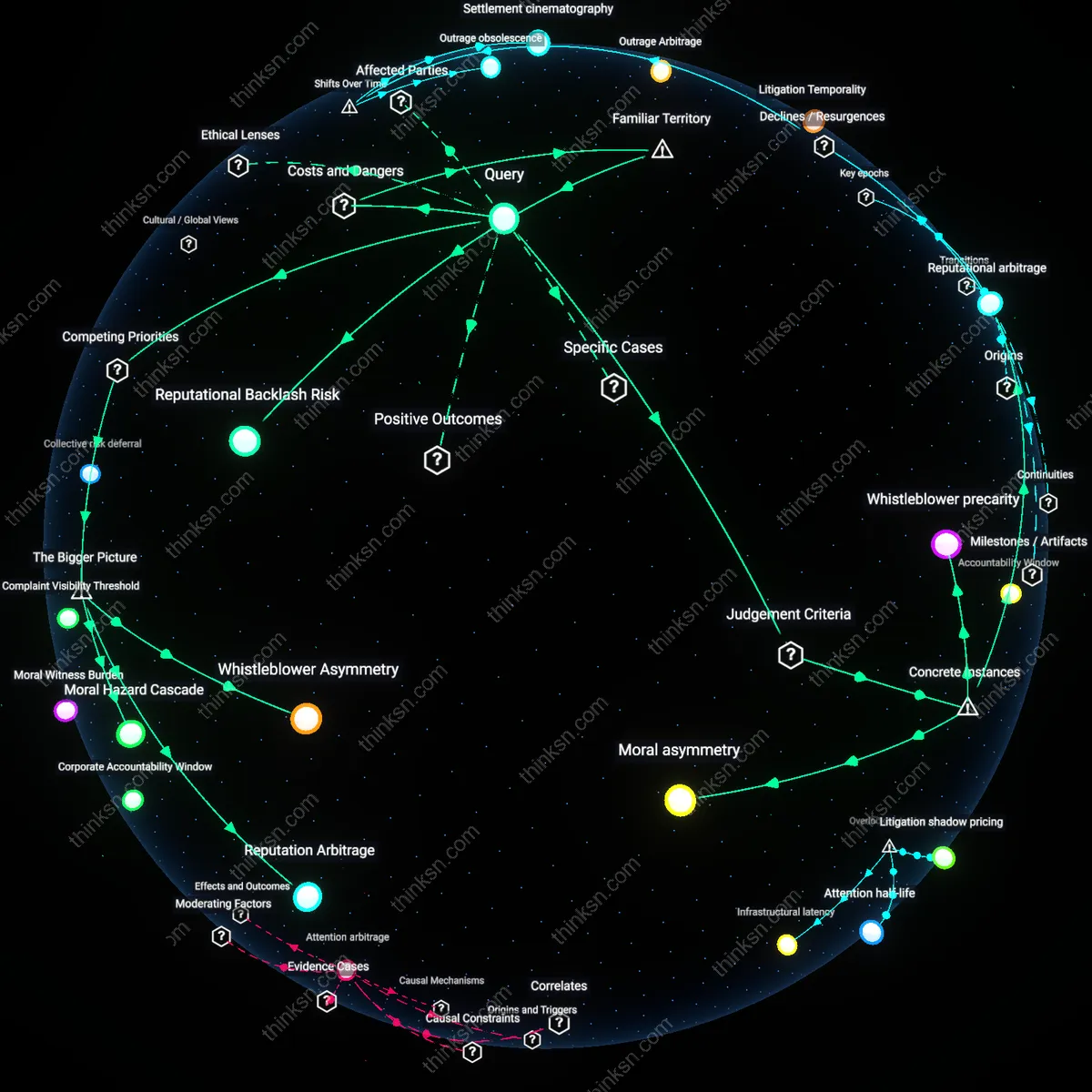
Moral asymmetry
A consumer should prioritize exposing corporate wrongdoing when the public harm demonstrably exceeds personal cost, as seen in the case of Dr. Mona Hanna-Attisha’s disclosure of elevated lead levels in Flint, Michigan’s water supply; she acted against institutional denial despite risking her career, leveraging scientific evidence within public health systems to shift political accountability, revealing that ethical responsibility to collective welfare can override individual vulnerability in governance gaps.
Reputational arbitrage
Consumers may rationally delay legal action to maximize reputational damage against a corporation as a bargaining chip, exemplified by the 2010 Deepwater Horizon oil spill, where individual plaintiffs and Gulf Coast states withheld immediate settlements until BP’s brand value plummeted and public outrage peaked, demonstrating that strategic timing of exposure can convert moral claims into economic leverage within asymmetric power negotiations.
Whistleblower precarity
An individual should weigh legal pursuit not by moral certainty but by institutional receptivity, as revealed in the case of Sherron Watkins’ internal warnings at Enron, where early exposure failed to trigger reform because audit and regulatory mechanisms were compromised, proving that personal cost is minimized not by truth alone but by the presence of functional oversight structures capable of receiving it.
Reputational Backlash Risk
A consumer should not prioritize long-term brand reputation impacts when considering legal action because public exposure often triggers aggressive corporate retaliation that escalates personal costs. Companies like Uber and Facebook have deployed legal teams and PR campaigns to discredit whistleblowers, leveraging asymmetric resources to shift narrative control and paint individuals as opportunists or disruptors. This dynamic operates through media framing and litigation intimidation, where the consumer’s identity becomes collateral in a reputation war they cannot win. The underappreciated reality is that brand damage is often temporary and recoverable, while the individual’s social and financial harm can be permanent.
Social Trust Erosion
Coming forward risks fracturing the consumer’s personal networks due to social stigma and perceived disloyalty, especially in communities tied to the corporation’s employment or economic presence. In towns dominated by a single company—like coal miners in West Virginia or auto workers in Detroit—exposing wrongdoing is seen as betraying communal survival, triggering isolation or ostracism. This operates through localized norms where economic dependence overrides ethical dissent, making the individual a scapegoat for broader systemic failure. Though people commonly associate whistleblowing with moral courage, the immediate social cost is often a collapse of trust that outweighs abstract gains in corporate accountability.
Whistleblower Asymmetry
A consumer who exposes corporate wrongdoing inevitably sacrifices personal stability to serve collective accountability, because legal systems incentivize organizational self-protection over truth disclosure. Regulatory enforcement bodies like the SEC rely on individual whistleblowers to detect fraud, yet the costs of litigation, retaliation, and career disruption fall entirely on the individual, while reputational consequences to the firm are diffused across shareholders and managed by PR teams. This imbalance is systemically reinforced by limited whistleblower protections and corporate capture of legal processes, making personal risk non-linear to public benefit. The non-obvious insight is that the legal architecture itself amplifies harm to the individual while minimizing institutional liability, turning moral action into a structurally disfavored outcome.
Reputation Arbitrage
Corporate reputation functions as a tradable asset that insulates firms from long-term consequences, allowing them to absorb short-term scandals without fundamental change, thereby reducing consumer incentives to pursue legal action. Multinational brands like Uber or Nestlé have repeatedly leveraged CSR campaigns and rebranding after misconduct is exposed, shifting public attention away from systemic failures and onto curated narratives of reform. This dynamic is enabled by financial markets that reward recovery over accountability, and media cycles that favor novelty over continuity, meaning reputational harm is both temporary and monetarily manageable for firms. The underappreciated mechanism is that reputation repair is a calculated investment, making consumer exposure more symbolic than transformative in most cases.
Moral Hazard Cascade
When individual consumers bear the cost of legal action against corporate misconduct, systemic actors—regulators, insurers, and auditors—adjust their risk calculations to tolerate higher levels of negligence, expecting individuals to act as accountability proxies. The 2015 Volkswagen emissions scandal revealed that despite years of engineering deception, no internal auditor or regulator initiated corrective action; it took a consumer-funded research study to trigger enforcement. This creates a feedback loop where institutions underinvest in oversight, knowing that aggrieved individuals will eventually shoulder detection and proof burdens, effectively privatizing public regulation. The overlooked consequence is that personal courage becomes a systemic release valve, preventing broader institutional reform.