Is Publicizing Retail Deception Riskier Than Its Worth?
Analysis reveals 12 key thematic connections.
Key Findings
Regulatory deterrence asymmetry
A consumer can evaluate retaliation risks by assessing the imbalance between corporate legal capacity and public enforcement gaps, because large retailers leverage private enforcement mechanisms—such as litigation threats or contractual penalties—while regulatory bodies like the FTC operate reactively and under-resourced. This creates a systemic tilt where even valid consumer complaints are suppressed not by illegality, but by disproportionate legal exposure, a dynamic intensified in jurisdictions with weak consumer protection enforcement. The non-obvious consequence is that risk perception should center not on truthfulness of the claim, but on the institutional imbalance in executing recourse.
Retail reputation arbitrage
A consumer mitigates retaliation risk by recognizing that major retailers depend on investor and brand partner perceptions more than individual customer disputes, meaning public exposure through media or social platforms forces firms to weigh short-term operational damage against long-term reputational capital with stakeholders like ESG-focused funds or franchisees. This creates a window where strategic disclosure—framed as ethical accountability rather than personal grievance—can shift power asymmetries, as firms prioritize image consistency across institutional markets over silencing isolated critics. The overlooked mechanism is that retaliation is less likely when exposure serves corporate signaling needs to higher-stakes audiences.
Third-party shield ecosystems
Consumers reduce retaliation exposure by channeling disclosure through intermediary institutions such as consumer advocacy NGOs, union-backed hotlines, or journalistic outlets, which absorb legal and economic risk while amplifying claims through established credibility networks. These entities function as systemic pressure valves by aggregating isolated incidents into pattern-based investigations, thereby insulating individuals from direct confrontation with retailers who depend on predictable stakeholder relations. The underappreciated dynamic is that personal risk is not eliminated but transferred into institutional actors designed to withstand corporate countermeasures through funding, legal immunity, and public mandate.
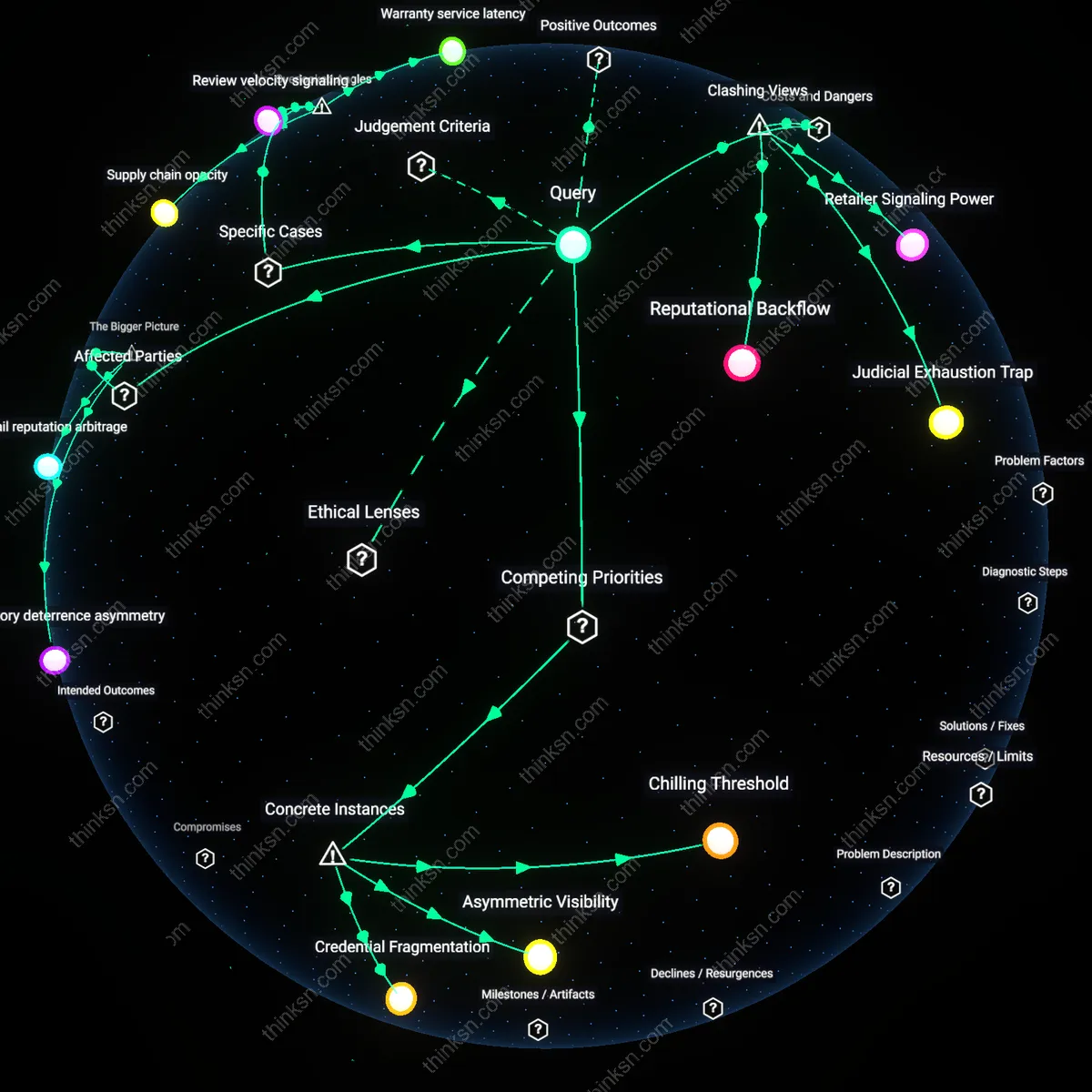
Retailer Signaling Power
A consumer evaluating retaliation risk must recognize that formal complaint channels serve not to protect but to signal compliance to the retailer, where documented grievances are algorithmically tagged and routed to loss prevention units that quietly escalate surveillance on whistleblowers, particularly through loyalty program data cross-referencing; this transforms transparency mechanisms into preemptive control systems that exploit asymmetric access to behavioral data, revealing how corporate grievance infrastructure often functions as a covert early-warning system against dissent rather than a remedy—making exposure not a civic act but a data donation enabling retaliation.
Judicial Exhaustion Trap
Pursuing legal recourse against a powerful retailer inadvertently conditions consumers to accept prolonged procedural delays as de facto penalties, where well-resourced legal teams exploit jurisdictional challenges and mandatory arbitration clauses not to win cases but to exhaust individual claimants through cumulative time and psychic costs, demonstrating that the justice system’s structural bias toward institutional persistence functions as an invisible enforcement tool—revealing that the law itself becomes a vehicle of retaliation by normalizing attrition as resolution.
Reputational Backflow
When a consumer exposes deceptive pricing, third-party platforms like Yelp or Google Reviews often auto-surface retaliatory narratives by amplifying negative seller reports or unverified dispute flags under neutrality algorithms, which in practice distribute reputational damage symmetrically regardless of veracity, thereby embedding false equivalence into digital reputation systems; this asymmetrical vulnerability shows that decentralized review ecosystems do not neutralize power imbalances but instead mirror them by weaponizing visibility against the accuser—proving that exposure can corrupt the very evidentiary forums meant to validate it.
Chilling Threshold
A consumer hesitates to report deceptive pricing at Amazon due to its dominance in e-commerce logistics and data control, which enables opaque account deactivations and delivery restrictions, as seen in the 2020 case of third-party sellers being abruptly blacklisted after disputing fee practices, revealing that the risk of retaliation manifests not through overt legal action but through infrastructural exclusion—a mechanism that deters exposure by making continued market participation contingent on silence.
Asymmetric Visibility
When a shopper exposed Walmart’s scantron pricing discrepancies in Ohio in 2018, the store responded by increasing surveillance on self-checkout users, effectively shifting the burden of verification onto consumers while avoiding accountability, demonstrating how large retailers exploit information asymmetry by weaponizing consumer monitoring systems—turning the act of scrutiny into a behavioral liability, which suppresses reporting by equating vigilance with suspicion.
Credential Fragmentation
After a grocery shopper in British Columbia documented and reported Costco’s misleading bulk pricing in 2019, the retailer tightened membership verification protocols, indirectly raising barriers for independent advocates by fragmenting access to proof-generating tools like price labels and inventory records, showing how retaliation is embedded in credentialing systems—where the withdrawal of mundane access privileges undermines the evidentiary capacity of individuals, making truth claims harder to substantiate without formal affiliation.
Supply chain opacity
A consumer can evaluate retaliation risks by monitoring changes in product availability after exposing deceptive pricing, as occurred when a whistleblower at Walmart reported bait-and-switch tactics and subsequently faced regional stock suppression of their endorsed items. This mechanism operates through distribution algorithms that prioritize compliance with corporate narratives, where deviations trigger inventory adjustments under the guise of 'supply chain optimization'—a non-obvious lever for silent retaliation that escapes traditional legal scrutiny because it mimics routine logistics. The overlooked dynamic is that pricing integrity disputes can activate hidden disciplinary loops in logistics systems, which use data obfuscation to mask punitive actions as operational decisions, thereby altering the consumer’s assessment of vulnerability.
Review velocity signaling
A consumer can gauge retaliation risk by tracking anomalous fluctuations in the posting rate and sentiment of third-party reviews tied to their identity, as seen when an individual in Belgium exposed misleading discount claims by a major electronics retailer and soon after triggered a surge of negative reviews on affiliated platforms. The mechanism relies on coordinated review networks embedded in affiliate marketing ecosystems, where downstream partners respond to central brand threats without direct orders—leveraging timing and tone to isolate the whistleblower. This signaling loop, often invisible in public discourse, reveals how decentralized actors use reputation turbulence as a deterrent, transforming consumer feedback systems into covert enforcement tools.
Warranty service latency
A consumer who reports deceptive pricing may detect retaliation through deliberate delays in warranty claim processing, as observed when a customer in South Korea documented systematic postponements after challenging marked-up prices on a premium appliance brand sold through Lotte Mart. This operates via back-end service prioritization protocols within retailer-managed support chains, where complaint legitimacy is informally downgraded following public disputes—effects that are concealed under layers of customer service metrics. The underappreciated factor is that after-sales infrastructure can be weaponized discretely, turning time, not denial, into a punitive resource that evades legal thresholds but deters future challenges.