Swift Settlements: Long-Term Risks and Rewards?
Analysis reveals 6 key thematic connections.
Key Findings
Settlement Ossification
Private settlement compensation, when applied to non-class-action cases, entrenches legal fragmentation by allowing powerful defendants to extinguish claims individually while preserving systemic harm; this mechanism prioritizes closure for individual plaintiffs over structural accountability, enabling repeat offenders to treat payouts as predictable compliance costs rather than corrective signals. The process operates through corporate legal departments that model per-plaintiff expenditure ceilings and calculate risk-adjusted settlements, effectively replacing judicial scrutiny with actuarial silence—this is significant because it transforms litigation into a transactional maintenance fee, foreclosing public adjudication even when widespread harm patterns exist. What goes unseen is that these settlements do not signal legal weakness but strategic endurance, revealing how the avoidance of class certification can serve not as a failure of aggregation but as a deliberate containment strategy.
Invisible Precedent
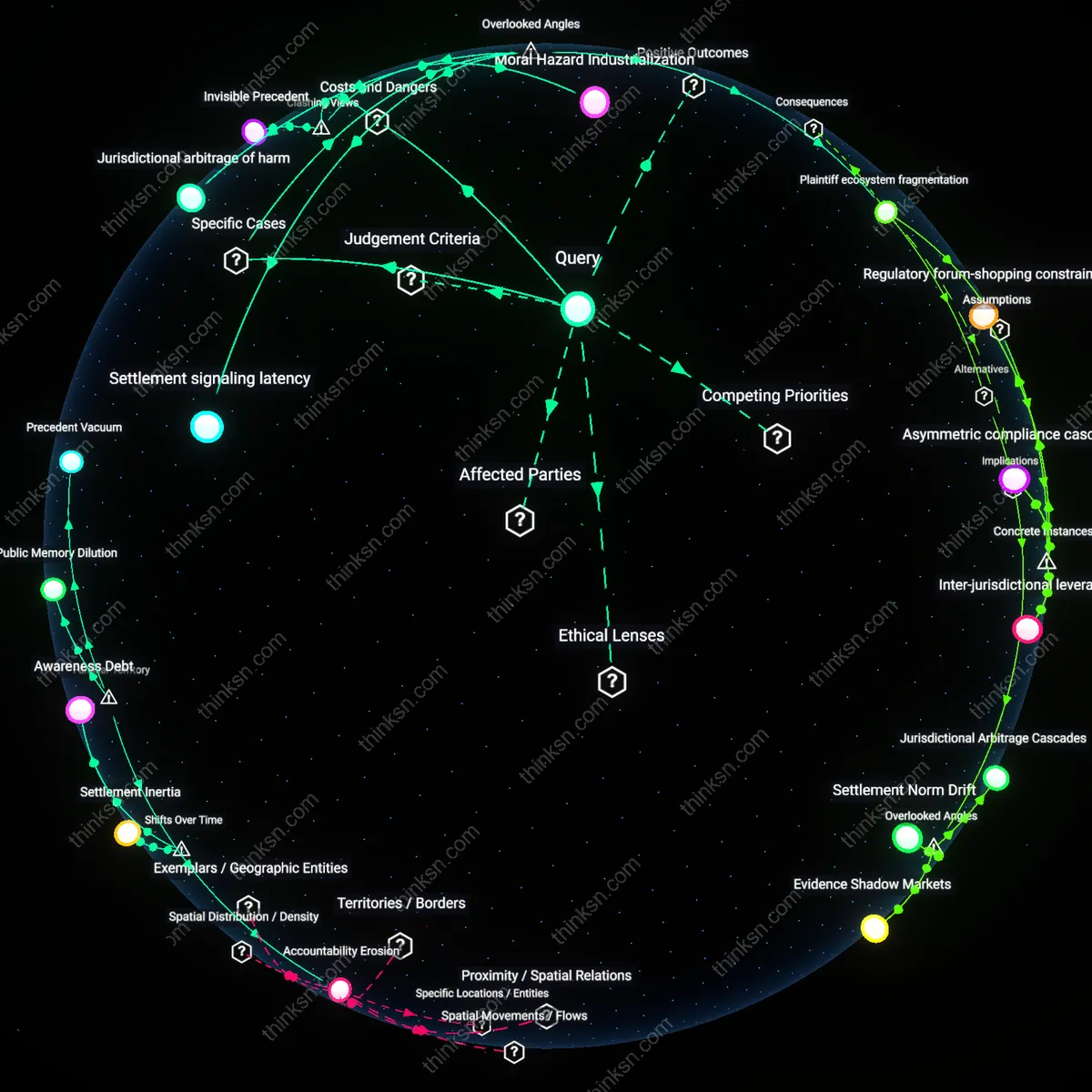
The acceptance of private compensation in excluded non-class cases creates binding private law through contract where public law fails to emerge, effectively privatizing the interpretation of rights without oversight or appeal; this occurs when settlement terms include non-disclosure and non-admission clauses that block future plaintiffs from citing prior outcomes, even though settlement amounts implicitly reflect adjudicative value. This dynamic functions within state-level civil dockets where individual attorneys negotiate against corporate defense firms with access to aggregated internal claims data, creating a feedback loop in which compensation levels are calibrated to prevent normative challenge rather than ensure justice. The underappreciated reality is that these settlements generate a shadow common law—one that binds only victims, while corporations remain legally unscathed and unobligated to change conduct.
Moral Hazard Industrialization
Repeated private settlements in the absence of class action incentivize the institutionalization of harm by decoupling financial consequence from operational reform, allowing entities like nursing home chains or payday lenders to treat compensation as a line-item cost embedded in service delivery models. This operates through risk management protocols where legal departments benchmark per-incident payout tolerances against profit margins, transforming tort liability into operational overhead; the system’s significance lies in how it disables legal deterrence, turning courts into passive ratifiers of corporate harm budgets rather than corrective institutions. Contrary to the intuition that compensation redresses injury, the dominant outcome is the normalization of violation—what emerges is not accountability but a monetized license to harm, invisible because each transaction appears consensual and isolated.
Settlement signaling latency
Private settlements in failed class-actions like the 2017 Equifax data breach disproportionately benefit early claimants while obscuring long-term systemic failures due to the absence of centralized legal scrutiny. Because individual payouts are processed without public adjudication of liability, subsequent victims remain unaware of emergent patterns in corporate data governance failures, effectively delaying regulatory recognition of risk. This latency in aggregating harm across dispersed claims masks recurrence until breaches become epidemic, a dynamic most settlement analyses overlook by focusing only on immediate compensation efficiency rather than information diffusion failure.
Jurisdictional arbitrage of harm
When plaintiffs’ firms abandon class certification in cases like the 2019 Boeing 737 MAX wrongful death suits and instead negotiate private settlements per victim nationality, they inadvertently enable defendants to exploit legal disparities across borders by offering lower per-capita compensation in jurisdictions with weaker tort systems. The lack of class status prevents the establishment of a uniform standard of harm valuation, allowing corporations to manage liability as a geographically segmented cost structure rather than a unified ethical obligation. This arbitrage is rarely acknowledged in settlement ethics debates, which assume compensation is a scalar moral duty, not a spatially optimized liability strategy.
Plaintiff ecosystem fragmentation
In opioid litigation where local governments like Scioto County, Ohio rejected joining broader state-level class-like agreements and instead pursued individual settlements with distributors such as Cardinal Health, the resulting patchwork of confidential terms eroded collective bargaining power and duplicated discovery costs. Without class mechanisms to pool evidence and synchronize legal pressure, smaller jurisdictions become isolated consumers of legal resources rather than contributors to a cumulative evidentiary body. This fragmentation destroys economies of scale in public interest litigation, a consequence typically ignored in favor of celebrating settlement speed, yet it fundamentally alters the sustainability of local enforcement ecosystems.