When Is Accepting Partial Payment a Strategic Choice?
Analysis reveals 10 key thematic connections.
Key Findings
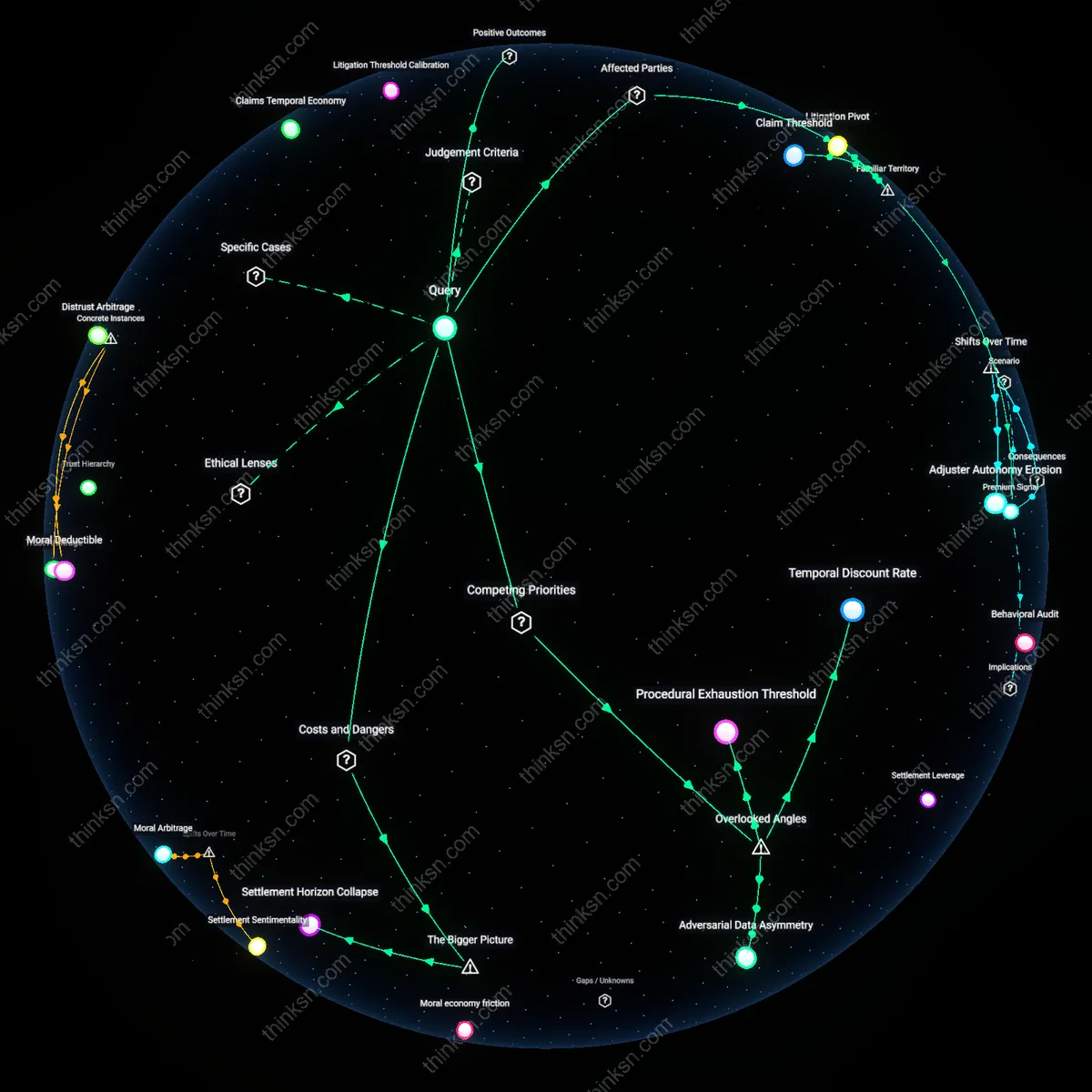
Claim Threshold
Accepting a partial payment becomes a strategic choice when claimants anticipate future denials and use the partial sum as proof of engagement to secure eligibility for subsequent compensation. Insurers, particularly in workers’ compensation or disaster relief programs like FEMA, treat initial partial payments as markers of active claims rather than settled ones, allowing recipients to preserve access to later stages of aid; this transforms an apparently coerced acceptance into a tactical foothold. Most people associate partial payments with concession because they signal compromise under pressure, but the non-obvious function here is procedural continuity—acceptance functions not as closure but as bureaucratic enrollment.
Premium Signal
Insurers treat partial payments as strategic when they come from policyholders with historically low claims, because accepting even reduced compensation reinforces a reputation for rationality and trustworthiness, which lowers future premium adjustments. Middle-income homeowners in wildfire or flood zones, for example, may accept underpaid settlements knowing that a formal dispute could trigger risk reclassification and higher rates, so they trade short-term loss for long-term cost stability. While the public assumes such acceptance reflects powerlessness, the familiar association with insurer authority masks how quietly rational customers manipulate behavioral signals to remain in the ‘model client’ category.
Litigation Pivot
Partial payments shift from concessions to strategy when plaintiffs’ attorneys accept them specifically to establish standing for class certification, turning individual settlements into jurisdictional leverage. In mass tort litigation—such as those involving defective medical devices or pharmaceuticals—defendants often issue small, unsatisfactory payments to dismiss claims, but plaintiffs’ lawyers allow this to create a documented cohort of affected recipients, enabling certification of a larger class. The public sees partial payments as defeat, but the familiar pattern of corporate delay and lowball offers inadvertently trains legal actors to exploit these gestures as procedural entry points, revealing settlement not as resolution but as recruitment.
Claims Temporal Economy
Accepting a partial payment became a strategic choice in the 1990s when insurers began standardizing settlement timelines, compressing the period in which policyholders had to respond or lose eligibility—this shifted concession into timing leverage, where delayed full payment offers created a new form of negotiation currency built not on dispute resolution but on calendar pressure managed by adjusters within actuarially modeled payout schedules. The non-obvious insight is that the strategy emerged not from policyholder agency but from the synchronization of claims processing cycles across property and casualty markets, rendering speed a proxy for equity.
Litigation Threshold Calibration
The shift from concession to strategy crystallized after 2008, when post-financial-crisis regulatory tightening raised the evidentiary bar for bad-faith claims, prompting insured parties to accept partial payments not as defeat but as a procedural anchor—to establish a recorded good-faith transaction that could later justify legal action if final settlements stalled, a move institutionalized in states like California through the use of specific statutory demand forms. This reveals how partial payments evolved into procedural instruments within a risk-averse legal environment, where timing and documentation became as critical as dollar amounts.
Reputational Capital Arbitrage
By the mid-2010s, multinational reinsurers began weighting claims settlement patterns in underwriting models, turning rapid partial disbursements into a signal of client reliability—enabling policyholders in sectors like commercial real estate to accept early partial payments not to relieve pressure but to boost their standing in global risk pools, a shift driven by algorithmic reputation scoring in platforms like ISO ClaimSearch. This reframing of concession as reputation-building exposes how strategic acceptance emerged from the datafication of trust, where payment behavior feeds into predictive networks beyond the immediate claim.
Settlement Horizon Collapse
A partial payment shifts from concession to strategy when future risk exposure becomes more costly than immediate loss absorption for the insurer. In high-frequency liability environments like auto no-fault systems, insurers monitor regional litigation density and adjust partial payment timing to coincide with court backlog peaks, deliberately shrinking the claimant’s rational settlement horizon. Because wait times for trial slots in urban districts like Toronto or Los Angeles can exceed 18 months, even modest partial payments reframe full compensation as economically irrational for claimants facing mounting medical debt. This operates through judicial capacity depletion—a systemic bottleneck the insurer doesn’t control but leverages—turning partial disbursements into temporal arbitrage tools that pre-empt higher awards.
Temporal Discount Rate
Accepting a partial payment becomes a deliberate strategic choice when the claimant’s temporal discount rate aligns with long-term liquidity preservation rather than immediate restitution maximization. This shift occurs when individuals or entities—such as small legal practices or accident victims reliant on installment-based medical care—calculate that absorbing a sub-optimal payout now secures operational continuity, avoiding cascading defaults on rent, litigation financing, or health bills; the mechanism operates through informal credit networks where reputation for solvency outweighs total recovery, a dynamic invisible in formal insurance economics. This reframes concession not as coercion but as intertemporal arbitrage, exposing how financial fragility reshapes strategic agency in ways that standard models, focused on claim value optimization, systematically overlook.
Procedural Exhaustion Threshold
A partial payment shifts from concession to strategy when it enables a claimant to clear the procedural exhaustion threshold required to access higher-value forums or regulatory escalation paths. For example, community health clinics billing Medicaid insurers may accept underpayments to satisfy audit-ready documentation requirements, thereby qualifying for federal grievance panels or class-action standing—leveraging apparent defeat as a compliance tollgate. This dependency on performative resolution, where partial settlement functions as a bureaucratic passport, reveals a hidden procedural economy in which symbolic closure is currency, a layer absent from both consumer rights narratives and actuarial analyses.
Adversarial Data Asymmetry
Insurers’ partial payments become strategically acceptable when recipients use them to instrument adversarial data asymmetry—intentionally accepting early offers to map underwriting blind spots and trigger future anomaly-based claims. Grassroots tenant unions in rent-regulated buildings, for instance, coordinate partial settlement acceptances across portfolios to generate comparative data on insurer risk modeling gaps, later exploiting these patterns in mass appeals or policy lobbying. The strategic value lies not in the payment itself but in its function as a reconnaissance probe, transforming passive recipients into epistemic agents; this flips the concession narrative by treating payment as intelligence gathering, a function erased in traditional victim-perpetrator insurance framings.