Outrage Infrastructure
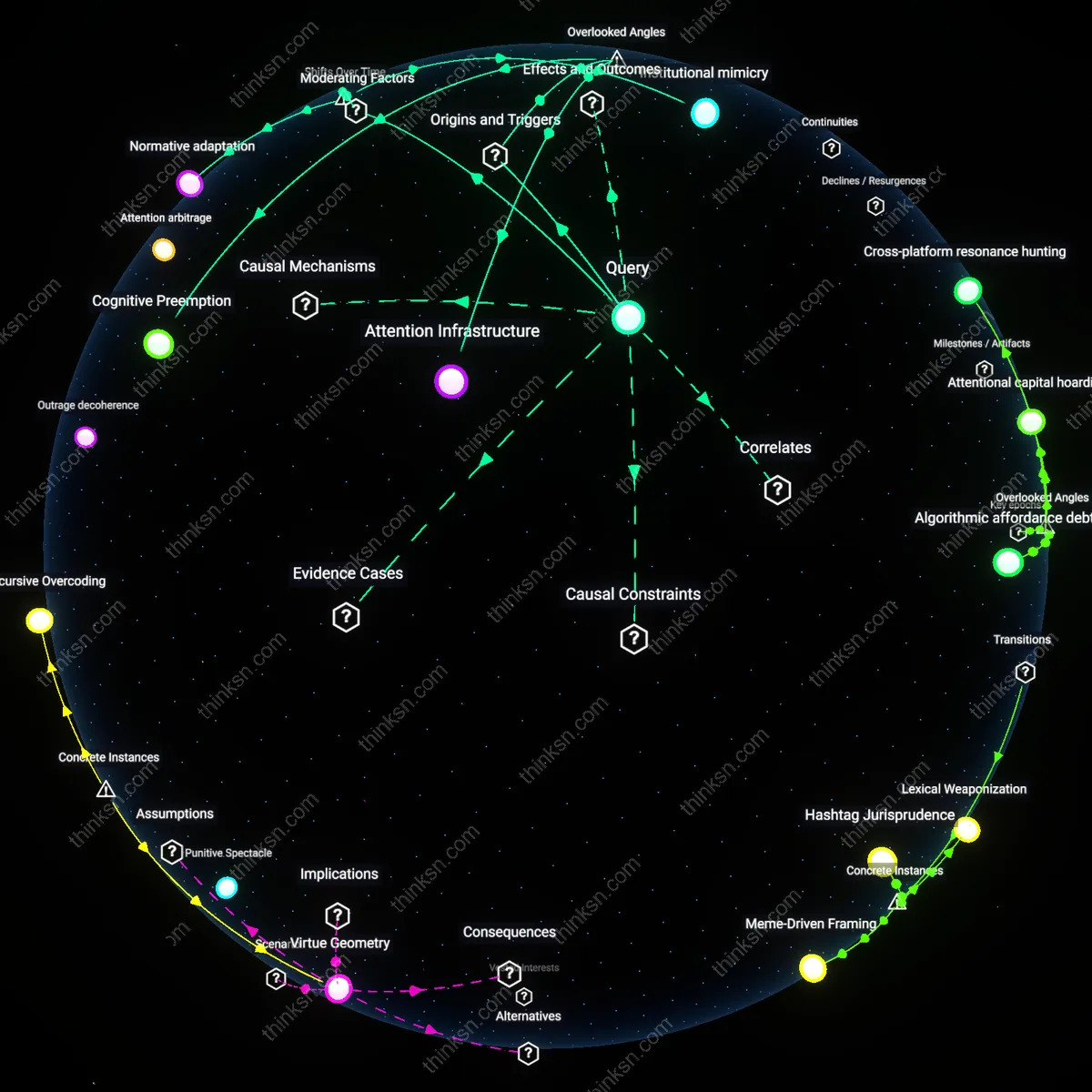
The rise of moral outrage phrases like 'cancel culture' and 'wokeness' did not emerge from grassroots public discourse but was structurally enabled by the scaling of commercial content moderation systems after 2016, when Twitter intensified algorithmic amplification of high-engagement conflict to stabilize ad revenue. Platform engineers, trust-and-safety teams, and third-party consultants built backend protocols that treated moral indignation as a predictable engagement driver, repurposing user behavior into a steady signal for trending algorithms and moderation triage. This institutionalization of outrage—hardened during the 2017–2019 redesign cycle—meant political arguments no longer unfolded as spontaneous debates but as performances calibrated to trigger automated visibility systems. The non-obvious outcome is that 'outrage' became less a cultural phenomenon and more a technical output, shaped more by engineering thresholds than by public sentiment.
Backlash Epistemology
Moral outrage phrases gained traction not because they described real shifts in public ethics but because they became tools for delegitimizing procedural accountability in decentralized online spaces, particularly among centrist commentators and media executives facing new demands from marginalized users. Figures such as op-ed editors and legacy media hosts weaponized terms like 'wokeness' to reframe calls for inclusion as ideological overreach, positioning themselves as neutral arbiters under siege rather than participants in evolving discourse norms. This reversal transformed political arguments from negotiations over representation into defensive performances of cultural authority, where the real subject became who had the right to define what counted as 'reasonable' speech. The non-obvious insight is that these phrases did not reflect a culture war so much as manufacture a rhetorical alibi for institutional inertia.
Punitive Spectacle
Political arguments on Twitter shifted from persuasive exchange to ritualized punishment scenarios because moral outrage phrases became condensed scripts for public shaming, enabling users to bypass argumentation and immediately assign moral status through labeling. Activist accounts, particularly from marginalized identities, began deploying 'cancel culture' rhetoric not as a call for expulsion but as a deterrent strategy to enforce new community norms in the absence of platform enforcement—turning accusations into performative warnings. Over time, opponents replicated the same pattern in reverse, using accusations of 'wokeness' to stage their own victimization and invert the moral hierarchy. The non-obvious result is that both sides converged on a shared theatrical form—not to resolve disputes, but to reenact them as fixed roles in a loop of accusation and counter-accusation, where winning meant visibility, not consensus.
Discursive Overcoding
The 2020 Black Lives Matter protests triggered a surge in tweets using 'cancel culture' as a preemptive rhetorical shield, exemplified when Fox News personalities amplified accusations of 'woke mob justice' following the removal of old comedy sketches from streaming platforms; this reframed political debate as a binary between moral accountability and free expression, embedding defensive language into argumentation before conflicts even arise. The mechanism—media actors injecting moral outrage lexicons into political discourse at scale—transforms Twitter debates into symbolic battlegrounds where positions are judged not by content but by alignment with preassigned cultural archetypes. What is underappreciated is that the phrase 'cancel culture' ceased functioning descriptively and instead became a semiotic weapon that alters the trajectory of discourse before substantive exchange occurs, revealing how moral outrage terms prestructure contention.
Virtue Geometry
During the 2018 #MeToo debates over Aziz Ansari’s public shaming, Twitter arguments rapidly pivoted from case-specific ethics to competing displays of ideological purity, where users deployed 'wokeness' both as accusation and aspiration to map moral proximity to progressive norms. The dynamic—individuals calibrating public statements to demonstrate alignment with perceived community values while avoiding excessive stigma—reveals a system in which political argument serves less to persuade than to position actors within a multidimensional moral hierarchy. Unlike traditional debate, the stakes here are not policy outcomes but social visibility and inclusion, exposing how outrage language fosters a geometry of performative virtue rather than reasoned exchange.
Attentional triage
The rise of moral outrage phrases reconfigured Twitter’s political discourse by shifting attentional gatekeeping from editorial curation to algorithmic reward of emotional escalation, privileging speed and intensity over contextual nuance. Power moved from platform moderators to users who learned to weaponize syntactic simplicity—phrases like 'cancel culture' act as cognitive shortcuts that trigger faster engagement, thereby gaming the platform’s visibility algorithms. This shift is overlooked because most analyses focus on content or ideology, not how cognitive load reduction in messaging alters who controls discourse flow. The non-obvious mechanism is that outrage phrases don’t just express anger—they function as efficiency tools in attention-scarce environments, reshaping argument structure into pre-emptive, defensive soundbites.
Ironic deflation
Moral outrage phrases altered political arguments by enabling a covert mode of resistance through ironic adoption, where users deploy 'wokeness' or 'cancel culture' not to critique but to simulate critique while disarming accountability. This pivot, driven by meme-literate communities on the political fringes, uses hyperbolic performativity to deflate the moral urgency of progressive claims, converting serious debates into absurdist theater. Most analyses miss this because they interpret such usage as purely hostile, failing to see how irony functions as a tactical suspension of belief that erodes shared epistemic grounds without overt confrontation. The overlooked dynamic is that irony becomes a structural solvent, weakening the seriousness required for normative political argument.
Platform vernacular
The adoption of terms like 'cancel culture' transformed political discourse by standardizing a cross-partisan lexicon that privileges meta-commentary over policy debate, turning accusations of ideological excess into the default mode of engagement. This shift was driven not by grassroots sentiment but by the assimilation of niche activist jargon into the speech patterns of journalists, influencers, and opposition research units who found these phrases maximally mobile across ideological audiences. The overlooked factor is that these phrases succeeded not because they clarified meaning, but because they function as semiotic placeholders—empty enough to be shared widely, charged enough to feel revelatory—thereby reshaping argumentation into ritualized call-and-response. This vernacularization desiccates substantive engagement by rewarding recognition over reasoning.
Attention arbitrage
The rise of moral outrage phrases like 'cancel culture' and 'wokeness' intensified the competitive monetization of moral panic through algorithmic engagement, shifting political argument on Twitter from ideologically grounded debate to a signaling economy dominated by influencers, activists, and media entrepreneurs. These actors realized that moral transgression framing reliably triggers rapid amplification, especially when accusations imply betrayal of in-group values, enabling users to convert indignation into follower growth, platform visibility, and eventual off-platform revenue. The mechanism operates through Twitter’s engagement-driven recommendation system, which prioritizes emotionally charged content, making provocation more valuable than persuasion. What’s underappreciated is that the content of the political argument matters less than its ability to simulate crisis—truth or falsity of the accusation is secondary to its utility as bait for algorithmic attention, marking a shift from discourse as collective reasoning to discourse as a resource extraction system.
Boundary choreography
The proliferation of 'cancel culture' and 'wokeness' reframed political argument on Twitter as a continuous performance of group boundary maintenance, transforming debates from policy disagreements into rituals that reaffirm insider and outsider status within ideological coalitions. This shift emerged prominently during the mid-2010s identity politics wave, when Twitter became a central arena for enforcing linguistic and behavioral norms among progressive communities, especially around race, gender, and sexuality. The dynamic relies on public call-outs that serve less to correct behavior than to demonstrate vigilance, with participants calibrating their responses to appear sufficiently aligned without appearing opportunistic. The non-obvious consequence is that political credibility on the platform began to depend not on analysis or consistency but on precise timing and tonal performance in boundary policing—turning argument into a choreographed, repeatable sequence rather than a discursive process.
Outrage decoherence
As moral outrage phrases became central to political discourse, they eroded the shared semantic frameworks necessary for cumulative argument, fragmenting Twitter’s political debates into parallel moral universes that simulate conflict while disabling resolution. This shift crystallized after 2020, when terms like 'wokeness' and 'cancel culture' were no longer descriptive but performative weapons, deployed not to name specific actions but to disqualify entire epistemic positions before engagement. The mechanism exploits the platform’s structural bias toward brevity and virality, where simplification and abstraction outcompete contextualization, resulting in meta-arguments about legitimacy rather than policy or ethics. What is underappreciated is that this is not polarization in the classical sense—where opposing views intensify—but decoherence, a breakdown in the very conditions for argumentative continuity, where moral language no longer connects to shared referents but functions as ambient noise affirming tribal alignment.
Attention Arbitrage
The rise of moral outrage phrases like 'cancel culture' and 'wokeness' transformed Twitter political discourse by incentivizing performative condemnation over substantive debate, as users and media entrepreneurs optimized for virality under algorithmic attention economies. Platforms like Twitter reward engagement signals—likes, retweets, replies—more than accuracy or depth, making indignant moral framing a reliable tactic for rapid visibility. This shifts argumentative norms toward preemptive signaling, where actors anticipate outrage to capture attention before being targeted, reframing political speech as a zero-sum game of moral posturing. The non-obvious consequence is not polarization per se, but the systemic substitution of policy reasoning with reputation management, where the threat of being 'canceled' becomes as monetizable as moral authority.
Backlash Infrastructure
Moral outrage phrases gained traction because conservative media ecosystems and right-leaning digital networks institutionalized them as mobilizing tools against perceived left-liberal overreach, embedding cultural grievances into broader partisan strategy. Outlets like Fox News, podcast networks, and right-wing influencers repurposed localized incidents of academic or corporate speech policing into national narratives of silencing, amplifying isolated cases to construct a mythos of systemic victimhood. This infrastructure converts episodic outrage into durable political capital by feeding a cycle where perceived threats to free expression justify reactionary consolidation. The underappreciated dynamic is that 'wokeness' functions not as a critique of ideology but as a metonym for status loss among dominant demographic groups, weaponized to organize resistance to demographic and cultural change.