Why Heavy Virtual Team-Building Fails to Stem Cultural Erosion?
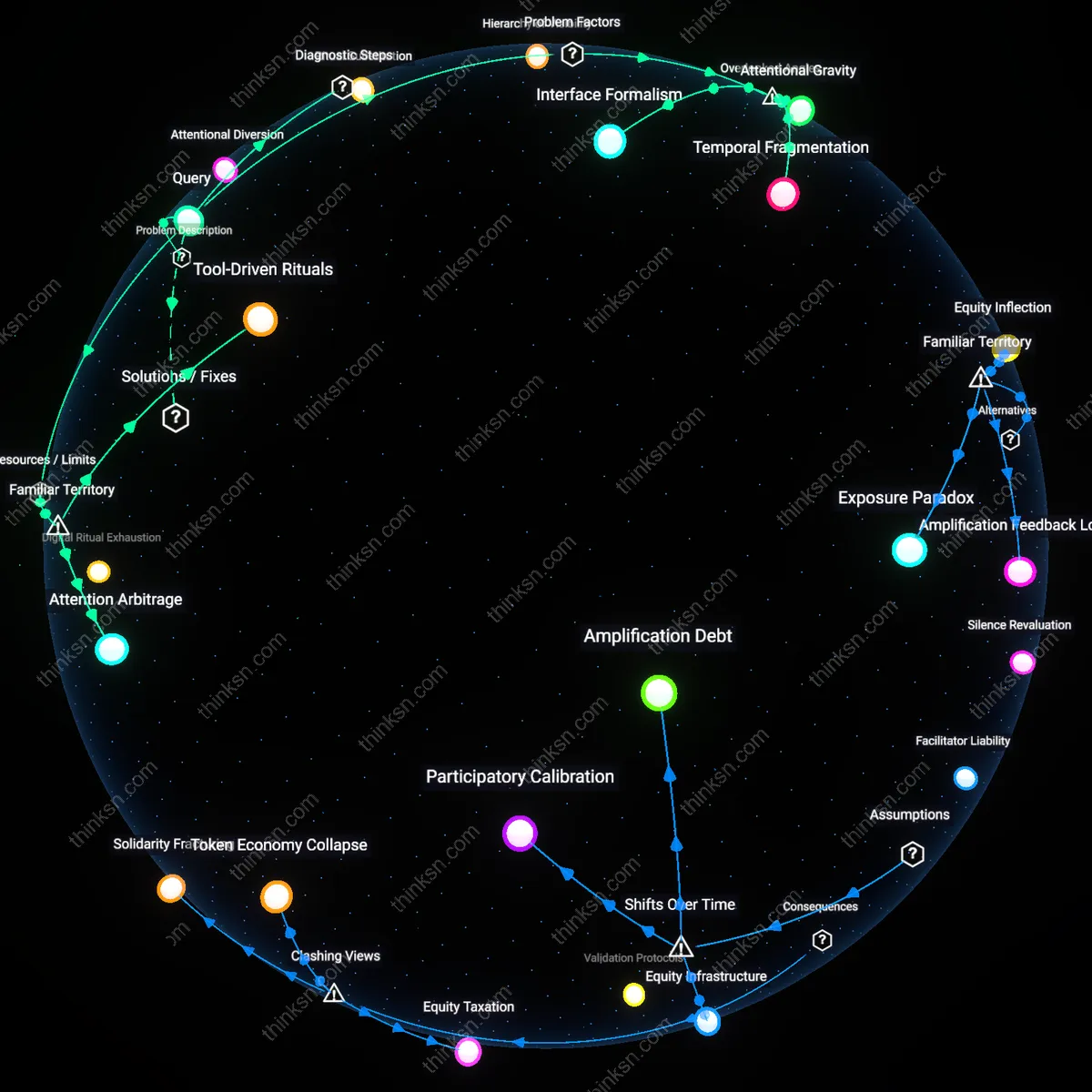
Analysis reveals 11 key thematic connections.
Key Findings
Digital Ritual Exhaustion
Virtual team-building platforms accelerate cultural erosion by replacing organic social rituals with mandatory, algorithmically scheduled interactions that elicit compliance rather than connection. When monthly ‘fun’ quizzes, icebreaker bots, or forced camera-on celebrations become institutionalized, they displace unstructured forms of bonding—such as spontaneous hallway exchanges or shared quiet workspaces—thereby hollowing out the cultural fabric they aim to reinforce. This reveals the non-obvious reality that high-tech rituals, even when well-funded and regularly deployed, generate performative participation and fatigue, not cohesion, which challenges the dominant assumption that scalability in engagement means deeper cultural integration.
Feedback Mirage
Investments in virtual team-building create a feedback mirage where leadership interprets high platform usage metrics as evidence of cultural health, while actual cultural transmission declines due to unmeasured power asymmetries in digital participation. Mid-level managers in global subsidiaries, for example, may dominate virtual forums not because of cultural influence but because of time-zone alignment or language fluency, skewing leadership’s perception of inclusivity. This undermines cultural continuity by privileging visibility over validity, exposing the dissonance between metric satisfaction and cultural depth—an alternative framework where data compliance masks systemic exclusion rather than resolves it.
Temporal Colonization
Corporate investment in virtual team-building platforms often functions as temporal colonization, where central leadership imposes synchronized cultural events across time zones, eroding locally rooted practices that depend on asynchronous, context-specific rhythms. Employees in regional offices, say in Santiago or Jakarta, are repeatedly required to join real-time celebrations or values workshops at 3 a.m. local time, forcing them to choose between cultural preservation and organizational loyalty. This mechanism reveals that the erosion is not due to lack of contact but to the monopolization of time by distant centers of power—an underappreciated force that prioritizes symbolic unity over lived diversity, challenging the intuitive belief that connection technologies inherently foster inclusion.
Attentional Gravity
The design logic of virtual team-building platforms systematically skews attention toward measurable engagement metrics, not cultural cohesion. Platform algorithms prioritize user activity—clicks, logins, reaction counts—over qualitative social depth, pulling team interactions into highly visible but culturally shallow domains like gamified quizzes or timed challenges rather than unstructured, meaning-carrying conversations. This creates an attentional gravity that deforms organic cultural transmission by privileging performative participation over sustained relational trust, a mechanism rarely examined because most cultural assessments focus on stated values or survey feedback, not the micro-distribution of attention across interaction types.
Temporal Fragmentation
Synchronized virtual events scheduled across global time zones routinely disrupt locally embedded cultural practices, degrading cultural continuity at the team level. The operational demand to accommodate dispersed participants fractures time into transactional slots, preventing the emergence of shared rhythms—such as informal check-ins or post-meeting debriefs—that culturally consolidate norms and expectations. This erosion is typically overlooked because diversity and inclusion metrics track attendance, not the experiential integrity of temporal patterns, thus masking how clock misalignment undermines the tacit temporal scaffolding of culture.
Interface Formalism
Standardized interface templates in virtual team platforms enforce procedural homogeneity, erasing culturally specific modes of communication such as indirect consensus-building or narrative-based decision-making. By reducing interaction to pre-coded actions—polls, emoji reactions, hand-raise buttons—these interfaces privilege Western, linear communication styles and marginalize relational modes common in collectivist cultures, effectively colonizing interaction norms under the guise of usability. This factor remains hidden in organizational assessments because platform usability is judged by adoption rates, not by the cultural range of expressive affordances preserved or lost.
Attentional Diversion
Heavy investment in virtual team-building platforms at IBM during its remote-work expansion (2020–2022) systematically displaced informal, cross-functional hallway collaborations that previously facilitated cultural transmission among mid-level engineers. The structured, event-based nature of platform-mediated interactions prioritized measurable engagement over spontaneous knowledge sharing, weakening the unscripted social conduits through which organizational norms were historically sustained. This reveals that the very design logic of scalability in virtual platforms undermines the low-signal, high-context exchanges essential to cultural continuity.
Ritual Substitution
When GitLab scaled its all-remote model using asynchronous video celebrations and digital badges via Donut and Zoom-based 'coffee chats', it replaced embodied rituals like onboarding dinners and desk-side mentoring with transactional recognition systems, leading to a documented decline in shared cultural intuition among new hires by 2023. The platformized interactions mimicked connection without reproducing the symbolic weight of co-located traditions, exposing how virtual tools often confuse participation metrics with norm internalization, thereby eroding tacit cultural coherence.
Hierarchy of Visibility
At Accenture, the rollout of the virtual collaboration hub 'myConcerto' elevated performative engagement—such as frequent chat posting and video-on compliance—as the primary indicator of cultural alignment, disproportionately rewarding extroverted, English-fluent employees while marginalizing quieter, non-Western contributors, as internal 2021 DEI audits revealed. This shift redefined cultural 'belonging' as algorithmic visibility, restructuring influence around platform-specific behaviors rather than substantive value contribution, thus systematically alienating cohorts whose cultural expressions were less mediated by digital performativity.
Tool-Driven Rituals
Virtual team-building platforms become compulsory rituals that replace organic cultural practices, enforced by HR systems and platform analytics that reward attendance over engagement. Managers and employees participate to meet compliance metrics tied to performance reviews, not meaningful connection, shifting culture from shared values to audited behaviors. The non-obvious consequence is that culture is not lost but formally recoded—what feels like erosion is actually displacement by performative digital rites that mimic cohesion.
Attention Arbitrage
Team-building events are scheduled during core working hours, forcing employees to trade project focus for platform participation, with managers enforcing attendance through visibility metrics. This creates a hidden economy where cultural contribution is measured not by alignment but by screen presence, privileging those who can absorb the time cost. The erosion arises because authentic cultural practices emerge in unmonitored time, but the platform logic colonizes every available hour, mistaking saturation for integration.