Do Pesticide Safety Standards Loosen When Scientists Accept Manufacturer Funding?
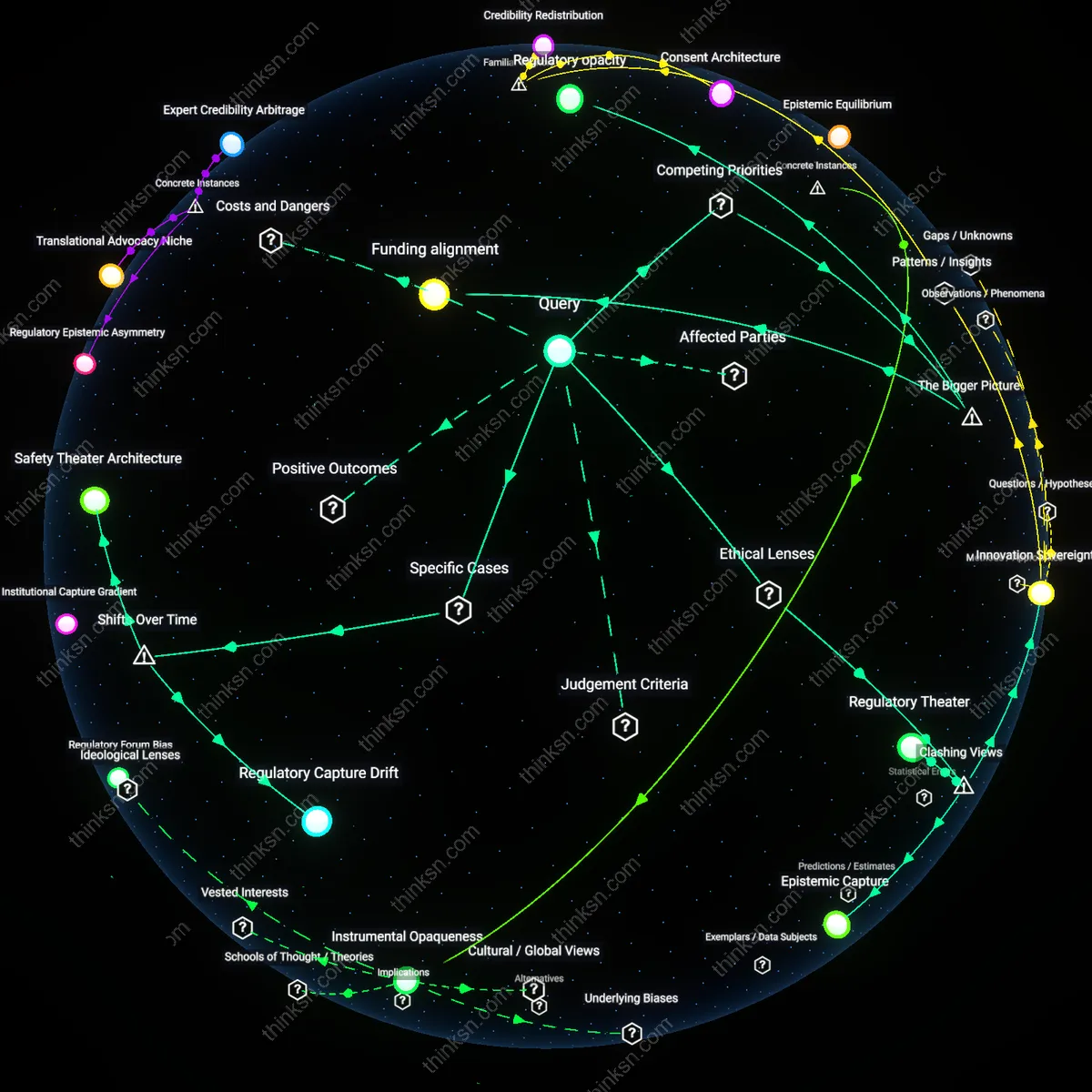
Analysis reveals 11 key thematic connections.
Key Findings
Regulatory Capture Cycle
Industry-funded scientists directly shape pesticide regulations by embedding within regulatory advisory panels, where their research selectively informs risk assessments. This occurs through formalized collaborations between agrochemical firms and government agencies, such as the EPA’s reliance on data from registrants under the Federal Insecticide, Fungicide, and Rodenticide Act, enabling a feedback loop where permissive interpretations of toxicity data become institutionalized. The non-obvious element is that regulatory trust in industry-generated science is codified in law, not merely informal bias—making permissiveness a structurally reinforced outcome rather than an occasional lapse.
Expertise Monopoly
Regulatory agencies depend on a narrow pool of toxicologists and agronomists whose careers are sustained by industry grants, creating a self-perpetuating network that defines acceptable science in pesticide evaluation. This monopoly emerges through university-industry partnerships, such as those between land-grant institutions and agrochemical companies, which control access to testing facilities and datasets. The non-obvious reality is that independence is structurally excluded—not due to corruption, but because alternative scientific communities lack the resources to generate the volume of data required for regulatory standing, making permissiveness a default of epistemic exclusion.
Regulatory revolving door
The U.S. Environmental Protection Agency’s 2017 reapproval of chlorpyrifos occurred despite internal scientists recommending a ban, after key advisory roles were filled by former Dow Chemical researchers who minimized neurodevelopmental risk data, revealing how personnel movement between agrochemical firms and federal agencies sustains permissive standards through institutional memory and loyalty rather than methodological consensus, a pattern underrecognized because it operates through career trajectories rather than overt policy mandates.
Data sovereignty imbalance
In the European Union’s 2013 neonicotinoid partial ban, industry-funded studies produced by Bayer CropScience and Syngenta—based on proprietary field trials not subject to independent replication—were granted equal weight as publicly funded research in EFSA risk assessments, demonstrating how regulatory reliance on non-public datasets skews deliberation toward permissive outcomes not due to bias per se but to asymmetric access to evidence, a structural issue often masked by procedural claims of scientific balance.
Epistemic delay mechanism
The protracted reassessment of glyphosate by the U.S. EPA, spanning over a decade beyond its scheduled 1993 review, was shaped by repeated requests for additional industry-submitted data from Monsanto, enabling incremental revisions that preserved existing approvals while simulating rigorous oversight, exposing how procedural deference to regulated entities functions as a covert mechanism for maintaining permissive norms through temporal dilation rather than explicit risk denial.
Regulatory Revolving Doors
Industry-funded scientists shape more permissive pesticide regulations because regulatory agencies frequently employ former industry consultants as decision-makers, creating a structural dependency on industry-aligned expertise. This revolving door ensures that risk assessment frameworks prioritize commercial feasibility over ecological precaution, as seen in the U.S. EPA’s toleration of chlorpyrifos residues despite neurodevelopmental risk evidence. The underappreciated mechanism is not mere bias but institutional assimilation—agencies reproduce industry epistemology because leadership backgrounds homogenize scientific interpretation. What makes this connection hold is the systematic recycling of personnel, which embeds permissive norms into standard operating procedures.
Asymmetric Evidence Burdens
Pesticide regulations become more permissive when industry-funded science controls the evidentiary threshold for harm, because regulatory systems require definitive proof of damage before restricting use, a burden that inherently favors delay. Industry actors exploit this by funding studies that emphasize uncertainty or demand implausibly high causal specificity, as occurred with glyphosate evaluations in the EU, where industry coalitions amplified dissenting interpretations to block reclassification. The critical systemic feature is not corruption but procedural rigidity—regulatory frameworks are designed to resist action without consensus, making them vulnerable to manufactured doubt. This dynamic entrenches inaction as policy, not as an accident but as a structural outcome of evidentiary rules.
Epistemic Capture of Standards
Industry-funded scientists produce more permissive regulations by dominating standard-setting bodies that define what counts as valid data in toxicology, such as OECD test guidelines, which exclude low-dose chronic exposure models favored by independent researchers. Because regulatory approval must conform to these standardized protocols, entire classes of ecological or epidemiological evidence are rendered invisible, as seen in neonicotinoid assessments that dismissed pollinator collapse due to non-compliance with lab-based thresholds. The overlooked driver is not lobbying but the quiet colonization of methodological norms—when industry shapes the epistemology, permissiveness is built into the tools of evaluation themselves. This makes resistance systemic, not individual, as even well-intentioned regulators lack institutional permission to act on alternative science.
Regulatory Arbitrage Geography
Industry-funded scientists in EU Member States with weaker enforcement capacity, such as certain Eastern European nations, have systematically shaped pesticide approval dossiers that later become binding across the Union under mutual recognition rules, enabling more permissive standards to propagate through regulatory deference. National authorities with limited technical resources rely on industry-generated studies assessed by bodies like EFSA, whose underlying data often stems from laboratories funded by pesticide manufacturers—creating a backdoor pathway where lax national contexts become leverage points for industry-wide influence. This dynamic is overlooked because scrutiny focuses on central EU agencies rather than the geographical asymmetries in data production and regulatory capacity that allow industry science to gain systemic traction. Regulatory Arbitrage Geography captures how spatial disparities in oversight infrastructure enable localized permissiveness to scale into transnational policy effects.
Methodological Capture
Pesticide risk assessments shaped by industry-funded scientists systematically exclude chronic exposure pathways—such as low-dose endocrine disruption or microbiome interactions—by defining them as 'not sufficiently established' under OECD test guidelines, thereby narrowing what counts as admissible evidence within regulatory review. This approach, entrenched in agencies like the U.S. EPA and EFSA, treats only acute toxicity endpoints as actionable, despite emerging independent research linking long-term, low-level exposure to broader health impacts. The omission is non-obvious because it appears procedural and neutral, but in practice, it insulates regulatory decisions from findings that could justify stricter controls. Methodological Capture identifies the invisible boundary work in standardization processes that preemptively disqualify inconvenient science before it reaches policy thresholds.
Legacy Data Lock-in
Regulatory agencies rely heavily on historical industry-generated data to fulfill legal requirements for pesticide re-registration, creating a path-dependent dependency where newer independent studies challenging safety are marginalized due to claims of non-comparability or methodological deviation. In the case of chlorpyrifos, decades of industry-provided studies continued to anchor EPA risk assessments even after peer-reviewed research demonstrated neurodevelopmental harms, because regulatory frameworks lack mechanisms to formally downgrade or supersede legacy data. This inertia is overlooked in debates that focus on current lobbying, yet it reveals how past industry investment in the scientific record creates durable structural advantages. Legacy Data Lock-in names the way prior data commitments constrain present regulatory responsiveness, making permissiveness self-reinforcing over time.