Do CDN Titans Skew Online Content? Biases & Balances
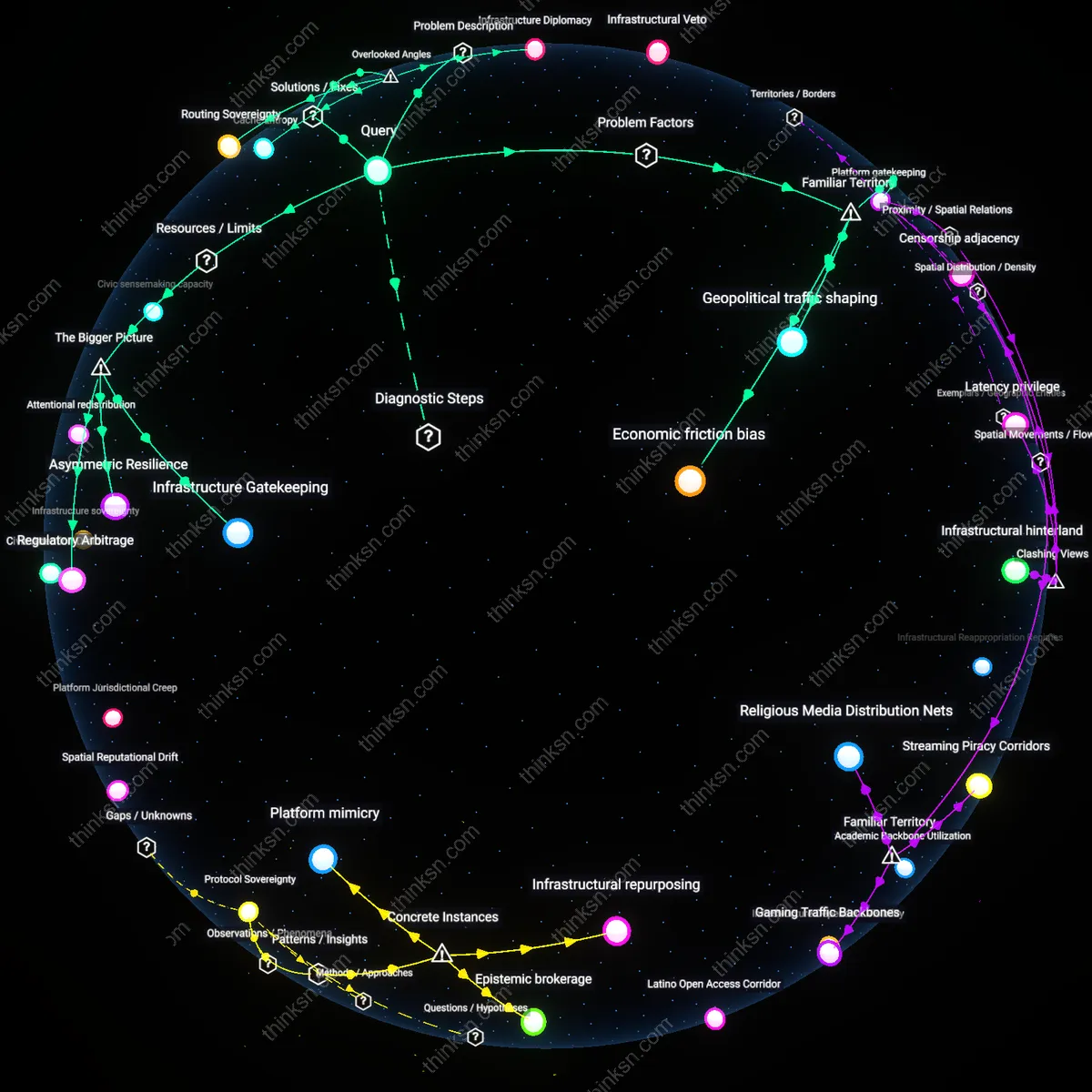
Analysis reveals 11 key thematic connections.
Key Findings
Infrastructural Veto
Concentrated editorial power among major CDN providers enables systemic bias by allowing a handful of infrastructure gatekeepers to covertly deprioritize or block content through performance throttling, rather than explicit censorship. Companies like Cloudflare, Akamai, and Amazon CloudFront control routing, caching efficiency, and DDoS protection—mechanisms that effectively determine whether content loads reliably or fails silently for large user segments. This creates a non-transparent layer of access control where political or commercial judgments are embedded in technical QoS parameters, privileging compliant or high-paying entities. The non-obvious consequence is that editorial influence operates not through content removal but through differential availability, exploiting the opacity of performance metrics to avoid scrutiny—a power that resists traditional press freedom frameworks.
Friction Substitution
The real source of systemic bias is not centralized control but the deliberate redistribution of access friction onto marginalized users and publishers through tiered CDN architectures. Major providers embed economic and technical thresholds—such as required TLS compliance, minimum bandwidth commitments, or geographic server proximity—that disproportionately burden non-commercial, independent, or Global South content creators. These thresholds appear as neutral efficiency standards but function as gatekeeping mechanisms that re-inscribe dominance by incumbent media and corporate platforms. The underappreciated dynamic is that bias is not caused by editorial intent but by the transfer of infrastructure complexity onto end creators, effectively replacing overt censorship with structural exclusion that mimics market naturalism.
Platform gatekeeping
Major CDN providers like Cloudflare, Akamai, and Amazon CloudFront act as de facto content gatekeepers by enabling or restricting access to websites through their infrastructure services. Their abuse prevention systems and terms of service allow them to suspend or throttle traffic for political, legal, or reputational reasons, effectively silencing content without public oversight. This centralized control is non-obvious because CDNs are marketed as neutral transit services, yet they wield discretionary power akin to editorial boards—especially during crises like disinformation campaigns or civil unrest—when their takedowns or throttling shape what millions can access.
Economic friction bias
High CDN pricing models and integration complexity inherently favor well-funded media organizations, entrenching systemic bias toward established publishers while marginalizing independent or nonprofit outlets. The cost and technical infrastructure required to achieve reliable global delivery means smaller actors face higher latency, lower uptime, and less visibility in user engagement metrics. This bias is underappreciated because speed and availability are typically seen as technical concerns, not editorial ones—yet they directly determine whose voices are accessible at scale and with credibility.
Geopolitical traffic shaping
CDN providers align their routing and caching policies with national regulations and strategic interests, leading to differential access of content across regions—such as limiting access to controversial political content in countries with repressive regimes. These technical decisions, made by corporate engineering teams to comply with local laws or avoid sanctions, create a form of editorial bias masked as compliance. The non-obvious part is that users perceive these access gaps as government censorship alone, when in fact CDN providers actively mediate and operationalize these restrictions through infrastructure design.
Routing Sovereignty
Develop standardized, open routing manifests that allow content originators to dynamically signal preferred delivery paths across CDN interconnects, reducing reliance on default peering arrangements controlled by dominant providers. This shifts partial control over traffic flow from infrastructure monopolists to publishers, particularly benefiting low-resource or independent outlets that lack private interconnection capacity. The mechanism leverages existing BGP-like signaling but embeds publisher intent, making it possible to bypass default paths optimized solely for cost-efficiency rather than reach equity—revealing how routing autonomy, typically treated as a network-layer technicality, is a latent governance variable that shapes visibility at scale.
Cache Entropy
Introduce randomized cache expiration policies across CDN nodes that reduce the dominance of frequently requested content by deliberately increasing variability in content freshness for high-traffic domains. This counteracts the positive feedback loop where popular content becomes disproportionately easier to access due to aggressive caching, while niche or emerging voices fade into retrieval latency. By engineering intentional unpredictability in cache persistence, smaller publishers gain transient parity in load performance, exposing how temporal consistency in caching—usually assumed as a reliability feature—is actually a hidden amplifier of editorial concentration.
Infrastructure Diplomacy
Establish neutral, treaty-based peering alliances among regional CDNs in the Global South that pool transit resources and negotiate collective access terms with major providers like Cloudflare or Akamai, treating digital delivery as a shared sovereignty issue rather than a competitive market. These alliances would operate through binding technical agreements enforced by distributed trust mechanisms, allowing geographically marginalized networks to resist content throttling or exclusionary practices during geopolitical disputes. This reframes interconnection not as a commercial negotiation but as infrastructural leverage, uncovering how diplomatic coordination—often absent from technical discussions—can alter power asymmetries in content distribution.
Infrastructure Gatekeeping
Concentrated editorial power among major CDN providers creates systemic bias by enabling a small number of infrastructure firms to function as de facto content gatekeepers, a role traditionally associated with publishers rather than network operators. Firms like Cloudflare, Akamai, and Amazon CloudFront control the technical pathways through which content reaches users, and their moderation decisions—driven by risk management, legal exposure, and client reputation—routinely remove or throttle access to marginal content without transparency or appeal. This gatekeeping emerges not from editorial mission but from operational risk calculus, embedding bias against controversial, dissenting, or culturally specific voices that providers deem high-liability. The non-obvious consequence is that content suppression now occurs upstream of visibility, bypassing public editorial debate entirely and shifting power from journalists or editors to backend engineers and legal teams managing service-level agreements.
Asymmetric Resilience
Systemic bias in content access is reinforced by the disparity in resources between major CDN providers and alternative networks, which limits the ability of marginalized or adversarial content ecosystems to build resilient, scalable delivery systems. High costs of bandwidth, server distribution, and DDoS protection—coupled with the economies of scale enjoyed by dominant CDNs—prevent smaller, mission-driven networks from sustaining consistent performance, especially under attack. This creates a feedback loop where only content aligned with the commercial or political interests of dominant CDNs achieves reliable reach, while dissenting or underfunded voices suffer degraded access or outage. The underappreciated dynamic is that technical resilience has become a precondition for free expression, yet the means to achieve it are controlled by actors incentivized to minimize disruption, not maximize inclusivity.
Regulatory Arbitrage
CDN-driven content bias is sustained by the ability of providers to operate across jurisdictions while selectively enforcing standards that align with the strictest or most commercially advantageous regulatory environments, effectively exporting censorship norms globally. Companies like Cloudflare apply uniform takedown or deplatforming policies across regions to reduce compliance complexity, even where local laws don’t require such actions, thereby amplifying the influence of jurisdictions like the U.S. or EU on global speech. This arbitrage allows CDNs to preemptively avoid regulatory risk by over-enforcing standards, disproportionately affecting content from regions with weaker legal protections or differing cultural norms. The systemic consequence—rarely acknowledged—is that private providers, not states, are becoming the primary enforcers of speech boundaries, yet operate without the accountability mechanisms expected of either governments or public institutions.