Flexibility vs Productivity Metrics in Modern Performance Evaluation?
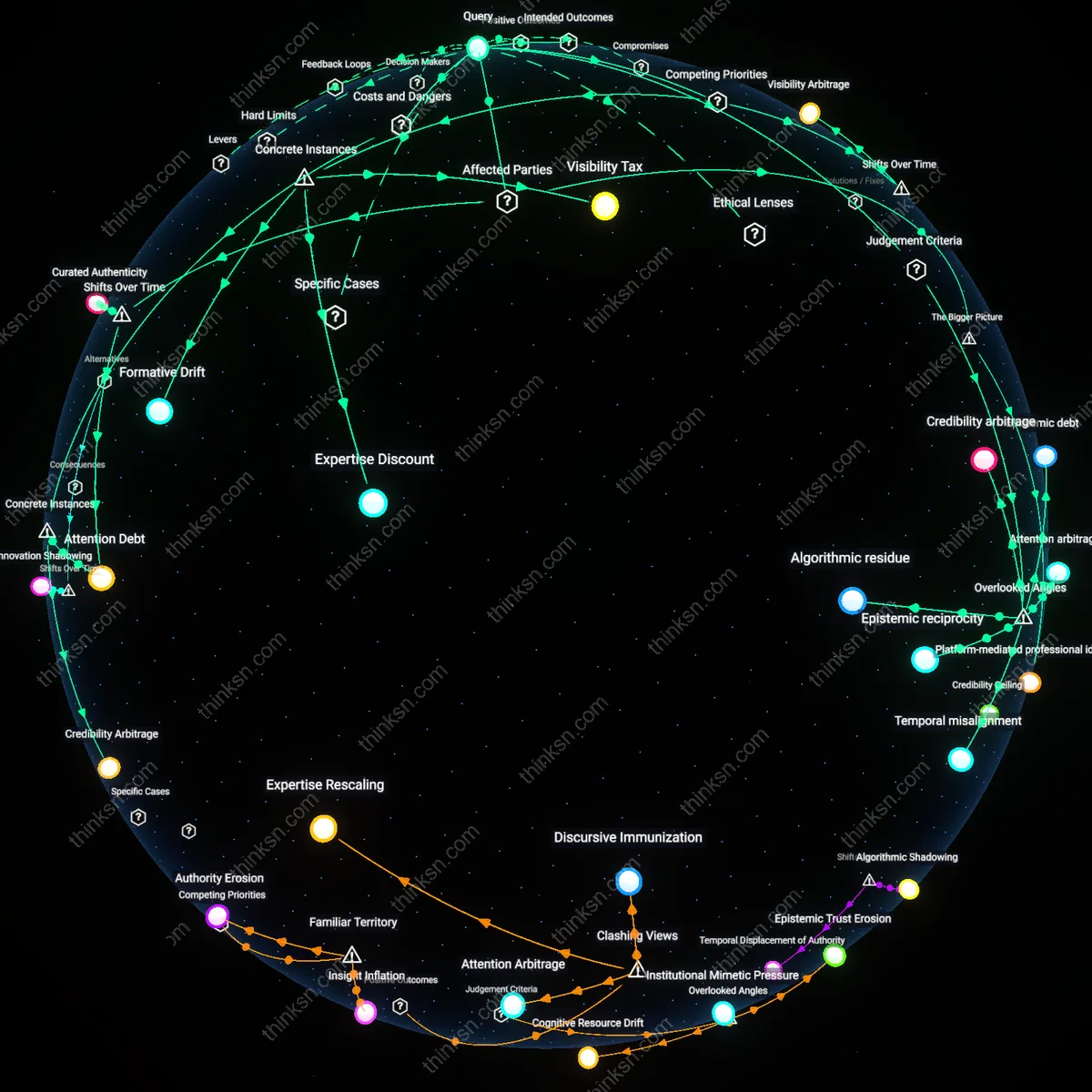
Analysis reveals 10 key thematic connections.
Key Findings
Metric affordance decay
Traditional productivity metrics are experiencing affordance decay because they were designed for environments where input-output relationships were linear and observable, such as manufacturing or call centers, but fail in knowledge work where value emerges from untracked cognitive labor like reflection or informal collaboration. Remote flexibility amplifies this decay by removing physical cues that once allowed managers to intuitively supplement quantitative measures with qualitative judgments, forcing a false precision that rewards easily measured tasks over high-impact but ambiguous ones. What's typically missed is that the crisis in evaluation isn't due to employee behavior but to the erosion of the epistemic conditions that once made those metrics plausible—even when the numbers appear stable, they no longer map reliably onto organizational value creation.
Evaluation infrastructures
The tension between flexibility and productivity metrics reveals that performance evaluation is no longer just a managerial practice but a technical infrastructure struggle, where digital tools like keystroke trackers or project management dashboards quietly redefine what counts as work by privileging quantifiable actions over tacit contributions. These systems are not neutral recorders but active participants in shaping behavior, as employees learn to 'perform visibility' to satisfy algorithmic surveillance, thereby distorting the very productivity they’re meant to measure. The overlooked reality is that the real conflict lies in whose logic governs these infrastructures—HR departments, software vendors, or engineering teams—because the architecture of evaluation tools embeds hidden theories of labor that silently overwrite human judgment.
Metric legitimization
The shift toward quantifiable productivity metrics reinforces managerial control by redefining flexibility as a variable to be optimized rather than a worker entitlement, because data-driven evaluations privilege observable outputs over qualitative labor experiences. Corporate HR systems, pressured to demonstrate operational efficiency amid remote work expansion, adopt digital surveillance tools like keystroke tracking or screen monitoring to translate employee behavior into standardized performance indicators. This mechanism reveals how the legitimacy of managerial authority is increasingly derived not from direct supervision but from the perceived objectivity of metrics, making employee autonomy structurally subordinate to auditability.
Institutional isomorphism
Tech industry practices—such as OKRs (Objectives and Key Results) and agile sprints—are being copied by non-tech sectors seeking to modernize performance evaluation, even when misaligned with their operational realities. This mimetic behavior spreads an implicit model where flexibility is tolerated only if paired with visible, frequent output measurement, driven by competitive pressures to appear innovative and data-savvy. The resulting convergence in evaluation design reflects not functional necessity but institutional mimicry, revealing how organizational legitimacy in contemporary capitalism often depends more on appearing aligned with dominant norms than on actual performance outcomes.
Metricized Presentism
The conflict reveals that performance evaluation is shifting toward proximity tracking disguised as productivity measurement, where physical or digital presence is conflated with output. Employers increasingly rely on timestamped activity logs, screen monitoring, and response-time metrics not because they correlate with value creation, but because they provide auditable proxies in distributed work environments. This represents a move away from outcome-based assessment to surveillance-enabled presentism, reinforcing managerial control under the guise of objectivity—what appears to be a productivity safeguard is actually a reassertion of temporal and spatial authority in knowledge work.
Flexibility Traps
The tension between flexibility and productivity metrics exposes how employee autonomy is being instrumentalized to extract more labor without structural investment. Companies promote flexible schedules as a benefit while simultaneously deploying granular time-tracking and output dashboards that fragment the workday into measurable units, effectively privatizing recovery time and cognitive downtime. This reveals that performance evaluation is not merely measuring effort but actively reshaping worker behavior through feedback loops that normalize constant availability—flexibility becomes a mechanism of intensification rather than liberation.
Evaluation Fracturing
The disconnect between flexible work and traditional productivity metrics signals a systemic split in how performance is validated across organizational levels. Frontline managers rely on visible activity metrics because they lack tools to assess distributed contributions, while senior leaders advocate for flexibility to retain talent, creating a misalignment that decentralizes evaluation into inconsistent local practices. This fragmentation undermines coherent performance systems and reveals that evaluation is no longer a centralized bureaucratic function but an emergent, contested terrain shaped by competing operational logics and visibility gaps.
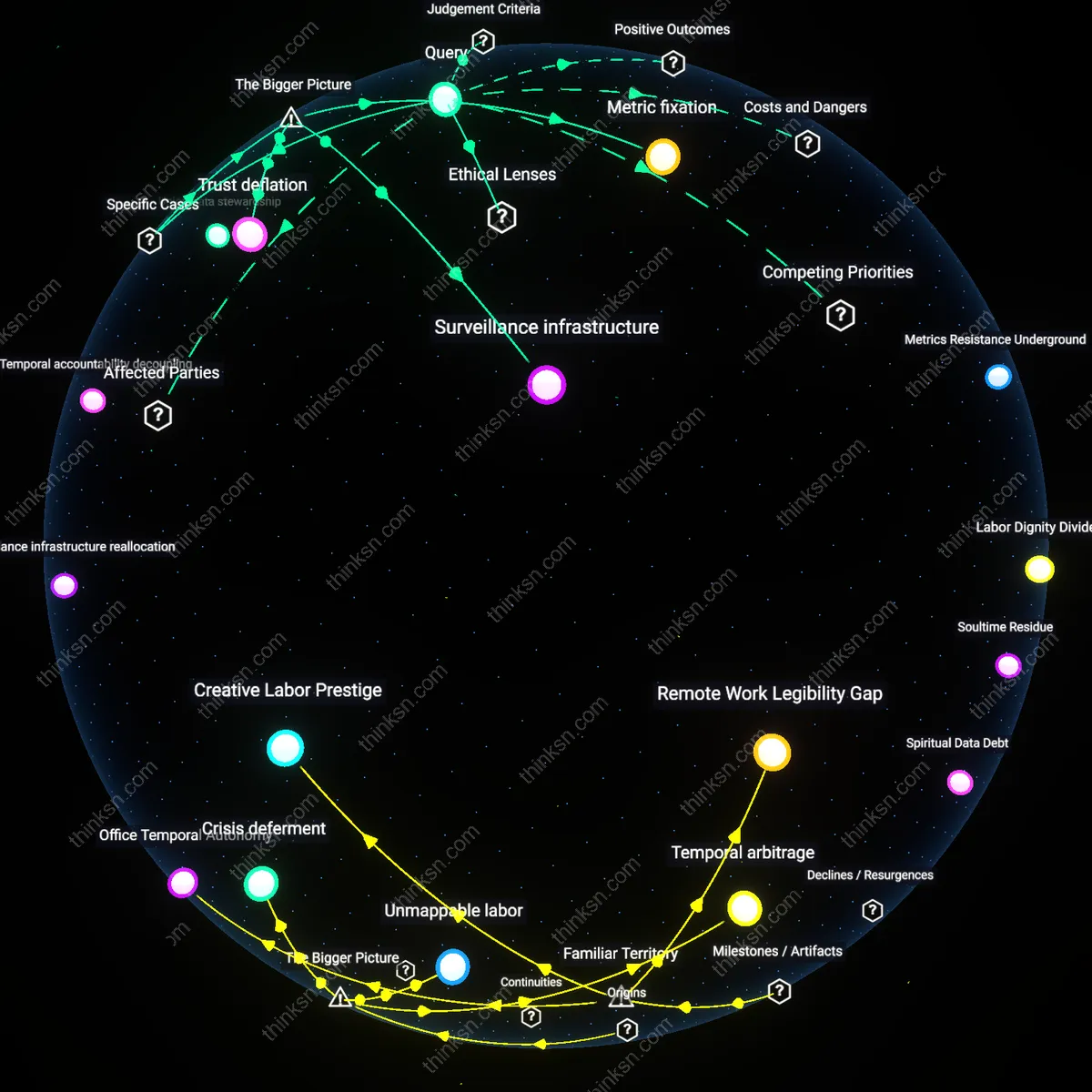
Metric fixation
Employers like Amazon warehouse operations increasingly prioritize granular productivity metrics—such as units scanned per minute or time off-task—over flexible work arrangements, directly displacing employee autonomy when the two conflict. This shift reveals how performance evaluation is becoming anchored in real-time operational data streams rather than holistic or human-centered assessments, making adherence to numeric targets the default standard of competence. The non-obvious consequence is that flexibility is no longer a neutral benefit but a conditional privilege revoked when algorithmic thresholds are breached, reframing worker trust as a byproduct of compliance.
Presence theater
At companies like Apple and Google, the reinstatement of office mandates despite proven remote productivity exposes how performance evaluation still implicitly equates physical visibility with commitment and promotability. Middle managers, lacking new tools to assess remote output, fall back on presence, responsiveness, and meeting participation as proxies for performance, making flexibility a career risk. The underappreciated dynamic is that productivity metrics have not disappeared but been replaced by subtler observational heuristics that reward performative availability over actual output.
Autonomy debt
Remote-first firms such as GitLab and Automattic offer high flexibility but compensate with extreme transparency requirements—daily stand-up updates, public goal tracking, and mandatory documentation—revealing that performance evaluation is migrating toward continuous peer- and algorithm-validated proof of contribution. This system sustains flexibility only if employees constantly demonstrate productivity through digital footprints, creating an unspoken obligation to over-document and self-monitor. The overlooked cost is that true autonomy is eroded not by policy but by the invisible labor required to prove one’s worth in the absence of direct supervision.