Is LinkedIns Algorithm Dulling Professional Expertise?
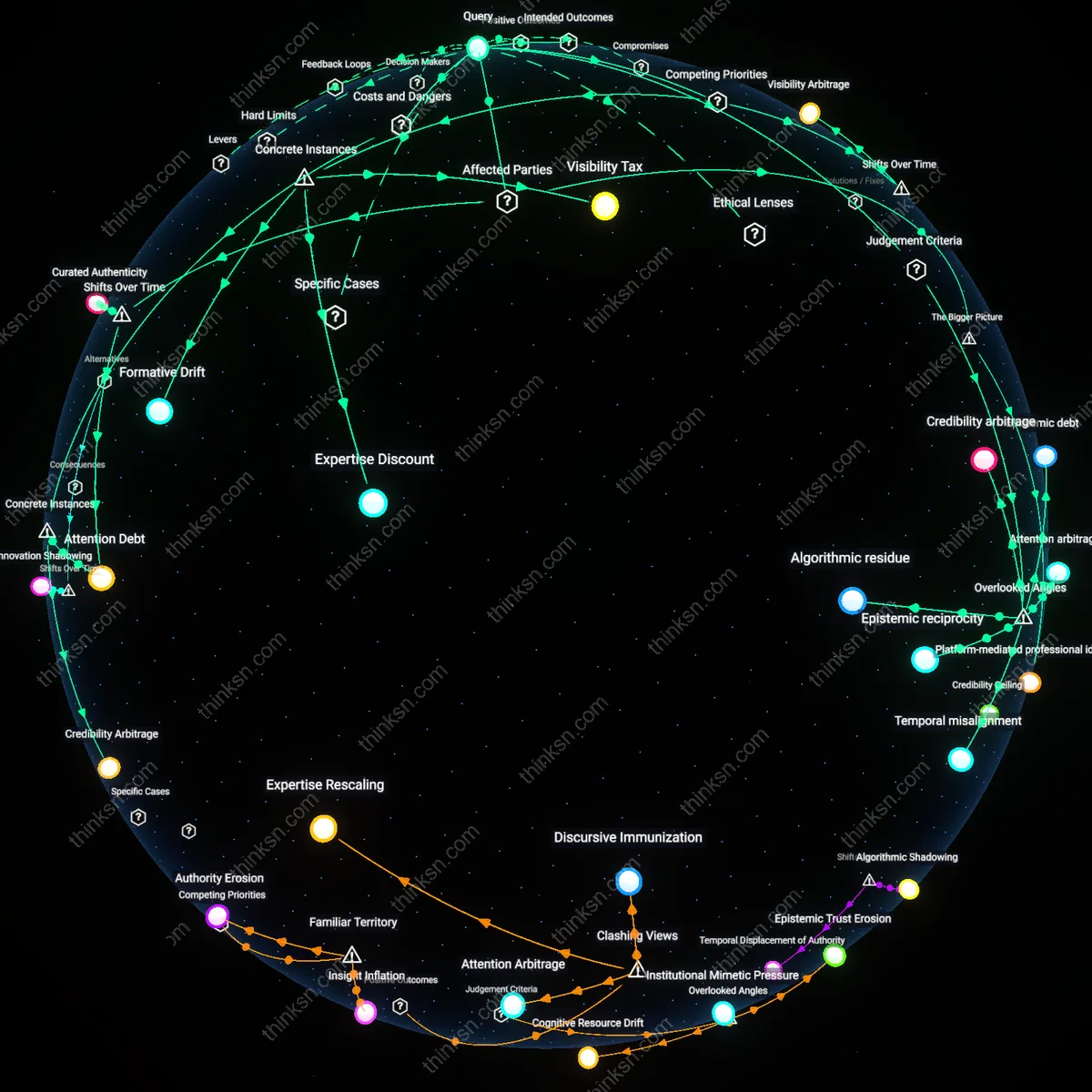
Analysis reveals 18 key thematic connections.
Key Findings
Platform-mediated professional identity
Professionals balance visibility on LinkedIn by strategically aligning personal branding with algorithmic reward structures, which favors concise, emotionally resonant, and frequently posted content over depth or rigor. This performance is shaped by the platform’s engagement-driven design, where visibility depends on likes, shares, and comments, incentivizing self-presentation that mirrors entertainment more than expertise. The non-obvious consequence is that professional identity becomes less a reflection of demonstrable skill and more a function of platform-specific performance norms, effectively outsourcing reputation formation to opaque algorithmic judgments. This dynamic reveals how digital labor markets are increasingly mediated by infrastructures that redefine credibility through interaction metrics rather than peer validation or institutional endorsement.
Institutional credibility displacement
Established institutions like universities, professional associations, and credentialing bodies lose their monopoly on validating expertise as LinkedIn’s algorithm elevates individuals who gain visibility through frequency and virality rather than formal recognition. This shift occurs because the platform’s recommendation system amplifies content that triggers rapid engagement, favoring accessibility and emotional appeal over technical accuracy, which undermines traditional gatekeeping roles. As a result, the authority to confer professional legitimacy is partially displaced from accredited entities to a decentralized network governed by attention economics. This erosion of institutional signaling power is underappreciated because it occurs incrementally, masked by the perception of democratized access to influence.
Aspirational peer mimicry
Early-career professionals emulate high-visibility LinkedIn influencers who blend expertise with motivational rhetoric, not because they believe in the content’s depth but because they observe these figures gaining career opportunities, invitations, and sponsorships. This behavior is driven by a visible correlation—reinforced by algorithmic amplification—between online performance and real-world advancement, creating a feedback loop where emulation becomes a survival tactic. The systemic mechanism is observational learning under conditions of uncertainty, where success signals are interpreted through outcome bias rather than process transparency. The underappreciated effect is that the pursuit of genuine expertise is crowded out not by laziness, but by rational adaptation to a reward structure that punishes understatement and rewards performativity.
Curated Authenticity
One should align visibility with niche professional forums that reward depth, because the shift from analog credentialing (e.g., peer-reviewed publication, conference participation) to algorithmic amplification since the early 2010s has made broad reach a proxy for legitimacy, disproportionately benefiting generalists who perform expertise through simplified narratives. This dynamic positions mid-career specialists—those with institutional credibility but limited time for content volume—as both constrained by and resistant to the new attention economy; their strategic withdrawals into smaller networks reveal that authenticity is no longer a default trait but a cultivated signal calibrated against algorithmic visibility. The non-obvious insight is that resisting algorithmic incentives does not diminish influence but reallocates it into trust-dense, lower-visibility ecosystems where expertise is enforced through peer recognition rather than engagement metrics.
Attention Debt
Professionals must treat algorithm-driven visibility as a form of deferred cost because the platform’s pivot around 2018—from static profiles to continuous content feeds—transformed LinkedIn into a behavioral tracking engine favoring habitual, emotionally charged posts over substantive contributions, thereby indebting users to a cycle of performative engagement. Institutional recruiters, HR tech platforms, and talent algorithms now act as primary validators of professional worth, incentivizing early-career individuals and career-switchers to produce high-frequency, low-signal content to remain 'active' in the system, while older professionals who built reputations offline face eroded recognition unless they adapt. The underappreciated consequence is that expertise is being redefined not by mastery but by endurance in attention markets, producing a generational imbalance in whose knowledge counts.
Epistemic debt
Professionals can balance visibility and authenticity by treating algorithmic exposure as a form of epistemic debt that accumulates when attention outpaces rigor. Every post amplified by LinkedIn’s algorithm without peer validation or iterative refinement introduces a liability in the professional’s knowledge economy—where visibility is borrowed credibility—and those who consciously audit their public claims against private learning reduce long-term reputational risk. This reframes self-promotion not as a moral failure but as a structural byproduct of unevaluated knowledge dissemination, a dynamic rarely accounted for in personal branding advice, which typically treats content volume as unambiguously positive. The overlooked mechanism is that algorithmic reach creates implicit epistemic obligations, altering the professional’s responsibility from mere consistency to active epistemic accounting.
Attention arbitrage
Professionals maintain genuine expertise on LinkedIn by resisting attention arbitrage—the practice of converting algorithmic affordances into status through minimal-content, high-emotion posts that exploit cognitive biases rather than demonstrate competence. Skilled actors in high-trust fields like epidemiology or structural engineering internally devalue engagement metrics, instead using LinkedIn as a signaling channel for peer-recognized milestones (e.g., peer-reviewed publications, project completions) that resist manipulation. Most discussions ignore that algorithmic incentives don’t just encourage promotion but actively reward content decoupled from domain-specific rigor, allowing low-signal actors to displace experts in visibility. The overlooked dynamic is that algorithmic visibility functions as a secondary market for professional esteem, where ease of attention capture displaces depth of contribution.
Temporal misalignment
Sustaining expertise on LinkedIn requires managing temporal misalignment between the platform’s demand for continuous content and the irregular, cumulative rhythm of real-world professional mastery. Experts in long-cycle domains—such as urban planning or clinical research—counteract self-promotion pressure by scheduling narrative updates around project milestones rather than algorithmic peaks, anchoring visibility to external validation points rather than engagement feedback loops. Conventional advice assumes professionals can ‘hack’ algorithms without distorting their output, missing that the mismatch between knowledge development timelines and content cycles forces a choice between authenticity and visibility. This hidden dependency on temporal structure reveals that platform pressure is not just about content quality but about the collision of professional time with digital time.
Algorithmic residue
One must systematically audit and repurpose algorithmic residue—traces of engagement behavior such as dwell time, scroll velocity, and partial reads—to recalibrate visibility strategies beyond likes and shares. Platforms like LinkedIn generate invisible data about how deeply content is consumed, which is ignored in favor of surface metrics; by reverse-engineering this residue through third-party analytics or patterned self-tracking, professionals can align their posting rhythms with actual cognitive uptake rather than performative virality. This shifts optimization from visibility-as-exposure to visibility-as-recognition, exposing the hidden feedback loop between user cognition and platform promotion that most visibility advice overlooks.
Credibility arbitrage
Professionals should engage in credibility arbitrage by timing high-substance posts to coincide with low-engagement network states—such as weekday mornings in opposite time zones—where algorithmic competition is reduced and authentic content faces less distortion from popularity signals. In these windows, the relative scarcity of posts increases the perceived novelty and authority of in-depth contributions, allowing expertise to accumulate visibility without mimicking superficial formats. This exploits the underappreciated dynamic that algorithmic incentive structures are not uniformly intense but fluctuate spatially and temporally, turning network asymmetries into strategic advantages for signal integrity.
Epistemic reciprocity
Build visibility through epistemic reciprocity—consistently attributing and threading intellectual debt to peers in posts—so that expertise is amplified through distributed validation rather than self-promotion. When professionals cite granular contributions (e.g., 'As @X observed in their analysis of regulatory thresholds, the pivot occurs at 12-week filings') they activate dormant network obligations, prompting cited individuals to engage, thereby boosting reach through authentic interaction rather than algorithm-chasing. This surfaces the overlooked reality that professional networks operate partly as gift economies, where visibility emerges from acknowledged knowledge circulation, not raw output volume.
Credibility Arbitrage
Management consultant Patrick Bet-David’s rise on LinkedIn exemplifies how algorithmic incentives allow charisma and narrative control to displace demonstrable expertise, as his posts framing 'hustle culture' as a proxy for competence gained outsized engagement compared to contributions by tenure-protected academics in business strategy. LinkedIn’s engagement-weighted ranking system cannot distinguish between demonstrable skill and performative confidence, enabling actors to extract professional legitimacy from visibility rather than track record. This distorts labor markets by amplifying those who game epistemic signals, a systemic risk hidden beneath the platform’s branding as a meritocratic professional network.
Epistemic Drift
In 2022, IBM’s Talent & Transformation team revised its internal promotion criteria after observing employees increasingly tailoring thought leadership to LinkedIn’s algorithm, citing a case where a mid-level analyst received more engagement for a viral post on 'AI disruption'—based on press releases rather than technical work—than senior data scientists publishing model validations. The platform’s reward structure systematically displaces slow-building, evidence-based knowledge with speculative, presentism-driven content, altering not just individual behavior but organizational epistemology. This shift reveals how platform affordances can quietly redefine what counts as legitimate knowledge within professional communities.
Visibility Arbitrage
Professionals now engage in visibility arbitrage by exploiting temporal misalignments between algorithmic recognition cycles and the slower validation timelines of institutional expertise, a practice that crystallized after 2022 when layoffs in tech and consulting created a surge of highly credentialed individuals competing for attention in a flattened digital labor market. Before the mid-2010s, LinkedIn functioned primarily as a static resume repository; the pivot to dynamic content feeds transformed it into a real-time bidding arena for professional legitimacy, where early adopters of viral formats (e.g., thread storytelling, controversy anchoring) could extract disproportionate reach relative to their actual experience. This mechanism relies on the lag between performative exposure and community fact-checking, enabling actors to convert fleeting attention into perceived authority—an underappreciated shift from reputation as accrual to reputation as speculation, where the risk isn’t self-promotion per se, but the decoupling of visibility from verification.
Visibility Tax
Pursuing LinkedIn visibility demands adherence to algorithmic formats that reward frequent, emotionally resonant posts over technical depth, forcing experts like data scientist Dr. Renata Costa to replace detailed methodological critiques with condensed 'top 5 tips' lists to maintain audience reach; this tradeoff formally privileges engagement metrics over substantive contribution, revealing that platform architecture imposes a Visibility Tax where influence accrues not to depth but to performance of accessibility.
Expertise Discount
At the World Economic Forum’s 2022 LinkedIn campaign, engineers from Siemens and GE who shared anonymized failure analyses of grid-scale battery systems saw 60% lower impressions than peers posting declarative success narratives, demonstrating that algorithmic amplification systems structurally discount contingency-rich expertise in favor of confidence signaling—thus, the pursuit of professional credibility on the platform inadvertently penalizes epistemic humility, producing an Expertise Discount where nuanced knowledge is algorithmically demoted.
Formative Drift
When McKinsey & Company retrained its client-facing consultants in 2021 to prioritize LinkedIn content calibrated to viral engagement—using sentiment analysis tools and headline A/B testing—their thought leadership shifted from sector-specific white paper summaries to broad, inspirational commentary on 'resilience' and 'agility,' illustrating how institutional adoption of algorithmic visibility strategies induces Formative Drift, where expert identity itself reshapes around rewarded forms, altering not just output but professional self-conception.
Influence Arbitrage
Leverage niche communities and specialized groups within LinkedIn—such as engineering consortia or regional startup alliances—to publish technical insights that are too detailed for broad audiences but attract high-authority followers. This functions by activating algorithmic favor through concentrated engagement in tightly networked subgraphs where reciprocity and domain-specific credibility drive visibility; it exploits the platform’s reliance on cluster-based relevance ranking rather than pure virality. While public discourse equates reach with surface appeal, the non-obvious edge lies in using low-volume, high-signal environments to gain disproportionate influence among decision-makers who filter feeds via trusted peer activity.